Serbia voted out Vučić, but not his policy towards Russia. Brussels celebrated a European breakthrough while Moscow received the one assurance it needed: nothing would change.
By Albatros Rexhaj (Tirana)
Aleksandar Vučić lost Serbia on Sunday. Vladimir Putin did not.
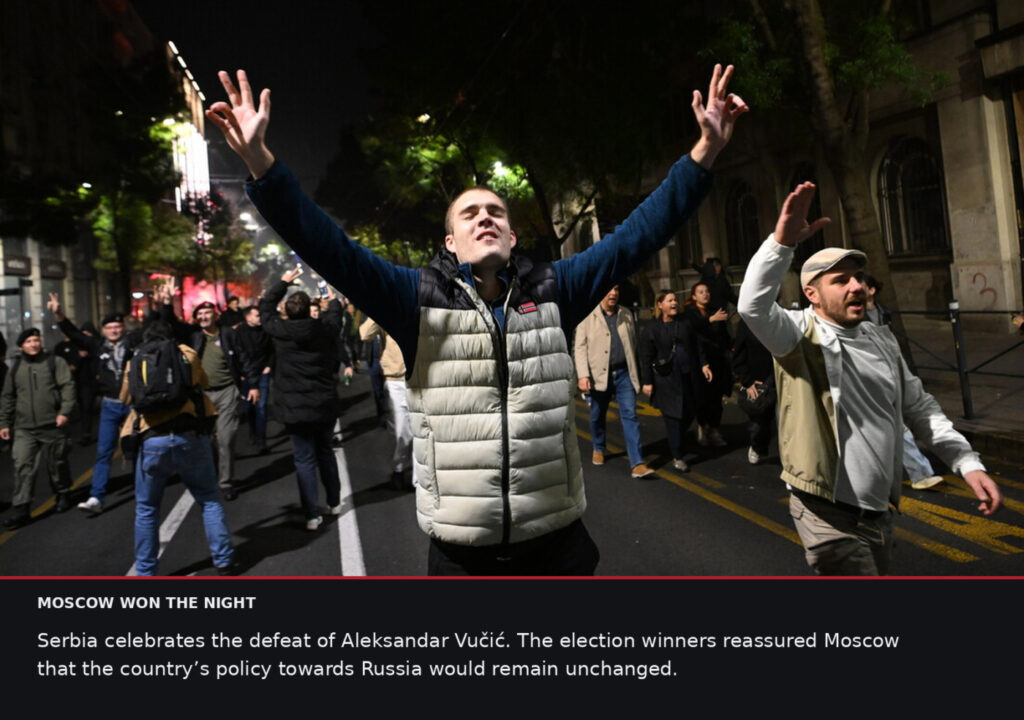
Serbia removed the man who ran it for thirteen years. It gave a list of students and professors a majority that no poll had dared to predict. Belgrade stayed up to celebrate. Every embassy in the city sent its congratulations. And before the night was over the winners had told Russia, on Russian state television, that none of this concerned her.
Jovo Bakić, the Student List’s spokesman for the evening, chose RT Balkan for the list’s first statement on foreign policy. Russia, he said, is a great power, a historically important partner and in many cases Serbia’s protector. In that area there would be no changes whatsoever. Sanctions on Moscow were out of the question: they would change nothing and would send a very bad symbolic message. Asked about Russian gas and oil and the European demand that Serbia give them up, he said the new government was not there to satisfy foreigners.
Protector is the myth, the one every Serbian government since Milošević has kept warm for the public. No sanctions is the doctrine, the practical policy Vučić defended against Brussels for three years of war in Ukraine. Foreigners is the identity: a description of the European Union as the outside party to whom nothing is owed. A government that says all three on its first night in front of a camera has described the whole relationship.
The students did not argue that sanctions would hurt Serbia economically. They argued that they would be bad symbolically. Symbolically for whom? For the relationship with Moscow. That is Vučić’s argument, in Vučić’s words. The man is gone. The sentence is still in office.
The Student List published its refusal to sanction Russia on 30 September, in the middle of the campaign. Its memorandum on Kosovo rejects recognition and treats the agreements Vučić signed in Brussels and Ohrid as somebody else’s commitments. The movement took these positions to the voters, won with them, and repeated them within hours of winning. A political programme has rarely been honoured so quickly.
Russia watched all this and had no questions. It never needed Vučić personally. It needed what Vučić maintained to outlive him, and on Sunday night it received, from his opponents, a public guarantee that it would. There is no better outcome for Moscow than continuity delivered with a fresh democratic stamp. Russian state television did not have to explain the defeat of a friendly politician. It broadcast reassurance from the people who beat him. The Duma’s observer, Konstantin Zatulin, was on the same channel praising the orderly vote. Milorad Dodik, the first foreign leader to congratulate the students, thanked Vučić for his service and reminded the winners that Serbs on both sides of the Drina remain one people. He received no reply, because he needed none.
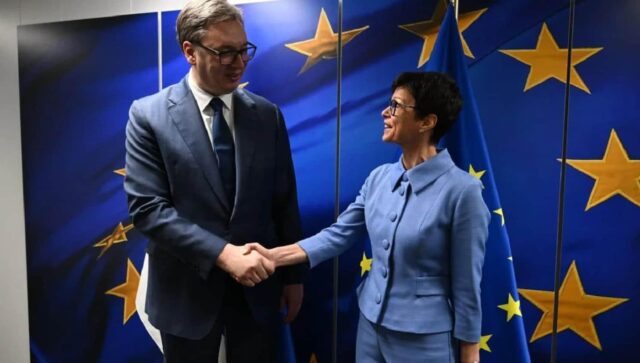
Then Monday came, and Brussels did what Brussels does. Ursula von der Leyen welcomed the result and offered partnership on Serbia’s European future. Marta Kos saw European values triumphant and a new chapter beginning, with the door to the Union open. The Commission congratulated a change of government as though the government’s positions had changed with it. Nobody in that building appears to have watched Sunday’s television.
For thirteen years the European Union behaved as though it had an explanation for Serbia. Serbia would not align with European foreign policy because Vučić would not let it. The obstruction was one man and his system; remove the man, and the country underneath would turn out to be European after all. Every Commission report noted the structural problems, the captured media, the public opinion shaped by a decade of state television. And every policy decision was taken as if those problems would leave with him. That assumption was the foundation of a decade of patience: the tolerated backsliding, the unspent conditionality, the annual report that found the same problems and recommended the same remedies.
Sunday tested the assumption, and it failed. The man was removed. The policy stayed. The Student List’s positions on Russia and Kosovo were public, printed, debated and voted on, which means they can no longer be dismissed as the product of an autocrat’s manipulation. Nobody can prove what each of the millions who voted on Sunday had in mind. But Brussels can no longer claim that Serbia’s refusal is something done to the Serbian people rather than something the Serbian people were offered and accepted.
What does enlargement policy do when the movement that defeats the autocrat freely adopts the positions Europe blamed on his autocracy? There are still courts to free and ministries to clean, and the students may well do it. But no judicial reform changes where a country places Russia, and no media law alters what an electorate has just voted for. There is a majority, a clean election, and a government that has said, in its first sentence to the world, that on Russia nothing moves.
In Belgrade the students won an election. In Brussels the Commission won a chance to repeat itself. Moscow won the night, and it did not have to run.