by Ngadhnjim Brovina (Regional Affairs Desk)
On the night of 25 October, Marta Kos congratulated Serbia on “nearly two years of protests for democracy, the rule of law and the fight against corruption” and wrote that these are “the very values at the heart of our European Union”. Within hours a reader answered her, and 214 people endorsed the answer: “For two years you watched with your own eyes how the pathocrat broke the bones of Serbian children on the streets of Serbia, and now you congratulate? You laughed and hugged him for two years. Those are the facts.”
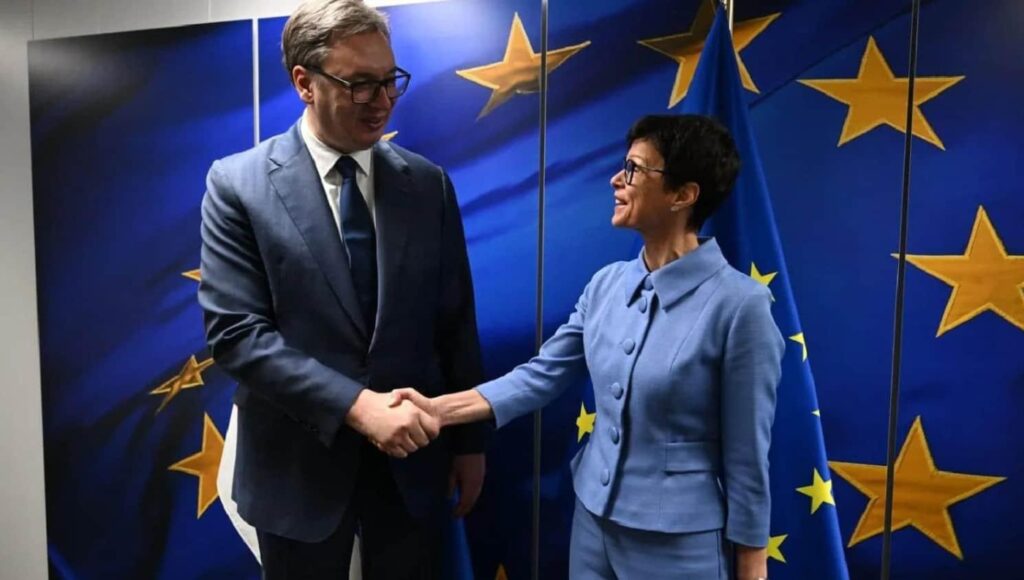
On 25 October 2024, exactly two years before the vote, Ursula von der Leyen stood beside Vučić in Belgrade and addressed him as “dear Aleksandar”. She congratulated Serbia on its investment grade, announced a Growth Plan that would bring it closer to the single market, and promised that the partnership on lithium and electric vehicles would create 20,000 jobs and add six billion euros a year to Serbia’s GDP. Seven days later the canopy of the Novi Sad railway station fell on sixteen people. The protests that Kos now calls European values began at their funerals.
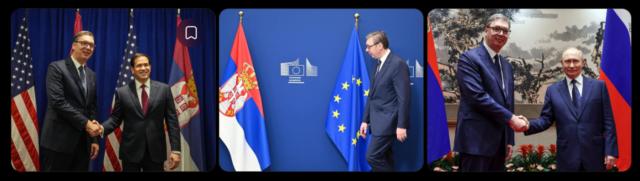
The partnership had been signed on 19 July 2024 by Maroš Šefčovič and Vučić, with Chancellor Scholz in the room, while Serbia’s roads were blocked by people who did not want the Jadar valley mined. When Vučić accused Western powers of organising those protests, the Commission said it remained “fully committed”. On 4 June 2025, with the universities under blockade and their rector under criminal investigation, the Commission designated Jadar a strategic project of the European Union, which it could not do without the consent of Vučić’s government.
Another reader, under von der Leyen’s post: “Vučić delivered everything Brussels asked of him, including the de facto recognition of Kosovo; the one thing he did not deliver was sanctions on Russia.” That reader supports the Student List. He is describing a balance sheet the Commission kept better than anyone. The Brussels agreement, the Ohrid annex, the Jadar consent, the ammunition that reached Ukraine through third countries while Belgrade denied it: all delivered by the government whose police were breaking the bones the first reader describes. Each was worth more to the Commission than the students were, and its statements were drafted accordingly.
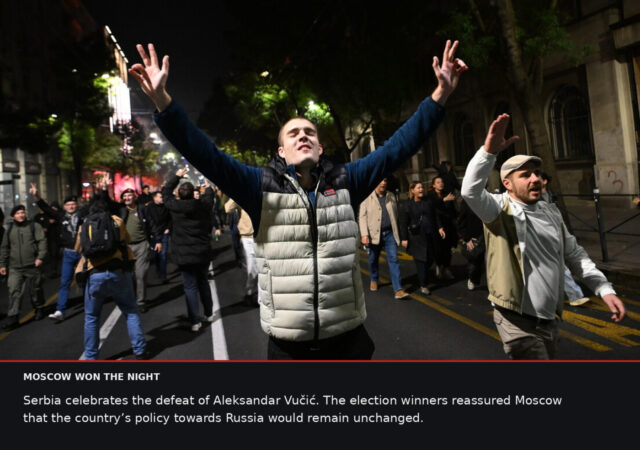
When the Rector of Belgrade University was summoned by police in April 2025, Kos was “concerned”. Visiting Belgrade that month, she saw Vučić first and the students in blockade last, paired with the regime’s counter-students as if the two were equivalent, and said that what the Commission asks of Serbia “is close to what people on the street are asking”. She drew a line once, in September 2026, postponing a visit because the state had glorified Ratko Mladić at his funeral: values, she wrote, “are not a matter of negotiation”. That was the Commission’s red line, a dead man. Twenty-two months of a living movement, beaten, arrested and smeared as foreign agents, had drawn concern. They had not cost Vučić a visit. Under Kos’s post, one reply put it in a sentence: “We voted to remove the corrupt government, that’s all.”
Then the government was removed, and the Commission’s language changed in a night. Von der Leyen offered support for “the rule of law, media freedom, the fight against corruption and strong democratic institutions”. Kos opened the door. Neither mentioned Kosovo, Russia, Ohrid or Jadar, the four subjects on which the Commission had conducted its entire relationship with the man who had just lost, and on which the winners had already said no in writing. The values named on election night are the ones the Commission had not asked Vučić for; the interests left out are the ones it had.
Nor can the Commission say to whom the door was opened. The Student List is a citizens’ group with no leader, by its own description, whose 250 candidates were chosen by student plenums that dissolve when they adjourn. It has no programme on EU membership, no name for prime minister, and one foreign-policy text, three paragraphs refusing sanctions on Russia. Its candidates contradict each other on television, one promising to send the agreements with Pristina to the Constitutional Court, another putting membership to a referendum. Whether its 140 deputies or the plenums behind them will decide what the deputies do is unsettled, and the first test comes within days, when an acting president from the losing party must name a mandate holder from a list that has none. Brussels proclaimed a victory for European values without knowing whether the victors have a European programme, a leadership that can be addressed, or any mechanism to deliver what Brussels will ask.
Under the two posts: “Pro student does not equal pro EU.” “Your puppet is gone now.” “Student List also believe Kosovo is part of Serbia. Will you accept that?” Twice, in two threads, the one economic interest named by name: “Say goodbye to lithium from Serbia.” “You will not dig.” One reader accepted the congratulation: “And now, we can talk.” Another gave the answer most of them gave, in six words: “Close the door, the draught will kill you.”
Brussels invoked democracy, rule of law and anti-corruption as the heart of the Union while conducting, for two years, a relationship in which all three were traded for lithium, Kosovo and a stable supplier. In defeating Vučić the students exposed the difference between what the Commission said it stood for and what it chose, every month of the struggle, to stand beside. The victory the Commission is claiming was won against a system the Commission had been financing, and the people who won it are the ones telling the Commission so.