Renada Bici (Tirana Examiner Legal Desk)
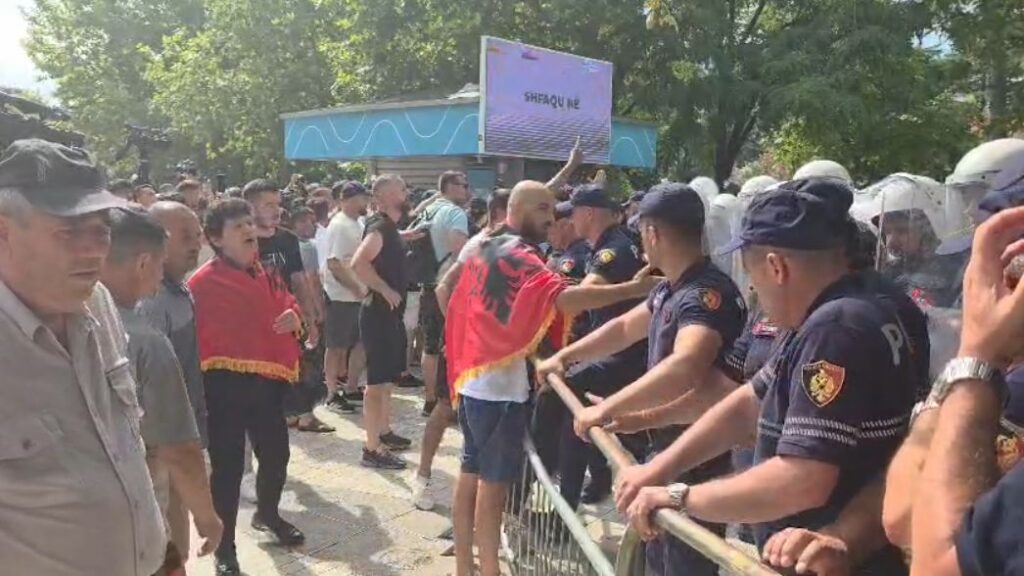
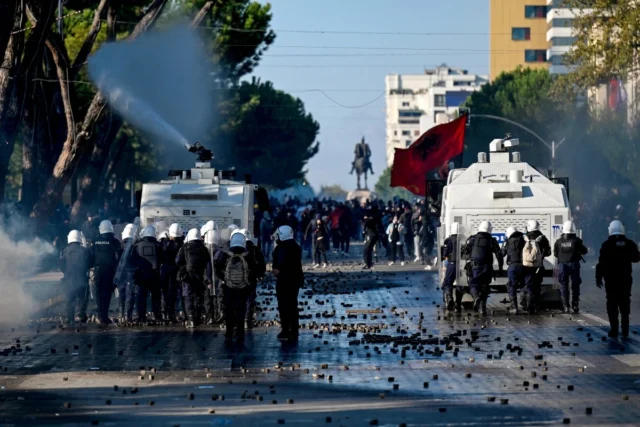
On the evening of July 1, from a stage in front of the Prime Minister’s office, a call went out to surround the Kuvend, Albania’s parliament, and prevent its deputies from entering. On the morning of July 2 the attempt was made. Eggs and flour struck the Speaker’s vehicle and Socialist Party deputies at the doors of the chamber. A section of the security fencing was torn away. Stones flew at the police cordon, and one of them opened an officer’s head. The deputies entered, the session convened, five people were detained. The blockade failed. The question it leaves behind must not be allowed to fail with it.
This publication’s position is not complicated. The announcement was illegal. The attempt was illegal. And beneath the illegality lies something the law exists to prevent: the claim that a crowd, by force of its own presence, may suspend the functioning of a body that ten times its number elected. No grievance confers that right. No sincerity of conviction confers it. Nothing confers it, because a democracy that concedes it once has conceded it permanently, to everyone.
The law here is not ambiguous, and it is worth stating with precision, because the organisers of this action have spent two days pretending otherwise. The Constitution’s Article 47 protects assembly, and protects it broadly; since the Constitutional Court’s 2021 ruling, no permit is required, only notification. The crowd that filled the square before the Prime Minister’s office this month stood inside that protection, and this publication would defend its right to stand there for another month. But the Criminal Code’s Article 235 punishes the obstruction of persons performing a state duty, with up to five years when committed in collaboration, and a blockade announced from a stage with time, place, and shopping list is collaboration reduced to its textbook form. Stones that injure police officers fall under provisions harsher still. The European Court of Human Rights settled the boundary a decade ago in Kudrevičius v. Lithuania: where obstruction is not the side effect of an assembly but its declared purpose, the protection of assembly ends. There is no reading of Albanian or European law under which yesterday’s plan was a right being exercised. It was a crime being announced.
And it was a crime against a specific victim, which the slogan of the square identifies without meaning to. The parliament is ours, the crowd was told, and not theirs. The first half is true. The parliament belongs to the whole electorate, which is exactly why the deputy of Article 70 of the Constitution carries a free mandate on behalf of every citizen, including the ones throwing eggs at him. A crowd that blocks a deputy has not struck at Edi Rama. It has struck at the voters of Kukës and Saranda and Shkodër who sent that deputy to vote in their place, and it has struck equally at the opposition voters whose deputies walked through the same gauntlet to chants that they represent no one. That is the tell. A movement quarrelling with a government attacks the government. A movement that declares the entire elected chamber illegitimate is quarrelling with elections, and there is a name for the condition that follows when that quarrel is won by force. The name is anarchy, and it is not a metaphor. It is the specific state of affairs in which institutions yield to whoever masses at the door, and its first law is that the door never belongs to the same crowd twice.
Those who cheered yesterday’s fence-pulling should conduct one honest exercise: imagine the precedent in the hands of their opponents. Imagine a future parliament, elected by the votes of today’s protesters, and a crowd of today’s Socialists at its doors, armed with the same slogan of ownership and the same conviction of betrayal. Every argument deployed this week would serve that crowd identically. The blockade is a weapon that cannot be patented. Whoever introduces it into Albanian political life hands it, loaded, to every faction that will ever lose an election.
What must follow is equally clear, and it is a test for the state as much as for the movement. Prosecution of the specific acts: the announcement, the perimeter breach, the stones, attributed individually to individuals, under evidence that survives the scrutiny of Albania’s reformed courts. Nothing more, because collective punishment would squander the legal clarity the morning delivered, and nothing less, because an announced crime left unprosecuted is a tariff schedule for the next one. The square remains open, the chants remain free, the demands, all of them, remain speakable. And the movement’s own leadership now owes the country an answer it cannot keep splitting: one of its organisers called projectiles at deputies a normal act of democracy, while one of its prominent figures stood in front of the crowd begging it to stop stoning the police. Both cannot be the movement’s doctrine. The choice between them is not the state’s to make, and the country is watching who makes it.
The Kuvend convened yesterday because the rule of law, on this one morning, held. It will need to hold every morning. Parliaments are not defended in the moment they are stormed; they are defended in the long habit, renewed daily, of a country that settles its furies by counting votes instead of stones.