A range watched for two years and photographed from the hill above it. A NATO air base in Albania mapped sortie by sortie. A freighter photographed through the fence at Pristina. The collection is published and persistent, and neither Albania nor Kosovo has visibly disrupted it.
Drizan Shala, Security Desk
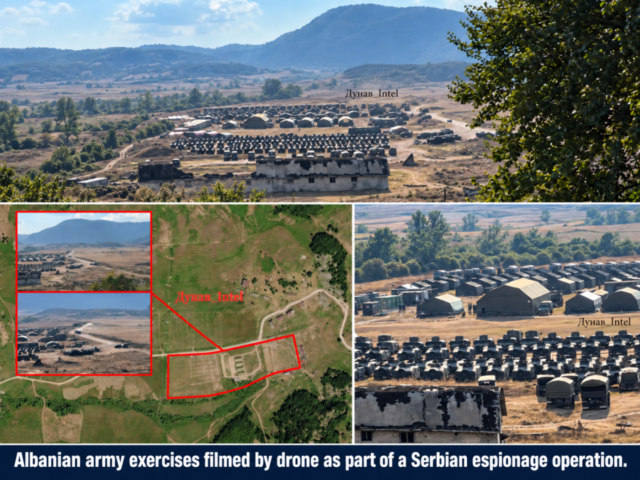
For more than two years, by its own statement, an X account called Dunav Intel has been watching the Albanian army’s training range at Bizë. On 2 October it published photographs taken from a position overlooking the range while the troops were in the field: tent lines, columns of tactical vehicles, the old barracks. In September a light infantry battalion group was certified to NATO standards on that range. The camera was above it.
At Kuçovë, a NATO air base, Albania’s Bayraktar TB2 drones are logged by transponder code, sortie by sortie. The account has even reported one drone with “misconfiguration or problems regarding its GPS/transponder”. The apron has been laid out on satellite imagery and matched to close photographs of the equipment standing on it, among them a mast vehicle carrying two radomes with a Bayraktar behind it. Its position on the base is public. The account’s most recent Kuçovë post appeared hours before this article was published.
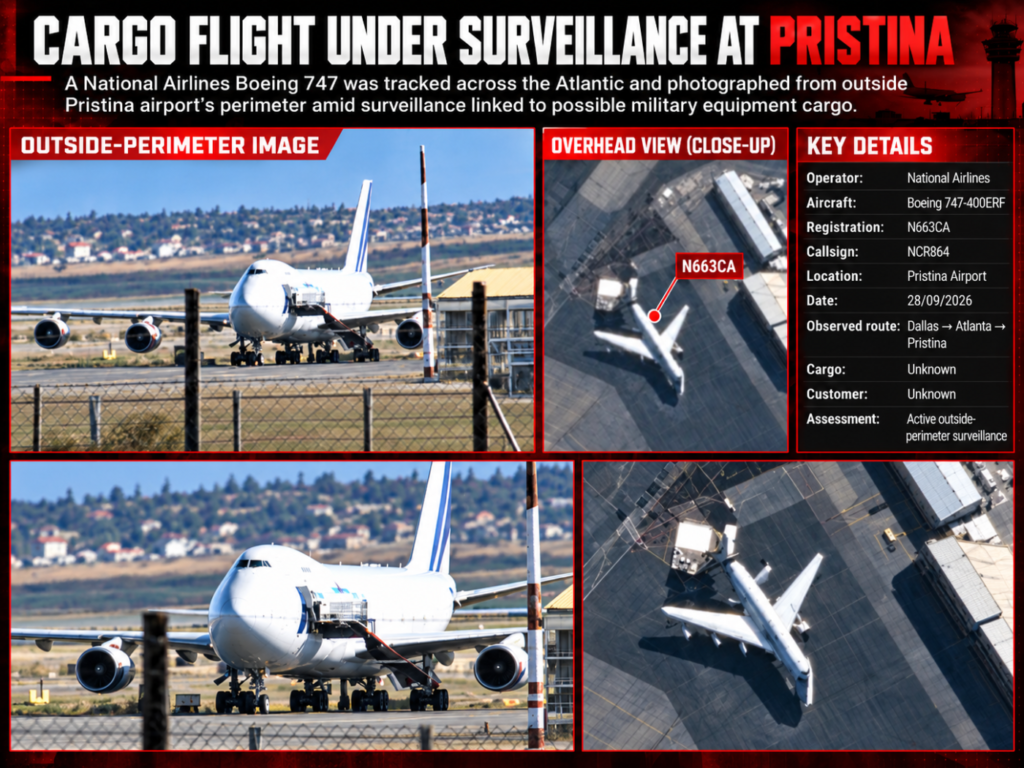
At Adem Jashari, Kosovo’s only international airport, a National Airlines Boeing 747 freighter, registration N663CA, landed on 28 September as flight NCR864. Its track from the United States was followed and published. So were two photographs of the aircraft on the ground. One looks down on the apron. The other was taken at ground level through the perimeter fence. What the aircraft carried is not known. Somebody was at the fence while it was there.
All of it appeared on the same account. Albania and Kosovo are visible from abroad, where transponder feeds and satellite imagery can be bought from a laptop. They are also being watched from inside their own territory, by people with cameras on a hill above a range and at an airport fence. At Bizë the account says the surveillance has lasted more than two years. My assessment is that this is a counter-intelligence failure in both states, and that it is still under way.
No single item in the feed is a secret. A photograph of a camp or a transponder code means little on its own. Two years of the same camp is different. So is a catalogue of sorties tied to equipment positions, or a flight track that ends with somebody waiting at the airport fence. That is how a target picture is built, and this one is being built on Albanian and Kosovar soil.
The account has not hidden how long the collection has been going on. On 11 August it told its followers that it had spent three years “carefully gathering information” on the region, that its administrator was “in the homeland, engaged in important discussions with various local Serbian stakeholders”, and that it discusses its findings “with international analysts in Belgrade”. That is the account’s own description of its work, and it makes the hobbyist explanation difficult to sustain. Seven weeks after the announcement a camera was at the fence in Pristina. Four days after that the Bizë photographs were published.
According to intelligence available to me, the people behind the account operate from the United States, and their contacts in Belgrade include Serbian security structures. Those contacts have dealt substantially with the monitoring of Albania and Kosovo. I state that separately from what the account says publicly.
President Vučić has called the defence partnership of Albania, Croatia and Kosovo “directed against Serbia”, and an account that discusses its findings in Belgrade is building a picture of where Albanian and Kosovar forces train, operate and receive equipment.
A counter-intelligence service exists to notice exactly this: a camera above a military range while troops are in the field, a camera at the fence of the national airport on the day a heavy freighter lands, a Serbian-facing feed that announces years of collection and then publishes the product. Nothing visible in the public record indicates that the collection has been disrupted. The account is still publishing, and Kuçovë was in the feed again hours before this article went to print. By its own admission, the collection has lasted years.
A senior defence official told Tirana Examiner that the surveillance is a persistent problem and that Albania lacks the counter-drone capability required against this kind of espionage. But Albania needs more than counter-drone defence. It urgently needs counter-surveillance systems as well, capable of detecting aerial and electronic collection and securing the approaches to sensitive military sites. Bizë shows what can be seen from the ground. Kuçovë shows how much can be collected electronically. At Pristina, someone simply waited outside the fence.
Equipment is one gap, and it is the smaller one. A sensor can detect a drone or flag activity around a perimeter. It cannot by itself explain why military sites are being watched repeatedly, why one of them has been monitored for years, who is collecting, where the product goes and what requirement it serves. The harder job is finding the collector and stopping him. Albania needs the equipment. It also needs a counter-intelligence service capable of doing that job. The record shows that the present level of protection has not stopped the collection.
Three years after the collector says the work began, the photographs are still being taken. One camera looked down on Bizë. Another was waiting outside Pristina airport. Kuçovë is logged sortie by sortie. The failure is no longer that Albania and Kosovo can be watched. It is that the collection has persisted long enough for the watcher to believe he can return.
Drizan Shala is a security researcher and doctoral candidate at the University of Sarajevo. He writes on defense, private security, and the security architecture of the Western Balkans.
Read also: The Enemy Does Not Need to Break In