The Newsroom
The European Union responded on May 9 with statements from both its member state ambassadors accredited to Albania and a spokesperson in Brussels, condemning what the institution described as personal attacks by Democratic Party chairman Sali Berisha against the EU Ambassador to Albania, Silvio Gonzato. The exchange unfolded over the course of Europe Day, beginning with the official commemorations in Tirana and concluding with two separate institutional responses from the EU side.
The day opened with the Europe Day events in the capital, at which Ambassador Gonzato appeared publicly alongside Prime Minister Edi Rama. Asked by journalists about opposition claims that Albania’s EU accession process had been blocked, Gonzato dismissed the characterization as “speculation,” and described the European Commission’s recommendations on the interim objectives for Albania’s negotiating path as positive.
A few hours later, in a livestream conversation broadcast on his social media, Berisha delivered a direct attack on Ambassador Gonzato. He accused the EU envoy of behaving as a representative of the Albanian government rather than of the European Union, and of transmitting falsehoods about the Albanian opposition to Brussels.
“As for the current ambassador, I have stated that he behaves as if he were Edi Rama’s ambassador,” Berisha said. “Perhaps this gentleman has, in a verified manner, transmitted to Brussels the most untruthful fabrications against the opposition. As if the opposition is not for integration. Without going into many other things.”
Berisha then connected his attack to the parliamentary immunity of former Deputy Prime Minister Belinda Balluku, whom Berisha referred to as “Lubi Balluku.” “And when it is discussed by Coelho that Lubi Balluku’s immunity is not being lifted, why it is not being lifted, His Excellency Gonzato says that this is the Albanian interpretation of immunity. He has completely unified with Edi Rama,” Berisha said.
In the same livestream, the Democratic Party chairman framed Europe Day as falling on a moment of historic peril for Albania. “This day finds Albania at the most dangerous crossroads in its history. At a crossroads of the destruction of the European dream,” Berisha said. “In one sense, the replacement of European values, standards, norms and criteria with those of the narco-state, of the absolute power of Edi Rama.”
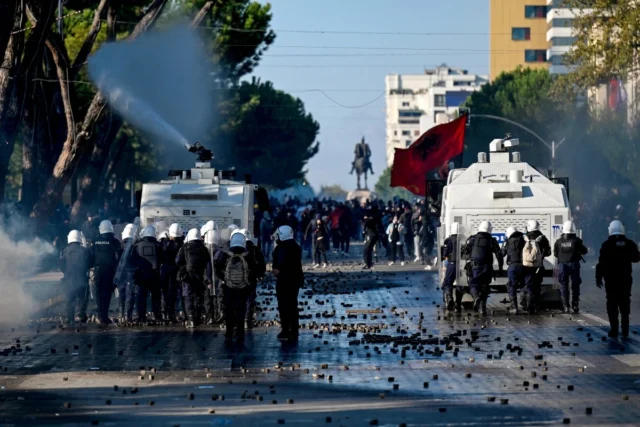
The Berisha intervention also addressed the Democratic Party protest he had led on May 8 in Tirana. The chairman attributed limited turnout to a police blockade he said had prevented the march from proceeding, which he framed as a reflection of the government’s fear of his supporters. He said the next protest would require, in his words, greater engagement from the party base.
The May 8 demonstration produced a separate criminal investigation. Six Democratic Party militants were placed under investigation by Albanian authorities for throwing Molotov cocktails at police officers during the protest. Klevis Balliu, a senior figure within the party, was named as the organizer of the demonstration.
The institutional response from the European Union came in two distinct statements on May 9.
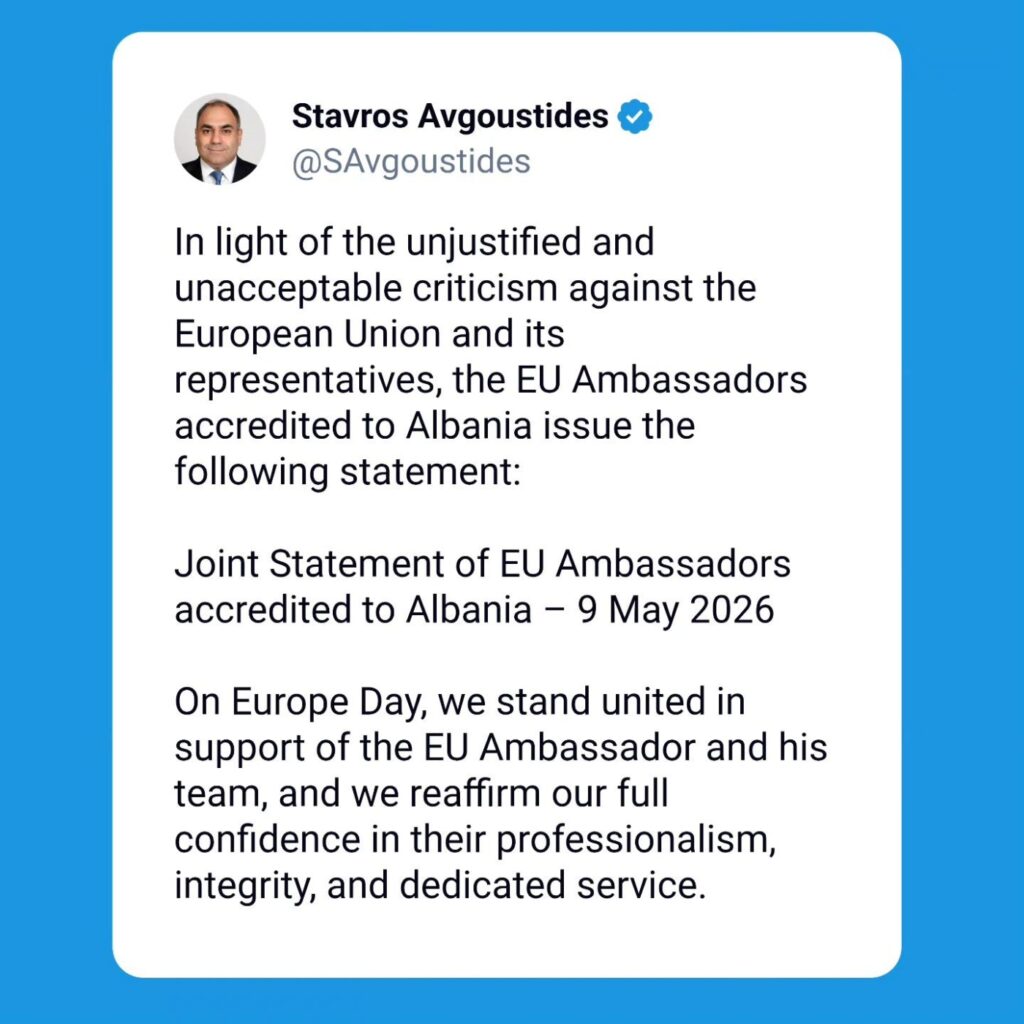
The first was a Joint Statement of EU Ambassadors accredited to Albania, issued on Europe Day. The statement was made public via the X account of Stavros Avgoustides, the Ambassador of the Republic of Cyprus in Athens, who is concurrently accredited to Albania and serves as Dean of the diplomatic corps of EU member states in Tirana. He introduced the text by noting it was issued “in light of the unjustified and unacceptable criticism against the European Union and its representatives.”
The body of the joint statement read: “On Europe Day, we stand united in support of the EU Ambassador and his team, and we reaffirm our full confidence in their professionalism, integrity, and dedicated service.”
The second statement came from an EU spokesperson at the level of the Brussels institutions. “Such statements are unacceptable. The EU strongly condemns the personal attacks made on Europe Day against the European Union Ambassador in Albania,” the spokesperson said. “The EU Ambassador has at all times acted with full professionalism and integrity. We have full confidence in him and his work.”
The exchange falls in an active phase of Albania’s EU accession process, with deliberations underway on the country’s progress in the Fundamentals cluster. Ambassador Gonzato has consistently characterized the integration timeline as on track, a position the Democratic Party leadership has disputed. The party’s internal leadership vote, in which Berisha is seeking to consolidate his position, is scheduled for May 23.
Neither Berisha nor the Democratic Party press office had issued a public response to the EU statements at the time of publication.