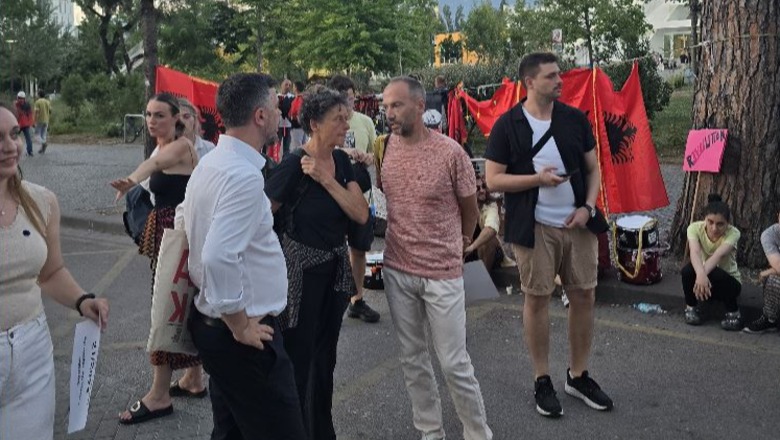
Solidarity with a protest is open to any member of the European Parliament. The deployment of the Parliament’s authority against an elected government is a different act, and it travels under the same name.
Besart Ruka (Tirana)
A member of the European Parliament carries two things that are easily confused, and the distinction between them is the whole of what follows. The first is a personal voice. A member may hold opinions about any country on earth, may travel, may stand in a foreign square and say she admires the people in it, and may carry word of them home. That voice is hers, and she may spend it where she likes. The second thing is the authority of the institution: the title, the file, the standing that the office lends to whatever the holder says next. That authority is not hers. It is lent, on terms, for use inside the mandate the Parliament gives. On the evening of 29 June, in front of the Prime Minister’s office in Tirana, six members spent the second thing as though it were the first.
Begin with what they were not. They were not an official delegation. No plenary sent them, no committee tasked them, no mandate framed what they could say or do in the name of the House. They came as individuals and as figures of one political family, the Greens, which is their right. But several of them did not speak as individuals. They spoke as the institution, and invoked it by name, and that is where the conduct question opens.
Consider Vula Tsetsi, co-chair of the European Green Party. She told the crowd there would be no enlargement for Albania “if Rama sells the country to foreigners and does not listen to your voice,” and then specified the remedy she sought: the European Commission, she said, should pressure the Prime Minister to back down. Set the rhetoric aside and read the request as an ethics adviser would. A senior figure of a European party, standing on the soil of a third state, called on the Union’s executive to bring institutional force to bear on that state’s elected leader until he altered a domestic course. That is not the expression of a personal view. It is an attempt to direct the machinery of the Union against the head of government of a country whose internal politics are not the Parliament’s to adjudicate.
Consider Tineke Strik, who holds a particular and delicate position: she is a shadow rapporteur on the Parliament’s report on Albania, one of the members whose hand is on the very file by which the country’s progress is judged. She is a politician, and entitled to a political position; no one expects a rapporteur to be without views, and holding them is not the problem. The difficulty is what she did with hers. She carried them into the street, told the crowd to continue the mobilisation, and said that Albania, by protesting, was showing that it belongs in the Union. A member who helps shape Parliament’s assessment of a country, and who then stands inside a movement against that country’s government and ties its European prospects to the movement’s persistence, risks compromising the appearance of impartiality the file depends on. Any member may cheer a protest. The member who holds the pen should be slower to.
Consider Nicolae Ștefănuță, a Vice-President of the Parliament. He told the crowd they need wait no longer to be rid of dictatorship, asked why the Europeans were present and the Prime Minister was not, and answered that the man is afraid. A Vice-President occupies one of the Parliament’s highest offices and inevitably carries more institutional weight than an ordinary member. For the holder of that office to describe the elected government of a candidate state as a dictatorship, from that state’s own square, is to lend the standing of the office to a call for the government’s removal. The dignity of the House is not a phrase from a brochure. It is a standard members accept when they take the office, and it is what was placed at the service of a regime-change slogan that evening.
Consider Jutta Paulus, and consider her with care, because her conduct raises the one question that is not a matter of convention but of fact. From the stage she told the crowd she had received an email from Edi Rama instructing her how to vote on an amendment, that she had defied it, and that European law is not for sale. Put to the Prime Minister on the record by this publication, the claim was denied: he stated that he does not know her and sent no such message. The document Paulus herself then circulated online, captioned as her proof, does not support her. It contains no instruction from Edi Rama. It bears neither his signature nor the seal of his office. It is dated 16 June, the eve of the vote, and it is a letter from two Albanian Members of Parliament, Taulant Balla and Bora Muzhaqi, addressed to members involved in the report and asking them not to support two amendments to it. It thanks the report’s rapporteurs by name. There is, in short, no head of government anywhere in the evidence she produced to prove a head of government had leaned on her. Tirana Examiner put the discrepancy to Paulus and had received no response by the time of writing. A member made a public statement of fact about pressure from a foreign leader, and the proof she offered contradicts the claim. That is not a question of taste or tone. It is a question of whether a member misrepresented a document to a crowd, and it is the kind of question the Parliament has the machinery to ask.
Anna Strolenberg instructed the Prime Minister directly and read out conditions. Cristina Guarda used the stage to prosecute her own quarrel with the Italian premier, casting the people of another country as the audience for it. The particulars vary. The pattern does not, and the pattern is the finding.
Set the conduct side by side and a single thread runs through it. These were not members observing a protest and reporting home. They were members deploying the authority of the office, the vice-presidency, the rapporteurship, the party title, to intervene in the internal political contest of a third country: to solicit the Commission against its government, to direct a movement against it, to brand it a dictatorship, and, in one instance, to do so on a false statement of fact. Most of this lives not in any black-letter rule but in the conventions and the dignity provisions that govern how a member carries the institution abroad, which is exactly why it should trouble the people who share that institution. Rules are tested in committees. Conventions are kept by colleagues, or they are not kept at all.
This is the part worth saying plainly to Brussels rather than to Tirana, because Tirana is not the audience that matters here. Every one of these acts would be unremarkable from an activist. None of these six is an activist. They are members of a parliament that spent the last several years rebuilding its credibility on the proposition that the office is not a personal instrument, and on the evening of 29 June a vice-president, a rapporteur and a party co-chair treated it as exactly that.
The distinction the office rests on is simple, and it is the one with which this began. A member’s voice is her own, to spend wherever she pleases. The authority of the office is not; it belongs equally to every member, and to the institution before any of them. That distinction cannot become optional the moment one crosses a foreign border. If these six wished to campaign in Tirana, nothing stopped them from doing so in their own names. What they could not do, and did, was spend for partisan ends an authority that was never theirs alone. The bill for that is not paid in Albania. It is paid in the chamber where they sit, and it is their colleagues, not Tirana, who will decide whether it is paid at all.