Renada Bici (Legal Desk)
On Tuesday a court prohibited publication of the Agasi decision under Article 103. On Wednesday the prosecution’s case against Vlora Hyseni, from the same investigation, was in the press.
On 22 September the Special Appeal Court upheld the detention of Ergys Agasi in the AKSHI investigation. Judge Florjan Kalaja’s disposition added a line: on the basis of and in application of Article 103 of the Code of Criminal Procedure, publication of the decision is prohibited until the preliminary investigation closes.
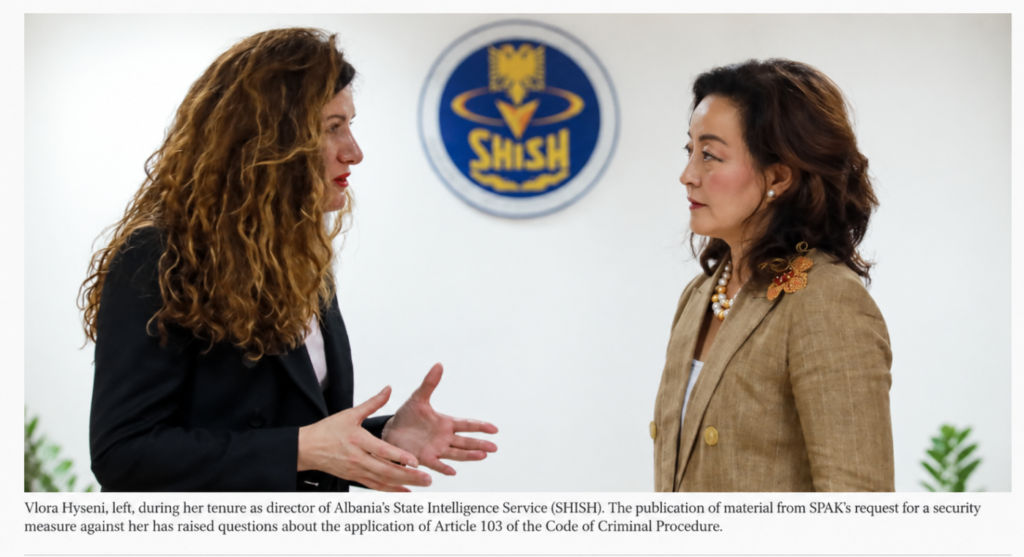
The next day, portals were publishing SPAK’s request for a security measure against former SHISH director Vlora Hyseni. The request is built on communications SPAK found on Agasi’s phone. The reports carried call and message counts, Signal extracts, and the prosecution’s own sentences, in quotation marks, rejecting her claim that Agasi was a service collaborator. Her account appeared once, inside the paragraph written to refute it. The measure had been executed the evening before, after she presented herself at the Morinë crossing.
Article 103(1) prohibits publishing secret acts, in whole or in part, or even their content alone, through the press. Article 103(2) prohibits publishing non-secret acts, even partially, until the preliminary investigation ends. If the request remained secret on 23 September, paragraph one applies. If it did not, paragraph two does, because the investigation has not ended.
Paragraph one names content and paragraph two names only acts. A summary of what a request alleges may be arguable. Reproducing the request’s own sentences is much harder to defend.
SPAK’s standard answer concerns the source. At his December 2025 hearing before the High Prosecutorial Council, Klodian Braho said that in 99 percent of cases material reaches the media after the parties have received copies, and that responsibility then lies with whoever holds them. Grant him the 99 percent. Article 105(3) provides that issuing copies, extracts or certificates does not lift the publication ban.
The Special Court uses the article. On 20 May 2024 it ordered a publication ban in the SkyECC investigation into seven organised-crime groups. In Decision 87 of 28 July 2024, at SPAK’s request, it prohibited publication until the end of the preliminary investigation of three things in the case of Aurel Zarka, the arrested former head of the Vlora prosecution office: its own reasoning, SPAK’s request for personal security measures, and acts connected with the case. It warned that a breach is an offence under Article 295/a(3) of the Criminal Code.
The Hyseni file forks here. If decision 67 of 21 September, or another order in the proceeding, prohibited publication of SPAK’s request or the acts that appeared on Wednesday, the question is what follows from their publication. If no such order exists, the statute still applied, but no one added the express restriction. That would be one day after the Special Appeal Court, in the same investigation, invoked Article 103 to protect its Agasi decision, and two years after the Special Court extended an express prohibition in the Zarka case to SPAK’s security-measure request itself. SPAK’s public notice of decision 67, as reported, lists the measures and the offences. It does not mention a publication restriction.
Article 104 makes a non-criminal breach by a state or public employee a disciplinary matter, with the prosecutor notifying the disciplinary body. Disclosure by prosecutors or judicial police is a crime under Article 295/a, and SPAK has prosecuted it. In July 2026 the Special Court convicted a former judicial-police officer, a member of an investigative team, for telling a suspect he was under interception and surveillance.
The material in Wednesday’s reports left the proceeding before it reached any newsroom. Under Article 105(3), every lawful copy carries the ban with it. Under Article 134(2), the delivery date of each copy of a prosecutor’s act is recorded on the original. The formal recipients and delivery dates are on file.
Three documents would settle the rest. Decision 67 shows whether the court restricted publication, and how far. SPAK’s request shows whether Wednesday’s passages match the original. The delivery record shows who formally received it and when. All three are in the hands of the court and SPAK.