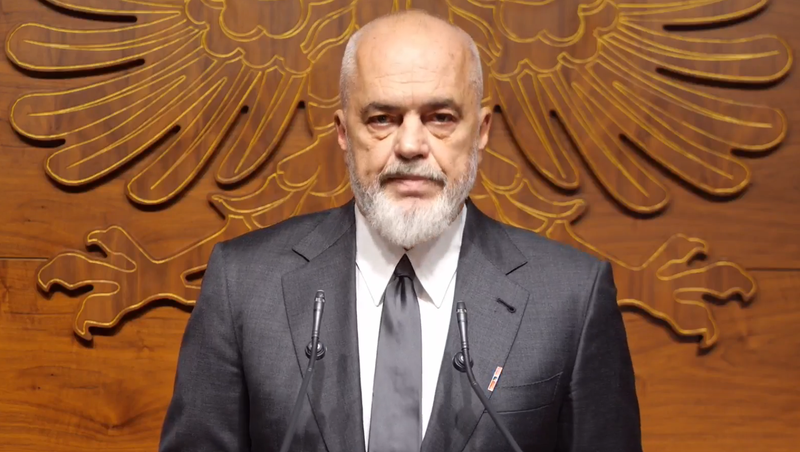
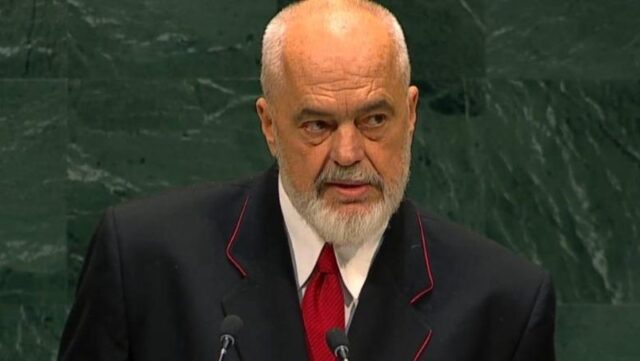
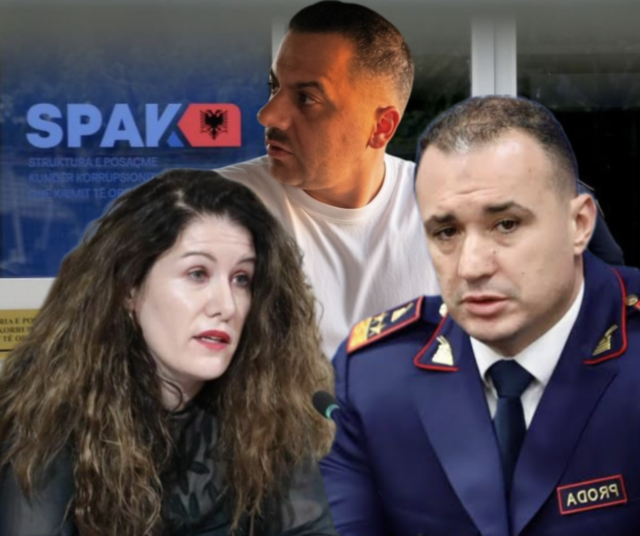
Prime Minister Edi Rama spoke to the country from Tirana’s Mother Teresa airport on Sunday afternoon, minutes after landing from New York, where he had represented Albania at the UN General Assembly. The address followed the house arrest of Vlora Hyseni, the dismissed director of the State Intelligence Service (SHISH), whom SPAK is investigating for supporting the perpetrator of a crime and for disclosure of secret acts or data, in connection with the businessman Ergys Agasi, himself in custody in the AKSHI case. Rama said he would not enter the contents of the file, but accused the justice system of letting investigative material flood social media before any court restriction, called the handling of the case “a problem of the whole state”, gave his first account of how Hyseni came to be appointed, and said he believes Monday’s National Security Council is the right place to reflect on institutional responsibilities. The second part of the address answered the opposition’s charge that the country is “drowned in corruption”, and closed with a reply to those demanding his resignation.
Below is the Prime Minister’s opening statement, in full.
I have just returned from New York, where, as you know, I represented Albania at the United Nations. I decided to address you straight from Mother Teresa airport. The developments of recent days, following the imposition of house arrest on the former director of the State Intelligence Service, call for an immediate and direct response, face to face.
It was without question an extreme measure, if we bear in mind that what is at stake is the exposure of a very key institution of the state. But I have neither the right nor the intention to enter into the contents of the file, the assessment of the evidence, or the reasons that led the prosecution to request that measure and the court to impose it. I have never done so before and I will not do so now.
Every reasonable suspicion about anyone must be investigated to the end. Every accusation raised against anyone must be proven or dismissed through an independent, impartial and regular judicial process. Every restriction of liberty imposed by the prosecuting authority on anyone who does not hold parliamentary immunity is contested only in court, not from the Prime Minister’s podium and not from the rostrums of politics. These markers of the governing majority’s line of conduct on individual matters of justice have been, and remain, the same for everyone.
On the other hand, respect for the independence of justice does not mean silence, even when a concern of principle arises in the course of its organs’ activity. Concretely, in this case, besides and beyond the individual criminal matter, there is another fact, one of principle and of state, that cannot be passed over as if it had not happened.
During the imposition of the measure and the judicial handling of the file, an institution of particular sensitivity for the security and reputation of the state was exposed. It was exposed to the potential of great harm, which could and should have been entirely prevented. The data of the investigative file had to flood social channels and media stalls before the court ordered a restriction on their publication, an order that came when it could no longer serve any purpose, and naturally without effect.
When the work and the conduct of an investigation climb as high as the head of the country’s intelligence service, this is no longer the problem of one independent branch of power. This is a problem of the whole state. And that is why this hands-off approach has left all our partners speechless too.
In other words, it is certainly not the first time in the history of the world that the chief of a secret service is charged. But it is the first time in the history of the world that the institution of the secret service becomes a national and international target of media gossip, because not one of the measures that states take in a case as unfortunate as this was taken.
To be very clear: the investigation and trial of Vlora Hyseni are the exclusive task of justice. That is beyond discussion.
The remainder of the address, in the passages published by Albanian media on Sunday afternoon, follows.
The protection of SHISH, and not only SHISH, from any unnecessary collateral harm is the task of the entire state. The separation of powers cannot appear as separation from state oversight. The time has come to treat this jointly and seriously. I believe the Security Council convened for tomorrow is the right place to reflect on institutional responsibilities.
No one can claim that the secrecy of the investigation should be guarded by the media. The problem does not begin with the informal spokesmen of the justice courtyard on the screens. They are used by prosecutors and judges to declare people guilty before the trial begins, just as in a dictatorship, where once the instruments of propaganda have done their work the trial remains a formality. This problem, which begins with lawfulised unlawfulness inside the justice courtyard, where the secrecy of the investigation is abused in order to lynch, cannot be sidestepped. We will not accept public lynching.
Attempts to explain the appointment of Vlora Hyseni as head of SHISH with all sorts of conspiracy fantasies have nothing to do with the truth. The truth is simple. She began working with me in the role of adviser. After a not-short period in that role, and on the basis of excellent references received from partner services, she was appointed head of SHISH. It is not in question today that the former head of SHISH has opened a difficult account with justice, and has incurred a great moral debt in this country. But it is equally not in question that this country does not become more just when people who are today under investigation by the prosecution are lynched on media stalls, nor does this society become better when it fans the fire of those pyres.
Justice cannot fight unlawfulness in the courtyard of business or of crime without addressing unlawfulness in its own courtyard. The independence of justice cannot appear as detachment from the Constitution and disregard for it. The prosecution has the right and the duty to investigate, the court to judge, the media to uncover and inform, but no one has the right to declare another person guilty and to dehumanise them. The rule of law is built with the courage to investigate the powerful and the certainty of protecting the human rights of the person under investigation. As far as I am concerned, when a senior official has opened an account with justice, and this includes the former director of SHISH, it is an individual matter between that person and the organs of justice. I have nothing further to add.
I have nothing further to add on that, but I still have something to say about the political meaning of this development, because this time too an indictment was raised to the heavens against the government and against me personally, with the unrestrained refrain “corruption has drowned us”. Regardless of one’s convictions or the direction of one’s vote, the fact that justice reaches people in high office, members of the government and associates, does not prove that corruption has drowned us or that it is growing. On the contrary. The facts in the episodes of this new chapter for Albania in no way prove that the governing majority is corrupt. This fact, these episodes, this new justice, when never before has there been an independent justice of this kind, and never before a political leadership interested in giving it independence or the political strength to support it by shouldering the costs, prove the opposite of the tune that corruption has drowned us. Corruption is being struck, not growing. The governing majority is unshaken in the fight against corruption, above all within its own ranks. We are committed to the end, whether for reforms or for bearing the political costs that the justice organs’ engagement against corruption brings.
How can I say again and again that they ate the pears behind my back? By that logic, the chief culprit in every case is me. I, who wanted justice reform when no one believed in it, who led it when no one wanted it, and who defend it like no one else. A prime minister cannot be judged by the absurd claim that no person connected to him will ever break the law, or else the offender is he himself. The prime minister and the government are judged by the stance they take when an account is opened with justice for someone among them or near them. Do they justify it, do they defend it, do they oppose justice, or do they let justice do its work?
I promised the Renaissance, not a government in which no one would ever step on a rotten board, nor an exemplary administration. I pledged the liberation of justice and the end of impunity for the powerful. That is the historic change that is happening. The proper question is not how the prime minister can fail to know when a subordinate breaks the law, but how he could know. The prime minister cannot foresee the conduct of an individual, is not permitted to eavesdrop on his collaborators, and cannot read someone’s mind when it is set on working the other way. That is why democracies have justice organs, that is why I asked for justice reform, and that is why I support the new justice, beyond its lapses.
I say it sincerely: I must have my faults, but in no case and for no reason can anyone make me guilty of having, in 28 years and 4 months of public service, touched the money, the property or the interests of Albanians. Of course plenty of people can come out and speak in my name, say that behind a corrupt deed there is me, tell tales about the architects of the world gathered around me to launder the money of my towers, say that Albania’s oligarchs make their money with me, that I sell them Albania’s land and they fly in private jets. All of it! All of it and much more than this they have said before and can say again, together with the new things their fevered minds will produce. But one piece of evidence that anyone has ever put anything in my pocket in exchange for a single signature of mine, as mayor or as prime minister, they cannot produce, because that kind of phenomenon has not been born yet.
Whoever has obtained constitutional rights to develop property, or lawful investment opportunities, knows very well what I am talking about, knows very well what I mean when I say that my power has not been used to grant dark favours. Today there is a museum of gifts in the Prime Minister’s Office. To those ragamuffins in parliamentary suits who have even produced a super-expensive watch that I supposedly received as a gift from organised crime, I say that in that museum there is a dozen expensive and super-expensive watches, given to me by powerful friends or foreign visitors. Unlike my predecessor, who gobbled them all up together, I have registered every gift to the Prime Minister as property of the Albanian state. Because what comes to me as prime minister, and what I am entitled to hold as prime minister, does not come to be carried off to my house.
It is precisely for the name, for Albania, that I want her with her head held high, with the flag as high as it can go, an equal at the highest tables, in the European Union within this decade, with a justice independent of me. That is why the topic of justice has stopped me in this hall today, when my opponents, from the dissolute of the opposition streets to the failed and the embittered, think they have invented the bomb that will bring down Edi Rama. Let them throw that bomb morning, noon and night. Let them detonate it hour by hour on social media, as if repeating a dirty word could undo the cleanliness of my all-round fight, which, whether they like it or not, gave this country back a capital that had been buried in rubbish, is transforming Albania and is raising the country toward a summit where it has never been. In no country drowned in corruption is there a frontal war against corruption. In no country drowned in corruption does the prosecution investigate power itself; it protects it. In no such country does justice reach ministers, directors and mayors; it sits and waits for the order of power to strike the opponents. The country drowned in corruption we have all lived in: where the leader of the opposition was jailed on orders from above, where protesters were killed with bullets paid for by the taxpayers, where the prosecution’s summonses for state killings in the middle of the boulevard became toilet paper in the office of a prime minister who denigrated the prosecutor as a boulevard whore, where the director of taxes stayed at the head of his office from house arrest, and where 26 innocent people killed in the explosion of a corrupt Ministry of Defence project were treated as victims of a natural disaster. Those four killed on the boulevard have not received justice.
The time when justice in this country was a closed door whenever right knocked, and an open door whenever evil wanted to sit cross-legged for a bargain, is not coming back. The time when political power and impunity were one and the same thing is not coming back. That time is gone because I and the Socialist Party walked into the sea on foot and took on the deepest and most painful reform, the act of surrendering the sword of justice from the hands of political power into the hands of a justice set free and made independent. I did it, not because I was naive, nor because I did not know it would demand heads, but because that burden of great political sacrifice was mine, ours. Today, for the first time in the history of the Albanian state, it is the system itself that is showing a capacity for self-cleansing it never had. This is a great achievement, whose authorship I negotiate with no one. The independence of justice did not fall from the sky; time did not bring it, nor did the United States, nor Europe. They helped, but without us they would have got nowhere. Nor was it brought by the crows and ravens who shout “corruption” and see SPAK as a weapon against me, whom I have beaten and will beat in every election, whenever they think they have cornered me and dug my grave. It is not their defeat that costs me sleep, nor their puffing and cackling. This is about what is happening, about corruption and justice.
I know that with the money of the factory of death at Gërdec the building of a media laundromat was financed, which today sets the miracle-working anti-government bombs. I know that another TV, “corruption, corruption has drowned us”, fed by the money of tax evasion, has taken an entire prosecution office hostage.
Corruption today is up against a different system, one in which organs that investigate are developing in full freedom and independence. Until yesterday corruption was the system; today the system is fighting corruption. That is the epochal change. The self-cleansing of the system is a long-awaited development in the organisation of the state, after an agony as long as the history of the Albanian state itself.
After an agony as long as the history of the Albanian state, the organism of the state is gaining immunity from the old diseases. And when this noisy, dirty and painful phase has passed, when the names, the secrets, the drool, the snorting and the shrieks of the media stalls have died down, when the smoke of the digital mirrors has cleared and the dust of the Justice Reform construction site has settled, then everyone will see that these developments are a vital part of the radical change, with no way back, along which Albania is moving today.
Today I have returned to Albania, but Albania is not going back.
No one and nothing will stop it, will stop us, will stop me.