In an address focused on artificial intelligence, the prime minister said a fabricated Israeli “takeover” narrative fed the Tirana mobilisation, announced an AI-based “digital mirror” to expose coordinated manipulation, and sided with the US president against restraint.
NEW YORK / TIRANA – The Newsroom
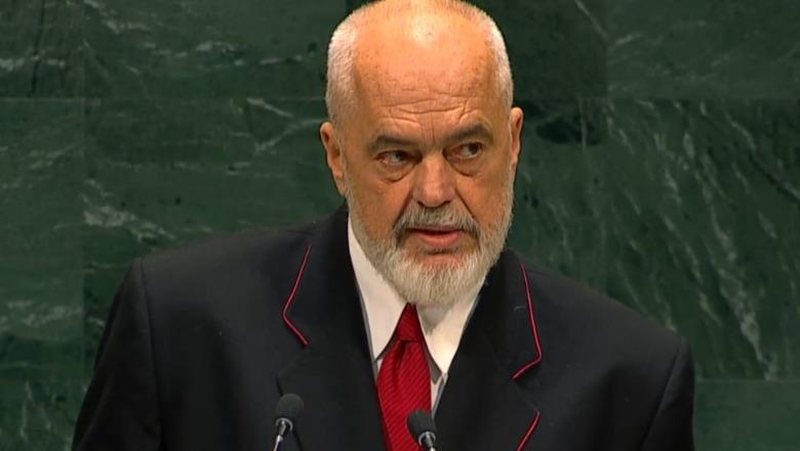
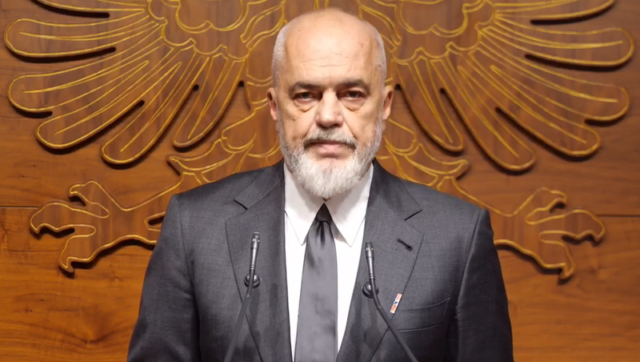
Prime Minister Edi Rama addressed the general debate of the 81st session of the United Nations General Assembly on Friday and devoted his speech largely to artificial intelligence, its use in manipulating public opinion, and Albania’s position on how it should be governed.
The speech contained four elements with direct domestic bearing. Rama described the summer protest movement in Tirana known as the Flamingo Revolution as a mobilisation in which citizens with real grievances ended up “protesting against a phantom”, a fabricated narrative of an Israeli takeover of the Albanian coast. He declared Albania opposed to slowing the development of AI and said the president of the United States “is right”. He announced that Albania is building an AI-based “digital mirror” intended to expose coordinated manipulation online. And he called for an international agreement on AI and for what he termed “sovereign artificial intelligence”.
The speech was delivered in English. The quotations below are rendered from the Albanian transcript published by Shqiptarja.com in its live coverage on Friday evening; the Prime Minister’s Office had not published an official text in either language at the time of writing. Where Euronews Albania’s English rendering was available, it matches in substance.
“The greatest risk is that it may convince the wrong people”
Rama opened by telling the assembly that many colleagues had asked him what was happening in Albania with artificial intelligence and that he had decided to share his thoughts. He placed AI in a sequence of technologies that changed the terms of human conflict.
“Gunpowder changed battles, nuclear fission changed the meaning of human survival, while AI is changing something more intimate: it can enter the mind of the citizen, fabricate a reality, calibrate itself to one person’s fears, and do so millions and millions of times.”
“Albania is not at the vanguard. We are a nation living the future that many are still debating. I have a simple message, and we owe it to all of you: the greatest risk is not that AI will stop humanity; the risk is that it may convince the wrong people.”
He said the machine “carries no flag, but can be used by a state”, “can tell billions of lies in the name of others”, and “has no conscience, but can enter the conscience of a government, the precision of a weapon”.
Distribution as a weapon
Rama devoted a substantial part of the speech to what he called the weaponisation of distribution. He described two neighbours on the same street voting in the same election “within completely different realities”, and said that when this happens democracy loses not a debate but “the common ground on which debate becomes possible”.
“Sovereignty is no longer eroded at the borders. Today in Europe we are running like mad to throw ever more money we do not have into defending our lands and our skies from a possible future war. But in the century we are living, this must also mean creating a free society able to protect the conditions in which its citizens form their own opinion. Without that, sovereignty over land and sky becomes an illusion.”
“Today freedom of expression is threatened by the weaponisation of the power of distribution. Distribution can be manipulated and used criminally. When a lie is multiplied a billion times, the truth is buried. The citizen remains free to speak, but in a storm in which no one can hear him.”
He said the answer to bad speech remains free speech, “but for hidden amplification the answer must be exposure”, and that this must come as early as possible. “If we protect freedom of expression while leaving control of distribution in the dark, it is like guarding the door but handing over the whole room.”
The Flamingo Revolution as case study
Rama then turned to the protests in Tirana. The movement began on 30 May with demonstrations against planned tourist development on the coast around Zvërnec and the Vjosa-Narta protected area, and later broadened into a wider campaign against corruption and the government. It has held near-daily gatherings in the capital since; on 1 September, its 94th day, protesters clashed with police at the Prime Minister’s Office.
According to Shqiptarja.com, the passage in Rama’s speech referred to an image circulated on social media showing a barbed-wire fence and a sign presenting the Zvërnec area as a border between Albania and Israel, with the two countries’ flags. The prime minister’s words, as transcribed:
“I am convinced you have followed the Flamingo Revolution, a fabricated narrative about an Israeli takeover of the Albanian coast, a takeover that never happened, but which was fabricated and transmitted through voices, pages and channels. Citizens already believed it. One citizen received a story of national betrayal, another of religious provocation, another of foreign occupation. Different fabrications were inserted into different emotional worlds, and all of them served the strategic lie. The consequences were real. Citizens had reasons to protest, but suddenly they were protesting against a phantom. Fear became anger, anger became mobilisation, and fabrication became reality.”
“It was not an experiment. I am not talking to you about a film. It was a Tuesday in Tirana. The algorithm did not invent the target; a human actor did. This is systematic deception. Election interference no longer requires a public television station or a propaganda apparatus addressing an entire population. It can now act on the will of each individual voter.”
Rama did not name any actor as the author of the narrative he described.
Diella and the limits of delegation
Rama devoted a section to what he called the economic incentives around AI, which he said “increasingly reward the replacement of human effort rather than the expansion of capacity”.
“Write the code so that I do not have to understand it; write the report so that I do not have to think; make a judgment and take a decision so that I do not have to bear responsibility. When success is measured by how much work the machine removes from the human being, we will have less capable people. A civilisation that can outsource knowledge, a civilisation that hands out its judgment, may discover that it has handed out responsibility.”
He then referred to Diella, the AI system the government presents as Minister of State for Artificial Intelligence since the formation of the fourth Rama cabinet in September 2025. Under the government’s own formation notice, responsibility for establishing and operating the virtual ministry rests with the prime minister; Diella did not take the ministerial oath alongside the human ministers. Rama presented it to MPs as a digital assistant to be used against corruption, nepotism and conflicts of interest in public procurement, and has described it as the world’s first AI minister. The opposition called the arrangement unconstitutional.
“Albania became the first country to bring the first AI minister, Diella. We did it to make procedures more transparent and the state more accountable. No algorithm holds a mandate. Behind every decision with public effect there must remain a legal mandate.”
“We are against”: acceleration and sovereign AI
On the question of whether AI development should be slowed because of its risks, a position raised by several speakers during the week, Rama placed Albania against it.
“We are against. We cannot regulate ourselves into powerlessness. On this question, the president of the United States is right: we must accelerate. AI in the service of citizens, responsible AI. The answer is democratic capacity.”
The reference is to Donald Trump’s address on 22 September, in which the US president said the United States rejects any attempt to construct a globalist scheme to control artificial intelligence. On the same day, UN Secretary-General António Guterres, in his final General Assembly address, named AI as one of four tests facing the international community, urged binding international cooperation on its governance, and said life-and-death decisions must never be surrendered to machines.
Rama defined “sovereign artificial intelligence” as follows: “A sovereign AI means that no country is powerless before decisions it cannot understand. Every country must be able to protect its own language, detect manipulated coordination, and inform its citizens without depending on a distant corporation.”
He then announced the domestic instrument. “This is why Albania is building a digital mirror based on AI. The mirror will detect coordinated structures, not only what is visible. It will not tell citizens what to think. The right must be protected openly. Our mirror aims to become an infrastructure of transparency, to protect society from an industry of lies. Citizens must know when influential political content has been generated artificially or manipulated. The architecture of distribution must become transparent: who created it, who targeted it.”
The government first presented a platform under the name PasqyrAlbania after the cabinet retreat in Pogradec on 24 August, where Rama described it as a technological interface between the state and citizens and as a means of equipping citizens against the effects of the algorithmic information environment; it featured again in his address to the Socialist parliamentary group on 3 September. The speech did not say which institution will operate the system or under what legal basis.
The international proposal followed. “Albania calls for an international agreement and for sovereign artificial intelligence. Digital sovereignty cannot be a privilege reserved for the richest states. Lies travel without visas. Algorithms cross borders without needing a passport.”
Rama did not specify what form the proposed agreement would take or through which international body it should be negotiated.
He ended with a passage on generational duty.
“Every generation is asked to defend freedom on the territory where it is most threatened. For one generation that territory was the battlefield; for another it was something else. For us it is clear: it is the human mind. To make sure that no citizen is left alone before a terrifying algorithmic army. That no democracy wakes up after an election and discovers that its people exercised the right to vote inside a world secretly designed for them by someone they did not even know existed.”
“AI does not decide whether this century belongs to freedom or to manipulation. We decide. The machine will obey. The question is whom it will obey, which law, and for what purpose. We have chosen acceleration, not failure. We chose freedom of expression, of speech, because we know what it means to live without it.”
He closed with a sentence the Albanian transcript renders as: “Without a shared world there can be no United Nations. My preaching in the desert ends here, and it is the last instrument in which I place hope.”
The general debate opened on Tuesday 22 September under the theme “Restoring trust, managing transformation: a United Nations that delivers for all”. Rama spoke on the fourth day.
Reaction from the opposition and from the protest movement had not been recorded at the time of publication.