The Democratic Party voted on Monday to hold a leadership election in May. It also established a working group whose unstated purpose is to remove the accountability clause Berisha himself wrote — the one that required a chairman to resign after losing a parliamentary vote. He lost in May 2025. The clause is still there. For now.
the Newsroom (Tirana)
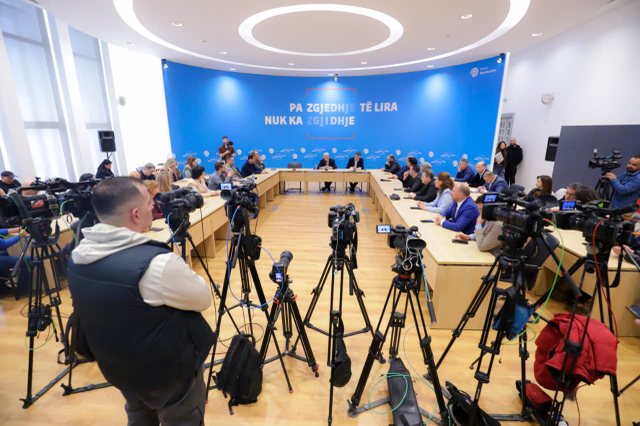
The Democratic Party’s Presidency set a leadership election date on Monday. It also began the process of removing the clause that requires its leader to resign when he loses one.
The electoral calendar is fixed: branch elections across roughly fifty local structures must conclude by 30 April, a membership referendum to elect the party’s next leader is scheduled for 23 May, and the National Assembly convenes on 6 June to ratify the outcome. The decisions require confirmation by the National Council before the process formally opens.
Alongside the calendar, the Presidency established a ten-member working group — chaired by Secretary-General Gazmend Bardhi, composed entirely of figures from the Berisha-aligned apparatus — mandated to draft amendments to the party statute. The group’s task was left formally open. Its political direction was not.
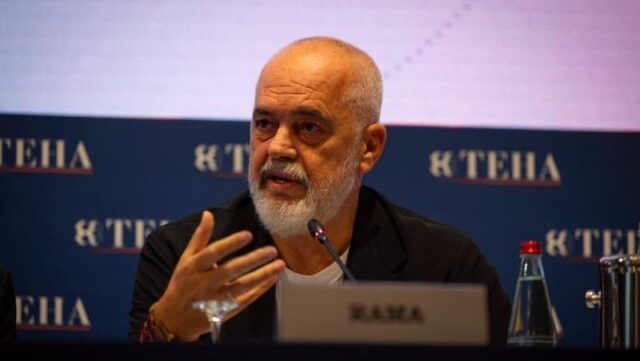
At issue is the provision known informally as the “Basha article,” inserted into the statute by Berisha during his confrontation with then-leader Lulzim Basha. The clause requires the party chairman to resign following a parliamentary election defeat. Berisha lost the election of 11 May 2025. He has not resigned. The working group Bardhi now chairs will determine whether that clause survives.
Berisha used the session to attack EU Ambassador Silvio Gonzato, accusing him of acting as Rama’s representative in Brussels and of misrepresenting PD’s pro-integration positions before European capitals. He denied that the party’s agenda follows the MAGA line. The broadside against the Union’s senior envoy in Tirana, delivered on the same day the party moved to rewrite its internal accountability rules, drew an immediate response — though not from inside the room.
Ervin Salianji, absent from Presidency sessions since the leadership declared him self-excluded following his parallel series of member meetings, replied on social media within the hour. “There is no greater service to Edi Rama than to behave and act exactly like him,” he wrote. “The Democratic Party cannot open the door to unilateral changes to the party’s constitution and statute. Article 46 is clear and sanctioned. Every action that imitates Rama’s model is not a solution, but a usurpation.”
Analysis: The Clause That Knows Too Much
Sali Berisha did not insert the accountability clause into the Democratic Party’s statute by accident. He inserted it as an argument — the argument that a party could not be the permanent property of a leader who kept losing elections. He made it loudly, repeatedly, and in the specific context of removing a specific man. The clause was not procedural housekeeping. It was political theory, given binding form.
That is what makes Monday’s working group not merely awkward, but structurally revealing. Had the “Basha article” been a minor administrative provision, its quiet revision would be a minor administrative matter. Because it was a statement of principle — Berisha’s own principle, articulated at the peak of his authority — its revision is a statement of principle too. The working group chaired by Bardhi is not really about statute mechanics. It is about whether the Democratic Party’s founding accountability logic applies to the man who founded it.
Berisha lost the May 2025 election. By the terms he himself set, he should have resigned. He did not. The clause therefore functions now as a kind of institutional memory the party would prefer to forget — present in every document, invoked in every internal dispute, available to any challenger willing to use it. The working group’s purpose, unstated but clear, is to remove that availability. The question is whether removing it costs more than keeping it.
Salianji has made his calculation. His response to Monday’s session was notable not for its content — opposition to unilateral rule changes is an obvious position — but for its framing. He did not appeal to democratic norms in the abstract. He drew a precise parallel: Rama is under international pressure for changing the rules on ministerial accountability; PD is now moving to change the rules on leadership accountability; the logic is identical, and citizens are beginning to notice. “Is it possible,” he wrote, “that the game is the same and the sides are closer than they appear?”
That question deserves to be taken seriously as analysis rather than dismissed as rhetoric. Albanian opposition politics has long rested on a structural assumption: that PD and PS represent genuinely different political cultures, not merely competing factions contending for the same institutional prizes. The Balluku immunity vote damaged that assumption on one side of the ledger. A unilateral statute revision — executed by a leadership that owes its existence to the statute it is revising — would damage it on the other. What Salianji is describing is not cynicism. It is convergence: the slow collapse of the behavioural distance between a government and the opposition that defines itself against it.
This is the context in which the Gonzato attack acquires its real significance. Framing the EU’s senior envoy as a partisan actor — on the same day that the party is reorganising its internal accountability architecture — is not an incidental outburst. It pre-emptively delegitimises the external reference point that would otherwise be available to critics of the revision. If Gonzato is Rama’s man, his concerns about democratic backsliding within PD can be attributed to political motivation rather than institutional judgment. The ground is being cleared. Whether by design or instinct, the clearing serves the same purpose.
PD enters its leadership contest as a party that has not yet decided what kind of institution it wants to be. The working group Bardhi chairs will, in the next several weeks, answer that question more honestly than any platform document or campaign speech. A statute that holds its leaders to account is a different kind of party than one that revises accountability clauses when they become inconvenient. Salianji has put his name to that distinction. The 23 May ballot will reveal whether enough Democrats have noticed it to matter.