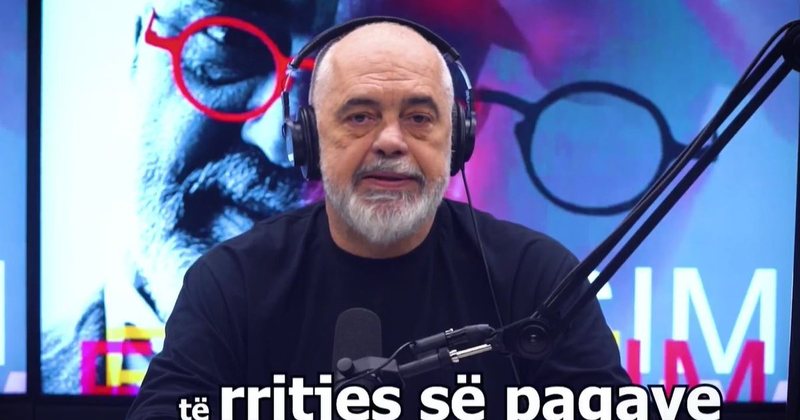
Prime Minister Edi Rama used the fourteenth episode of the sixth season of his weekly podcast, Flasim, to address several policy and governance matters: the opening of the fourth diaspora summit in Tirana, the new wage indexation mechanism and public sector salary increases effective from June, a complementary pension pillar built on matched contributions, the trajectory of foreign direct investment, and Albania’s top regional ranking in a European Union public procurement assessment. Below is a full transcript of the weekly address.
In the week that begins tomorrow, we welcome to Tirana the diaspora summit, the fourth edition, which once again brings together Albanians from every part of the world: those who live and work abroad, but whose eyes remain on Albania, and who, whenever the opportunity arises, think about it, communicate with it, and visit it. We open on April 13 with the welcome ceremony, where attention will be on people and on their stories. Stories of success, of work, of dedication, which are also stories of Albanian pride everywhere, but at the same time an opening for appreciation: appreciation not only for Albanians who have achieved and contributed abroad, but also for their friends, foreign friends who have chosen to be part of the Albanian journey, who have come together and in some way joined the wings of our eagle.
Today the diaspora is a concrete force for development, and it comes to this summit for the first time after a historic participation in the country’s political elections. It comes as an expanded space of Albania beyond its borders, and it becomes an Albanian reality in continuous transformation, increasingly a partner, a direct partner, beginning with the political elections, and then in the economy as well, step by step along the paths of knowledge toward the new horizons of the future. Our challenge is not only to maintain this connection at a symbolic level, but to structure an entire network of hearts that beat for Albania and sustain it, and of minds that create added value in a cooperation that produces results for the country, and not only for Albanians wherever they may be.
From the first of January of this year we have entered a new phase of wage growth with a clear direction: real growth in incomes and protection of purchasing power. And here we are speaking not only of nominal wages, which from the national minimum have risen to 500 euros, or which in the overall average have reached approximately ten percent, at a steady pace in both the public and the private sector. Here we are speaking of what we have lacked as a mechanism, not because we did not know it was missing, but because we were unable to address that absence as a consequence of the limitations and lack of opportunities in the economy. Today, now that the economy has given us new opportunities, we have decided to index wages in the public sector every two years, with additional mechanisms for different categories, and in this way to correct the impact of inflation on wages for teachers, doctors, nurses, police officers, military personnel, and the administration.
Special attention has been given to the health system, where from June wages will rise further in several critical services. Emergency physicians will be treated at the same level as others, including with regard to shifts, which represent an additional burden. Concrete supplements will reach 18,000 lekë per month for physicians and 12,000 lekë for nurses and technicians, accompanied by higher pay for shift work and a reassessment system based on seniority. This is a direct intervention where responsibility is highest and where the system requires daily support. It is a sustainable policy because it rests on sustainable economic growth, and these are mechanisms that have been made possible by that growth, and that are measurable in the accounts of every family that lives by honest work.
In the meantime, having stabilised and set in motion a scheme of annual pension increases, under which what was increased this January will double in the coming January, triple in January 2028, quadruple in January 2029, and quintuple in January 2030, we are also preparing a second pillar of the pension scheme, which joins in a complementary way the current system, the current central pillar of pensions, creating a new space and a second opportunity for support in the future. The idea is very simple. Every employee who chooses to contribute a small amount from their wage, for example one euro per month, will receive an equal contribution from the other side, the state or the employer in the private sector. In this way the contribution is doubled, and month by month an individual fund is built, which is added to the pension received normally from the first pillar, the existing first scheme. This is absolutely not something Albanian in invention, because we do not do such things; we learn from the best experiences and try to bring proven models here. It is a well-known model that creates the possibility of gradually building a pension fund for greater security for the individual and for a more stable relationship between the employee and the employer, whether state or private: a mechanism of financial security for older age, and I repeat, a complementary mechanism that does not touch but strengthens the current one.
The economy grows, and grows in a sustainable way, also because foreign direct investment grows in a sustainable way. In the last five years Albania has attracted more foreign investment relative to the size of its economy than the regional average, reaching close to seven percent of gross domestic product, above the Western Balkans average. In 2024 alone, 1.6 billion euros in investment were certified, while in the first nine months of 2025 we reached 1.21 billion, confirming the steady pace of growth, with the total stock of foreign direct investment having reached 16.6 billion euros. A figure unimaginable until not many years ago. A figure that clearly shows that Albania has changed its positioning in the region. Albania has changed its approach and its impact, moving from a market regarded with great reservations to a country where investment is made concretely and with a long-term horizon. And if we account for the applications, the expressions of interest, and the opportunities visible from the entire table of files at the relevant agencies, then I can tell you with full confidence that tomorrow is far better than today.
This is a tomorrow of results directly connected to what we have sown with effort through all these years: with the transformative reforms we have carried out, with the economic stability we have created, with the continuous improvement of the business climate, and with a structured approach to investment in a predictable environment for long-term capital.
Finally, I want to share with you the satisfaction of receiving in these days a very significant report from the European Union through the relevant instrument of SIGMA and the OECD, which has analysed the overall landscape of public procurement in our region, in which Albania stands out for its improvements. Through figures and facts we will be able to show the public how far removed are all those things that are said and repeated, feeding a negative perception concerning Albania’s relationship with corruption and concerning the position of this majority toward corruption, from the reality of concrete facts and figures identified and set out not by the government or its experts, but by a credible and high-quality instrument of the European Union, with all the professional integrity required to show what the truth is, including in what connects public procurement with transparency and the quality of the mechanisms that put it to use for the benefit and in the interest of the public. In this as well, Albania again stands out as first in our region.