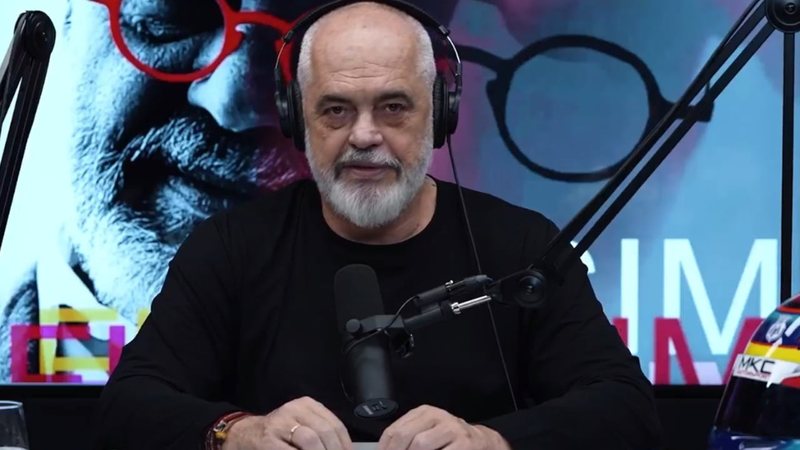
Prime Minister Edi Rama used the twenty-first episode of the sixth season of his weekly podcast, Flasim, to address several policy and governance matters: the historical significance of the May 26 Brussels intergovernmental conference opening the final phase of EU accession negotiations, the accession timeline with chapter closure by end of 2027 and membership by 2030, the National Sustainable Development Roadmap 2030, a new strategic partnership with UN agencies for 2027 to 2031, and the launch of Albanian Digital Solutions as a public company for digital governance. Below is an edited transcript of the weekly address, reconstructed and condensed for clarity from the original recording.
In the week now behind us, precisely on May 26, as if by an irony or smile of fate, thirty years after the May 26 of violence, of the bloodying of the opposition, of the stealing of votes, and of the sealing of an autocratic rule with dictatorial features in Albania, we arrived at the day when Albania entered the new and final phase of its European journey: closing the phase of opening negotiation chapters and opening the phase of closing them.
On May 26, Albania climbed to the highest point ever reached on this arduous historical climb, and now the summit where we will climb together and plant the red and black flag of Ismail Qemali and Gjergj Kastrioti, giving full meaning and full sense to a centuries-long history of dreaming of European union today, but for what until yesterday was the space of the sun that rises from where it sets, is closer than it has ever been.
This is an extraordinarily meaningful moment on the road to membership, and at the same time an absolute certification of tireless work over a long period of time. It is a moment that comes with much satisfaction, but equally with much responsibility, because this is not simply a success on the road of negotiations and this is not a date on the integration calendar, but is a result of the deep transformations our country has made in the last decade, of extremely difficult and challenging reforms, of the confirmation that institutions are now established, and at the same time of the necessity to consolidate the rule of law, to consolidate the space of individual freedoms, and to consolidate what is the essence: equality before the law. It is significant that the European Union confirms the successful fulfilment of all tasks to date precisely in those fields connected to justice, to the fight against corruption, and to the functioning of democratic institutions. And it is as much a reason for pride as it is a reason to feel the full weight of responsibility in this final phase, which is not the easiest but the most difficult, and for which we have an agreed calendar with the European Commission to successfully complete the closure of negotiations by the end of 2027. We have an intermediate window in 2028 and the major objective of Albania’s membership in the European Union within 2030.
Immediately after that marked day in Brussels, when we entered the final phase of the accession negotiations, we sat down and approved several important decisions connected to the Albania we want to build by the end of this decade. An Albania whose work is focused of course on fulfilling the objectives connected to closing the 33 negotiation chapters according to the agreed calendar in order to realise the objective, but at the same time an Albania that in this context, through the National Sustainable Development Roadmap 2030, a document approved immediately after Brussels, sets concrete and measurable objectives for the development of the country in the years ahead. We are in essence realising a plan that orients our institutions toward priorities connected to the economy, education, health, the environment, good governance, and in general the quality of life. We have also approved a strategic partnership with the United Nations agencies for the period 2027 to 2031, for cooperation that will support Albania in several of the most important areas of development, from human capital and economic transformation to green growth, justice always and unquestionably, and in general the strengthening of institutions.
I have brought this moment into these notes because often EU integration, the road of negotiations, the fulfilment of tasks for the relevant chapters, are seen only as a separate process, as a process connected to the interaction between us and the European Commission. But in fact integration is much more than that. It is directly connected not only to our ability to build stronger institutions, to invest in people, to plan long-term development, but also to the necessity of preparing Albania, of establishing within our republic the proper place of standards and of the responsibilities of the state in relation to the citizen and of the citizen in relation to the state, both together in relation to the tomorrow of the homeland.
This week we also presented a new public company, Albanian Digital Solutions, which marks the new phase of the digital transformation of the Albanian state. After building the platforms and then digitalising more than 1,200 public services, which have been delivered for several years now directly from a mobile phone or computer through the e-Albania platform, today we have taken another step to enter a stage where new technological capacities will give us the possibility of transforming deeply the electronic governance of the country. To serve this purpose we are creating a public company that will be a centre of excellence for Albanian technology talents and that will cover the public sphere of needs and innovation in public services, innovation in the governance of the country at both levels, and innovation in service of an extraordinary transformation.
Today we have a significant growth in applications for innovation programmes. More than 1,100 applications have come in the last cycle alone for the Startup Albania grant programme, and all of this tells us that we have gradually gained ground where we started from the very bottom, and today we have a place on the European and global map of innovation as it concerns the public sector. But we need to go much further forward, and we need to go much further forward in the private sector. We need to exploit all the new capacities of technology in governance as well, something we have in fact already begun and will continue with intensity, also thanks to this division of AKSHI into two parts. AKSHI will be the director, regulator, and quality monitor, while Albanian Digital Solutions, ADS, will be in practice the brain that continuously produces the necessary solutions and on the other hand guarantees the maintenance of our systems.