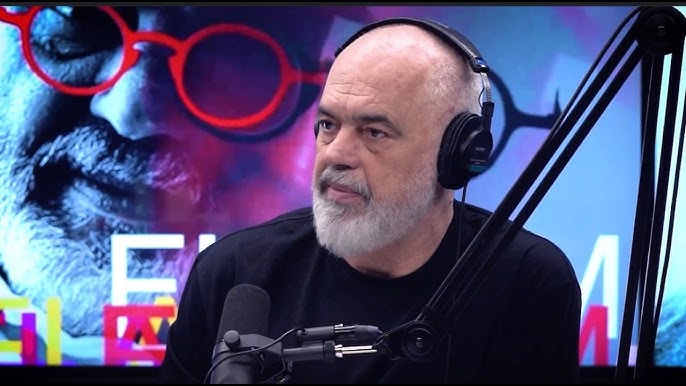
Prime Minister Edi Rama used the thirteenth episode of the sixth season of his weekly podcast, Flasim, to address several policy and governance matters: the disinformation environment surrounding Albania’s EU accession negotiations, the forthcoming Double Your Enterprise SME credit programme, the normative act introducing an automatic fuel excise reduction tied to international price thresholds, the 2026 national farmer support scheme, and a record increase in budget revenues. Below is a full transcript of the weekly address.
We are engaged in a process — an internal campaign within the Socialist Party — to elect those who will lead our organisations throughout the territory of Albania, from the polling centre level to the administrative unit level to the municipality level. This matters for these weekly notes because it is not simply an internal campaign of organisation and energising. It is also a campaign of communication — among ourselves, and between us and all those who support us, who trust us, or who have the need and desire to hear us, and whom we need to hear.
We live in a time when it is becoming increasingly difficult to learn the truth or to receive direct information about a fact that concerns you. The opposite happens. You are immediately overwhelmed by half-truths — which are the greatest lies — by outright fabrications and inventions, by commentary of every kind that, at the end of the day, obscures rather than helps in the search for truth. These things are said from all sides, heard from all sides, but what concerns me most, and concerns us most, is that Albanian affairs are not discussed or debated on their own terms. On the contrary, they are identified solely with a miserable political war and a continuous effort by everyone on the opposing side to ensure that the substance of what is happening in this country is buried under the pitch of their despair and the mud of all their hatred, resentment, and spite.
Albania has problems, of course. We have a great deal of work to do. Not everything we have done has been done as it should or as much as needed — that is beyond dispute. But Albania is working, and Albanian affairs as a whole are on track. Just as I will close this note by saying: the most important historical process of EU membership is on track, with negotiations continuing. The great lie — manufactured by those who aim to obstruct Albania while in reality fighting the government — is that those negotiations have been blocked, halted, or obstructed for reasons that amount to no reason at all. The simple truth is that this great undertaking continues day after day after day, and very soon, just as we have had good news with the opening of chapters, we will have more very good news for everyone.
This week was also a working week for a new programme that the Albanian government will make available shortly to all those interested. The programme is called Double Your Enterprise. It is built on cooperation between the Government of Albania, the Bank of Albania, and the second-tier banks, with the aim of opening a new credit line and putting in place new guarantee instruments for small and medium enterprises that have already established a base — that have a growth vision, that have the ambition and will to grow — but that face precisely the impossibility of supporting that vision and ambition with sufficient capital and access to finance. This is exactly what the government is doing with the Bank of Albania and the second-tier banks. We had a very productive meeting a few days ago during the past week and agreed that within one month, at the beginning of May, we will announce the programme with the ceremonial signing of all necessary agreements, making available to all those who want to grow a guarantee and a financing instrument capable of doubling their enterprise.
This week we also approved the normative act — the one that had been promised — for the reduction of fuel excise at the moment when fuel, as a consequence of the war’s impact on international markets, exceeds the threshold of 220 Albanian lekë per litre, with petrol at 200 lekë per litre. A 20 percent reduction in excise takes effect immediately upon crossing those thresholds. These levels are pre-set to guarantee a fair and balanced intervention in relation to market developments that we do not control, did not cause, and cannot stop — but that we are obligated to manage so as to cushion the immediate impact on consumers, without on the other hand undermining the stability of public finances at a time when international market uncertainty remains both high and equally dynamic. The measure will remain in force until the international situation fully stabilises, while the transparency board that has been activated will remain the guarantor of every development in global markets, reflecting immediately, fairly, and verifiably what must happen in the domestic market. This is a proper, measured, timely response that guarantees rapid decision-making, embodies full responsibility, and will ensure that citizens and drivers are not abused by fuel distributors. Measures against all those who violate the price set by the transparency board on the basis of market rates will be drastic.
This week also saw the approval of the national support scheme for farmers for 2026, which was built on intensive direct consultations in all counties and shaped by the farmers themselves. For this reason the scheme significantly increases support for farmers — not merely in terms of financial volume, but also in terms of easing the conditions for accessing what each farmer is entitled to under it, while simultaneously directing financing toward priority areas that guarantee greater productivity and better strengthening of the value chain. For the first time, forms of support are included that have not been used until now. Another innovation is the promotion of sustainable practices in agriculture through support for biological methods and approximation with European standards. A special focus of the scheme is on young farmers, for whom a considerable fund is foreseen to support their investments. The scheme as a whole strengthens domestic production — since this is a primary goal — increases competitiveness by creating more opportunities and access, and naturally encourages approximation with European standards.
This week was also characterised by another encouraging indicator: the growth of budget revenues at an absolutely historic level. This is an important signal of the stage where the Albanian economy now stands — a meaningful reflection of its strengthening. Contrary to all those who preach increasing corruption and increasing abuse, the economy proves that it grows precisely because corruption decreases and abuses decrease, because these two things do not go together otherwise. The revenues that have reached new levels are precisely the result of far more efficient administration with far less corruption and abuse — a feature of the severe disease inherited from the past, which we have fought and will continue to fight day by day. According to projections, more than one billion euros in additional revenues are expected to be collected in the current period — not from tax increases, because we have not raised taxes, but from economic growth, and from the improved quality of tax and customs administration, the improved quality of oversight regarding transactions at the business level, between business and consumer, and between businesses, and from the growth of fiscal awareness. We are in a position to share this important moment with those who have supported and voted for us and to tell them: your vote counts and is valued every day, at every step, in every sector — and this growth in revenues is a very meaningful example of that.