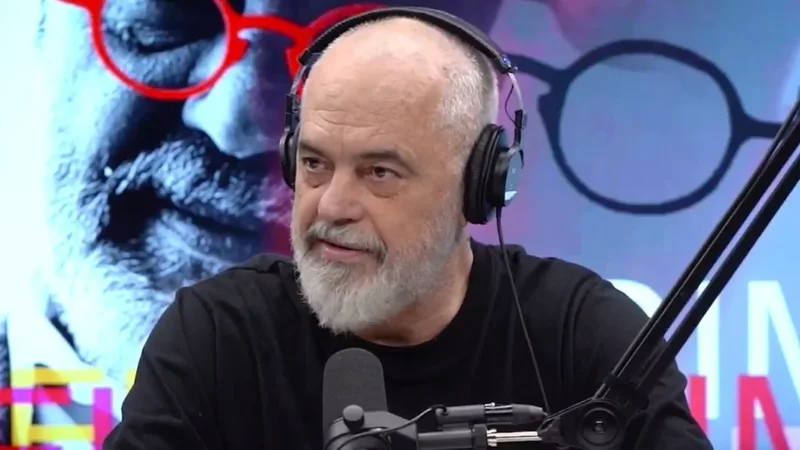
Prime Minister Edi Rama used the eleventh episode of the sixth season of his weekly podcast, Flasim, to address a range of policy matters: the government’s escalating response to rising fuel prices, Albania’s performance in the Freedom House and cybersecurity indices, defence spending and military salaries, and economic growth projections through 2030. The broadcast opened with holiday greetings marking the coincidence of Eid al-Fitr and Nowruz with the arrival of spring.
The episode’s most consequential announcements concerned fuel: a temporary reduction of approximately 20 percent in the fuel excise tax, the activation of the Transparency Board regime for price oversight, and the imminent introduction of a state-backed market actor in the fuel sector. Rama also committed to directing any excess revenue generated by elevated fuel prices toward pensioners.
Below is a full transcript of the PM’s weekly address.
Greetings for Eid al-Fitr and Nowruz
Today, those notes can only begin with greetings for two blessed holidays on this land of religious coexistence that is our Albania. Two celebrations that this year also coincide with the arrival of spring: Eid al-Fitr and Nowruz.
My heartfelt wishes go to all Muslim believers, after a month of prayer, restraint, and reflection. May health, peace, and joy prevail in their homes.
Likewise, warm wishes to all Bektashi believers. May this day, which symbolizes renewal, hope, and new beginnings, be only the first in a long sequence of good days for them and their loved ones.
But above all, I hope that such days lie ahead for Albania itself — and I am confident that they do.
Note 1: Economic Growth
Albania continues on a steady path of economic growth, positioning itself among the top-performing countries in the years ahead. According to projections by international financial institutions, by 2030 the country’s gross domestic product is expected to grow by around 32 percent. This places Albania among the leading economies in terms of both stability and growth — based not on government claims, but on independent international assessments.
This growth is not accidental. It rests on the foundations we laid and strengthened through long-awaited and long-missing reforms — reforms that have finally put the country in a position to move forward with speed.
It is a growth driven by sectors that continue to expand. And perhaps most importantly, what is now tangibly visible in this process is the steady rise in wages — not only in the public sector, but increasingly in the private sector as well, particularly for those with qualifications or professional skills.
This is also a call to Albanians abroad to look with renewed optimism at the possibility of returning home. For many of them, Albania today offers more than the countries where they currently live — not only in terms of employment and income, but also in something more fundamental: the warmth of home.
Note 2: Defence Spending and Military Salaries
When we approved the 2026 budget, we decided to allocate nearly 12 percent more funding to defence than the previous year. This reflects both our commitment to NATO’s funding trajectory and our obligation to ensure a more dignified treatment of our armed forces.
At the end of February, we also implemented a salary increase for military personnel, effective retroactively from January. In the most recent government meeting, we approved full coverage of transportation costs for all active servicemembers. This is a long-awaited and widely welcomed step for those who serve the country in uniform on every front.
Our goal remains clear: competitive salaries and financial treatment that, by the end of this mandate, will reach the average level of NATO countries. In practical terms, this means that the base salary of a soldier in the Republic of Albania is projected to increase by up to 70 percent.
Note 3: Freedom House and Cybersecurity Rankings
Albania also received a positive assessment in the well-known Freedom House report, Freedom in the World 2026. This is worth noting, even though I approach all reports — except those of the European Commission, which I take as fully authoritative — with a degree of caution, given that their methodologies are not always consistent.
Nevertheless, this is one of the reports that commands attention and broad respect. According to it, Albania has not only improved compared to previous years but is now ranked as the most free country in the region. It stands ahead of Montenegro, North Macedonia, Kosovo, and Serbia — reflecting measurable progress both regionally and domestically, particularly in political rights, institutional performance, anti-corruption efforts, and the transformation of the justice system.
What makes this result even more meaningful is that it comes at a time when, globally, freedom and democracy are under pressure and in decline in many parts of the world.
Even though I am not an enthusiast of such reports, as I said earlier, today’s notes include not one but two. And the second carries particular weight in the current moment: the cybersecurity index.
This is especially important for us, as we remain the target of an adversary that attacked us relentlessly a few years ago — catching us not fully prepared, but ultimately failing to inflict the damage it intended. That same adversary continues to target us daily, but now without success, or at most causing minor disruptions — such as the recent, insignificant data exposure related to the Albanian Parliament, whose systems are not yet fully integrated into our national defence architecture.
According to this international index, Albania ranks within the top ten globally. This places us in a highly selective group of high-performing countries in the field. And in this case, the ranking fully corresponds with the real-world testing of our systems.
We have built a cybersecurity defence system of genuinely high standard. We have strengthened the institutions responsible for cyber protection, continuously improved response capabilities, and deepened cooperation with the right international partners. As a result, we have implemented an innovative and effective system that has placed Albania in the upper tier of global rankings.
Note 4: Fuel Prices and State Intervention
I leave this final note not because it is less important, but precisely because it coincides with an exceptionally complex global moment — one that has directly affected fuel supply chains and is now aggressively reflected in rising oil prices.
We have addressed this in recent days. It is an issue that requires constant attention — and it has ours, hour by hour. As we have stated, concrete steps have already been taken.
A task force has been established within the Ministry of Economy and Finance to strengthen oversight and identify any potential market abuse. So far, no abuses have been detected, but monitoring continues. Given the latest spike in prices, we have decided to activate the Transparency Board regime, ensuring that no opportunistic actors can exploit the crisis for excess profit.
At the same time, we have adopted a temporary measure — similar to those taken by other countries — to reduce the fuel excise tax by approximately 20 percent, in order to ease the burden on vehicle users.
But I want to be absolutely clear: our primary concern is to protect pensioners. This means that any additional revenue generated by higher fuel prices — even after the tax reduction — will be directed exclusively toward supporting them.
Meanwhile, we are moving forward on two parallel tracks. On one side, the draft law on strategic reserves is currently under public consultation — a process that began even before this latest crisis, which is tied to the broader disruption of global equilibrium.
On the other side, we are preparing to introduce a new public market actor — a state-backed force that, together with a broader set of measures, will intervene meaningfully to restore balance in fuel pricing, raise transparency across the sector, and address persistent issues such as evasion and fuel smuggling through the transit regime.
Those practices are coming to an end.
We will act — and in the not-too-distant future, we are confident we will demonstrate, with concrete results, that this intervention serves the public interest: the interests of consumers, of fuel users, and above all, of those who do not pollute and should not bear the cost imposed by those who do.