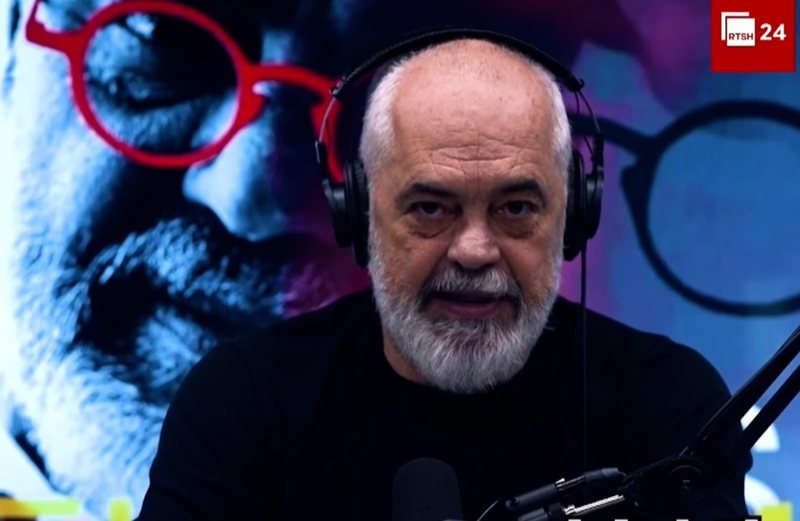
Prime Minister Edi Rama used the nineteenth episode of the sixth season of his weekly podcast, Flasim, to address several policy and governance matters: visits to Germany and Estonia connected to Albania’s European future and euroatlantic security, Albania’s formal accession to the NATO Cooperative Cyber Defence Centre of Excellence, bilateral cooperation with Estonia in technology and digitalisation, public procurement data showing Albania leading the Western Balkans region, the signing of the SME credit programme, and a cross-party parliamentary resolution on EU membership. Below is an edited transcript of the weekly address, reconstructed and condensed for clarity from the original recording.
This week I began with a visit to Germany and then to Estonia. Two stops directly connected to Albania’s European future, to euroatlantic security, and to the moment Albania is itself passing through on its path of accession negotiations with the European Union.
In Aachen, I had the pleasure and the honour of being once again part of the group of distinguished guests at the prestigious ceremony of the Charlemagne Prize, one of the most important European recognitions for contributors to the Union and to the future of Europe, where the great European Mario Draghi was awarded the Charlemagne Prize 2026. And then in Tallinn I was invited to the important Lennart Meri Conference, one of the prestigious international forums on security, diplomacy, and transatlantic relations.
A moment of particular importance was Albania’s formal accession to the NATO Cooperative Cyber Defence Centre of Excellence, one of the alliance’s newer and most advanced structures in cyber defence, and a strategic step for Albania itself as a contributor to the alliance’s cyber security, which is now placed at a different level of cooperation within the alliance in a field that today represents one of the most critical frontiers of our security and of global security as a whole.
At the same time, relations between Albania and Estonia are entering a new phase of cooperation, particularly in technology, digitalisation, artificial intelligence, and innovation broadly, where Estonia has been a pioneer and where Albania today is regarded with respect. I was genuinely pleased, since our Estonian friends were very well informed about Albania’s technological and digital developments, and on the other hand very interested themselves in strengthening communication, cooperation, and interaction between our two countries.
This week we shared several meaningful data points on Albania’s extraordinary progress in the field of public procurement, one of the most important chapters of the EU membership process, and a chapter where, unlike the entirely distorted picture of reality offered by the channels and portals here, Albania is seen as positively transformed and assessed with meaningful progress. Today, on the basis of European evaluation, Albania is first in the region and at a distance from other countries in the region across all public procurement indicators, while on several key indicators Albania stands above the average of European Union member states. For example, while the average rate of single-bidder procedures in EU countries exceeds 32 percent, in Albania that figure is 23.5 percent, and in public works procurement it falls to 12 percent.
Other data speak directly to the fact that the fight against corruption is not simply and only the fight on the front that we made possible, and that thanks to our will was opened on the side of justice, but is also the daily systematic fight on the side of modernising the state and building systems that make the presence of corruption ever less possible. These are results that show how, on the one hand, our citizens have for years now been served with a single click through the digital services system, where 95 percent of the services they require from the state are available on the Albania platform: no more queues, no more bribes to jump the queue and so on, but a direct relationship with the state. While on the other hand there is precisely the entire public procurement system. I am therefore proud today that Albania is cited as a positive example by those who judge us objectively, unlike what happens in the distorted mirrors of the self-appointed, subjective, partisan, and half-blind or entirely blind popular judges.
This week we also signed the very important state and banking system partnership for the support of Albanian enterprise. A step that was announced in advance, but which is a step in the right direction with extraordinary potential for the further growth of Albanian entrepreneurship, between the government, the banking system, and the credit line of the Bank of Albania for the national programme of financing small and medium enterprises. It is an open door, a programme that gives small and medium enterprises far greater opportunities to grow through low-interest loans and the government’s sovereign guarantee on their credit. A programme born from the now ever louder need of small Albanian enterprise to grow on the foundations laid with much work, much effort, much toil, and in many cases with the experience gained in emigration: people with ideas, people with energy and will, who need the state at their side and the government at their side to expand their activity, because to reinvest requires financing that they do not have, but who on the other hand hold in their hands a foothold capable of turning that credited financing into genuine commercial success entirely justifiable against the supporting loan. And so through this programme we believe strongly that by making available a credit line with interest rates of between two and three percent and a sovereign guarantee of between thirty and seventy percent based on risk, we will open very concrete and significant opportunities for thousands of Albanian enterprises.
The final note concerns something welcome in the Albanian parliament, where, unexpectedly but, I repeat, positively, the opposition forces in the Albanian parliament joined the governing majority for a resolution linked to EU membership. I am genuinely pleased that something of this kind happened. It would be good for it to happen continuously when we speak of EU membership, but even once is still once with its own value. And I am likewise pleased that, as far as I can understand, they have grasped that the process is unstoppable, that the much-talked-about blockage does not exist, that very soon the new and good news will come, as all previous good news on the opening of chapters has come before it, of the transition to the next phase of the process, and the path will open for beginning the closing of negotiation chapters. And so the joining, however unexpected and however hurried, onto the boat of European Albania, where we have been for a long time and where there is always a place for everyone, is entirely welcome.