Albania’s justice reform, measured at last by the citizens it was built for
by Aurel Cara (Tirana)
For the first time since the vetting began, the Albanian public has been asked what it makes of the justice reform, and the answer is no longer the one the reform’s critics have grown accustomed to citing. Public trust in the courts has doubled in five years, from 26 percent to 53 percent. Institutional independence, the dimension Albanians rate as having improved the most, has risen by thirty points. Citizens who view the reform positively now stand at 56 percent, against 17 percent who view it negatively, a near-inversion of the 2020 ratio when 38 percent took the negative view.
The figures, released in Tirana on Monday by the Ministry of Justice in coordination with the World Bank and the European Commission, come from the 2025 Regional Justice Survey conducted under the EU4RuleOfLaw programme. The reform has been judged on results. It has, on the metric that matters most, passed.
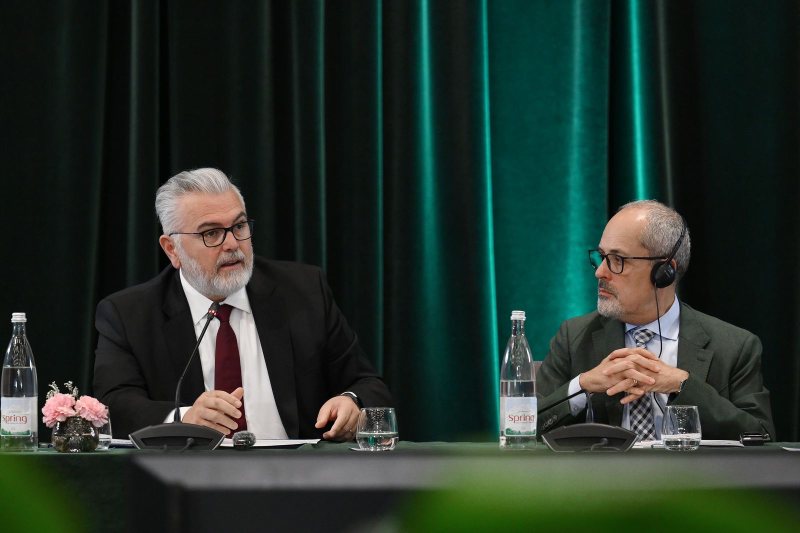
It has not been absolved. Seventy-two percent of citizens still consider the system financially out of reach, a figure openly cited by Justice Minister Toni Gogu at the launch ceremony. “This gap does not shame us, it orients us. Justice that costs too much is not justice for all,” Gogu said. The honesty of that admission is itself a marker of how the reform’s political grammar has shifted. Albanian ministers a decade ago did not, as a rule, stand alongside the EU Ambassador and concede their own headline failures.
The 2025 Regional Justice Survey is the second instalment in a methodology launched in 2020 under the EU4RuleOfLaw programme, financed by the European Union and executed by the World Bank across all six Western Balkan jurisdictions. It is one of the few instruments by which Brussels independently calibrates the credibility of the rule of law chapter in accession negotiations, alongside the European Commission’s annual Country Report, the Council of Europe’s GRECO findings, and the World Justice Project Rule of Law Index.
This is the first citizen-derived dataset on Albanian justice that does not pass through the Albanian government’s communications apparatus. That single methodological fact is what gives the numbers the weight they carry in COELA. The Ministry of Justice can claim credit for them. It cannot author them. The corruption-perception dimension, historically Albania’s hardest, registers what the Ministry has presented as the period’s principal achievement, and it tracks closely with the 2025 European Commission Rule of Law Report, which found that SPAK had consolidated its results in the investigation and prosecution of high-level corruption and enjoyed a high level of public trust. The Regional Justice Survey is the citizen-facing mirror of that institutional finding.
EU Ambassador Silvio Gonzato, speaking at the launch, framed the moment in the language of a country whose institutions have started to function. The real challenges of the reform, he said, now lie in implementation, in proactive response, and in continuous improvement. The grammar has moved from build-the-system to make-the-system-perform.
The temptation, in any government-friendly reading, is to attribute the numbers to communications. They are not a communications phenomenon. They are the lagging indicator of a structural reform that took its hardest decisions years ago and is only now being judged on results. Three mechanisms account for the shift.
The first is the vetting. Between 2018 and the close of the Independent Qualification Commission’s mandate at the end of 2024, the KPK evaluated 805 magistrates and dismissed 268, while around 100 resigned preemptively, anticipating that they would fail to meet the criteria. The reform replaced, in effect, the better part of a generation of Albanian judges and prosecutors. The first phase of re-evaluation ended with some sixty percent of Albanian judges failing the asset verification process, leading to the dismissal or preemptive resignation of 207 judges out of 400 vetted, while only 165 were confirmed in office. That is not a process any electorate forgets, and it is the reason the trust figure could plausibly double rather than merely improve.
The second is SPAK. The Special Structure Against Corruption and Organised Crime has spent the last three years doing what Albanian prosecution had never previously been seen to do. In 2025, SPAK investigated 871 criminal proceedings, with a 13.5 percent increase in the number of individuals involved and total assets seized and confiscated reaching around 45 million euros. In high-level corruption cases, more than half of those investigated were sent to court, with ten final convictions. A serving Mayor of Tirana in pre-trial detention; a Deputy Prime Minister suspended from office; two former heads of state under investigation. Whatever any citizen makes of any individual case, the cumulative effect on the perception of impunity is measurable, and the survey measures it.
The third is the legal architecture itself. A new Cross-Sector Justice Strategy for 2024 to 2030 has been adopted. Sufficient budget has been allocated to a modern integrated electronic case-management system. The Anti-Corruption Strategy 2024 to 2030, the partial judicial map implementation, the digitisation pipeline now targeted by the Ministry for completion in December 2027, and the agreement on harmonisation and standardisation of judicial statistics signed in April 2026 between the Ministry of Justice, the High Judicial Council, the High Prosecutorial Council, the General Prosecution Office, the High Justice Inspector, and the School of Magistrates form the unglamorous machinery on which the headline numbers depend. They are the reason the gains are likely to compound rather than reverse.
It would be a disservice to Albanian readers to leave the analysis at the trust gain. The reform has three exposed surfaces, and they sit in a hierarchy.
The structural ceiling on every other gain is affordability. The 72 percent figure is not a presentation detail. A justice system citizens trust but cannot enter produces the appearance of legitimacy without delivering it. The Ministry’s response, expansion of free legal aid, is correct in direction; the question is scale, and the figure is not yet matched by the budget.
The most likely point of failure in the next twenty-four months is capacity. The vetting cleared the bench. It did not refill it. The new judicial map proposes a final picture of 325 judges, eighty fewer than before the process began, while Council of Europe demographic benchmarks suggest a minimum of 450. In 2025, the School of Magistrates accepted only ten new candidates, far below its capacity. The 35 new assistant-magistrate quotas and 100 administrative-staff positions announced this week are necessary, and they are not yet sufficient. Backlog reduction is the point at which the trust curve could flatten.
The chronic structural fragility is referrals. SPAK does its work in significant part because state institutions refer cases to it. They mostly do not. By SPAK’s own count, the state police are the only institution that have made consistent referrals, reporting 293 cases between 2020 and 2024. Until the rest of the public administration changes posture, the prosecution function will continue to depend disproportionately on a single specialised body, which is an institutional fragility rather than a strength.
The 2025 Regional Justice Survey is not the end of the Albanian justice reform. It is the first independent confirmation that the reform’s central wager, that institutional cleansing painful enough to break a generation of careers would over time produce measurable citizen-level returns, was empirically sound.
The trust gain is permanent in proportion to the vetting being permanent. The 72 percent affordability gap is the reform’s next frontier; every additional point of trust earned above 53 will require a corresponding move on access. And for the first time in this accession cycle, Brussels is holding a piece of citizen-derived evidence on Albanian justice that the Albanian government did not author. That changes the conversation in the room.
The numbers do not mean Albania has arrived. They mean Albania has, by the testimony of its own citizens to an instrument neither side controls, moved measurably forward on the question the entire reform was designed to answer. For a country whose justice system spent the better part of three decades being the source of its own democratic doubts, that is the precondition for everything else.