Prime Minister Edi Rama used the twentieth episode of the sixth season of his weekly podcast, Flasim, to address several policy and governance matters: visits to South Korea and Japan and the growth of Albania’s international standing, the May 26 intergovernmental conference in Brussels marking the opening of the final phase of EU accession negotiations, the opposition’s campaign to obstruct and discredit Albania’s European path, and a new disbursement of 49 million euros under the EU Growth Plan for the Western Balkans. Below is an edited transcript of the weekly address, reconstructed and condensed for clarity from the original recording.
Good evening there. Good morning.
Greetings from Tokyo, from where, just before departing for Albania, I am recording these notes after a week of significance for Albania, for the way our country grows in international relations: not in scale, but in the degree of respect and appreciation for the dignity with which we stand in the community of states.
First in South Korea and then in Japan were two stations where we found a heightened interest in Albania, a legible desire for cooperation and for the strengthening of the natural friendships between democratic countries.
At the Asian Leadership Conference I had the opportunity to speak as a guest of honour before a broad representation of the economic community of this developed part of the world. I spoke about Albania’s great transformation from isolation toward union with Europe. And then, in the meeting with Prime Minister Kim Moon-soo, we dwelt on the possibilities for expanding cooperation in artificial intelligence, digital technology, the defence industry, and tourism, noting also the symbolism of the meeting, which coincides with the 35th anniversary of the establishment of diplomatic relations between our two countries. There we also met a series of large, prestigious companies, where we found genuine interest in Albania as an example of success and as a destination for possible investment.
Then here in Tokyo the visit confirmed the growth in the level of relations between Albania and Japan. It was truly a special honour to be received with full state ceremony by Prime Minister Sanae Takaichi, with whom we immediately established a direct and friendly communication. We discussed the expansion of cooperation in the economy, in technology, in energy, defence, and here too tourism. As the Prime Minister subsequently noted in her public statement, Japan’s support for Albania’s EU membership was not simply a formal message, but an expression of Japan’s respect for our success on the path of the historic transformation of the Albanian state into a vibrant, democratic, and continuously and sustainably developing state. It was a pleasure and an honour in itself to be invited to speak at the United Nations University in Tokyo, where I shared with students, diplomats, and academics the history of Albania’s transformation, the phase the negotiation process with the European Union is in today, and our perspectives on the future of the shared Europe. Also full of positive energy were the meetings with the parliamentary structures, the Speaker of the Japanese parliament, members of the League of Friends of Albania, and with the Japanese business community. But I believe what matters above all is the fact that today Albania has entered entirely naturally into the spaces of dialogue and partnership where, not many years ago, it would have been truly difficult even to imagine the respect the world now has for our country.
But as was already known, the note of notes is the one connected to the deliberations in Brussels between the European Commission and the member states over the report on the tasks completed by Albania following the opening of all negotiation chapters.
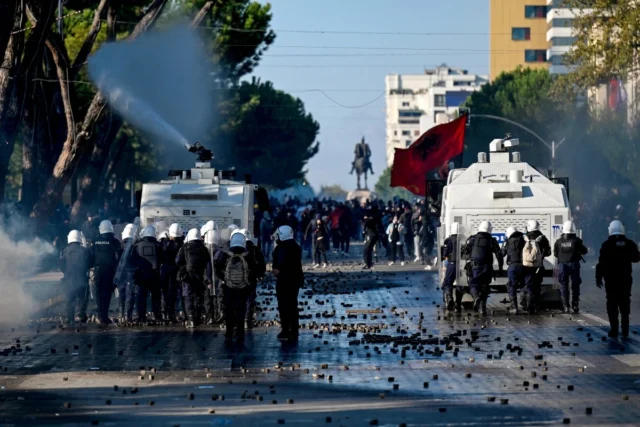
Those deliberations took their own time, during which the Molotov throwers of Tirana were unleashed in desperation in an offensive of unmatched negative energy, unleashed onto the streets to destroy Albania’s image in the eyes of the world at any cost, celebrating like children when photographs of burning bins or of Molotov incendiary devices thrown across Tirana circulated in the world’s media. Gather petrol and throw handmade bombs with paid vandals. They were unleashed across Albania’s channels and portals to poison Albanians: gather and throw political hatred, mirror by mirror. They were unleashed across Europe to spread the proverbial mud and filth, including what happened with the so-called three-day visit to the Foreign Ministry in Berlin, to smear Albania in the eyes of our partners wherever possible: gather and throw yourself up and down demanding punishment, blockage, isolation for Albania, leaving a trail of disgrace unlike any other opposition in the history of the European integrations of countries that today are part of the European Union or aspire to join it.
They said the European road was blocked. They said Albania had finally been punished. They said our government was completely isolated. They were wrong, they were wrong, as always, from that shallow and backwards thinking of theirs, and in the end, in the end they lost with shame, and Albania won again with effort, with dignity, and with pride.
And so, on May 26 in Brussels, the Albania-European Union intergovernmental conference sealed the successful conclusion of the introductory phase and opened the final phase of the accession negotiations for Albania’s membership in the European Union. We have climbed another difficult height toward the summit, which we will reach by all means within this decade, and where we will plant the flag of Skanderbeg and Ismail Qemali there in the courtyard of the great house of united Europe.
Further financial support from the European Union has arrived from Brussels: alongside the decision to open the final phase of negotiations, a new fund has simultaneously been disbursed for Albania under the Growth Plan for the Western Balkans. Forty-nine million euros, which bring the total support to 212 million euros, the highest figure obtained by any country in the region from the Growth Plan. The Growth Plan is a results-based financing plan, and these are results certified by the European Commission, unimpeachable in their objectivity, because unlike what is proclaimed day and night by those who always end up losing, our Albania, the European Albania we are building, is a success story: a story not written with screams, not made with slander or with Molotov devices, but with vision, with work, with great patience, and with commitment step by step, reform after reform. And so, congratulations to everyone, and above all thank you. Thank you to every Albanian, man and woman, who believes, who supports, and who walks with us in this historic mission. Strength, strength. Nothing can stop European Albania.