By Ylli Manjani, former Minister of Justice of Albania
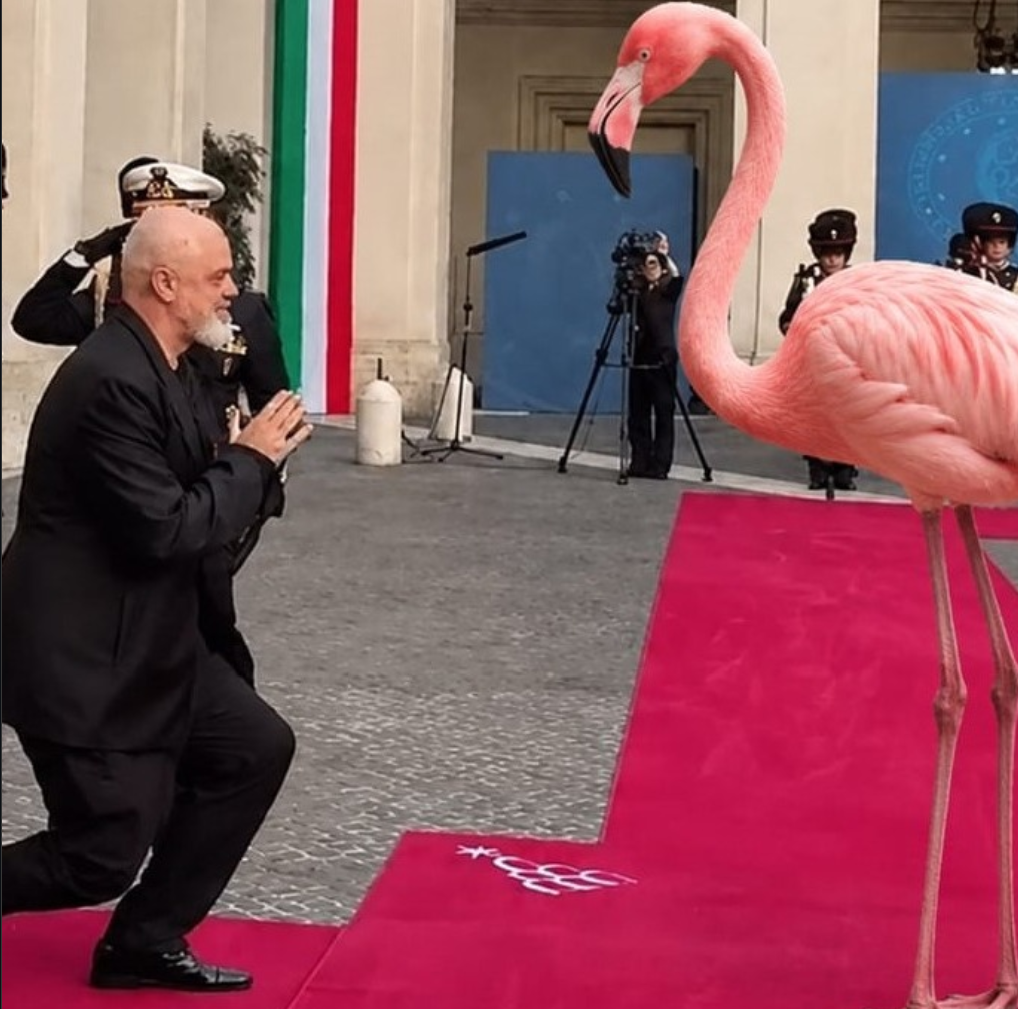
The protest wave that its authors have christened the “Flamingo” revolution has bruised Albania’s prime minister. It has not produced the one thing that could remove him.
As things stand today, even after the noisy eruption of what can be called, without hesitation, the Flamingo revolution, Edi Rama looks politically destined to remain prime minister at least until September 2029.
This may sound unpleasant to his opponents. It may seem unjust to those who have poured energy, anger and hope into bringing him down. But politics does not run on wishes. It runs on the balance of forces.
And today there is no real political threat to Edi Rama.
Yes, the revolution of algorithms, of social networks, of viral videos, of organised indignation and of digital crowds may have wounded him at the ballot box. It may have worn him down. It may have damaged his image. But these are wounds Rama has lived with for years.
Look at his political history and you find a man who has survived far heavier injuries than these. He has come through political crises, mass protests, boycotts, scandals, accusations and entire campaigns built to destroy him. It is therefore difficult to believe that a storm of algorithms, however aggressive, can topple him where far more concrete confrontations have failed.
The central problem does not lie in Rama’s strength. It lies in the weakness of the alternative.
His opponents, a camp in which, despite my own incompatibility with revolutions, I include myself, refuse to grasp an elementary rule of politics. Power is not brought down merely by demonising the man who governs. Power falls when a more convincing alternative is built in its place.
Very well. Let us remove Rama.
Who stands across from him?
The question remains unanswered.
In its place we are offered abstractions. The people will speak. The revolution is coming. The system is falling. These are formulas that sound impressive on social networks and have never once produced a government. The people do not govern as an abstract concept. A revolution does not administer a budget, does not negotiate an international agreement and does not take an executive decision.
In the end, politics always reduces to a very earthly question. Who is the person seeking to take the wheel?
And it is precisely there that the opposition, the digital revolutionaries and every adversary of Rama collide with the wall of reality.
Because Edi Rama does not retreat from noise. He does not retreat from insults. He does not retreat from the trends of the social networks. He does not retreat even from the algorithms, deceptive though they may be.
Rama withdraws only when someone stronger stands before him. Someone stronger in politics, more convincing in public, more charismatic at the ballot box. A figure capable of producing hope where today there is only anger.
This has always been the way power changes hands in a democracy.
The question, then, is not whether Rama has been wounded. By every appearance he has. Nor is it whether there is discontent. That exists, and it is plain to see.
The only question that carries any weight is this. Who is the one who will replace him?
Until a serious answer to that question appears, Edi Rama will go on reigning. Perhaps more worn. Perhaps more tired. Perhaps more wounded. But on the political throne all the same, at least until September 2029.