Jorida Tabaku speaks fluently to Europe and forcefully against the government. The one subject on which she stays quiet is her own party. At Zvërnec, that silence stopped being invisible.
By Ardit Rada (Tirana)
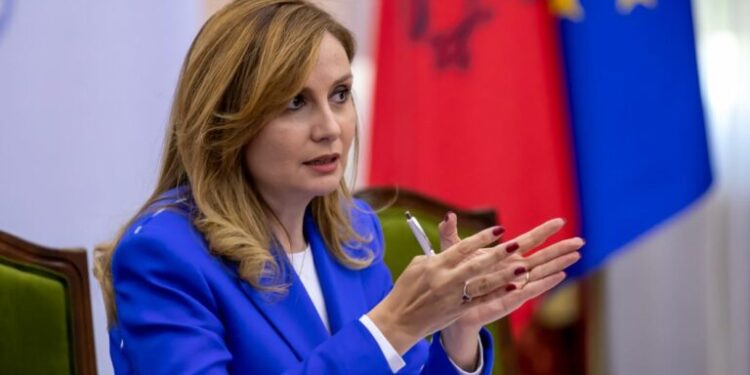
When the protests over Zvërnec turned, as they have, against not only the government but the way the opposition itself is led, and against Sali Berisha by name, the Democratic Party’s deputy chair offered the public a reading. Jorida Tabaku said the protesters’ demands mirrored those of the European Union. It was a characteristic move, and a revealing one. A crowd was assigning blame inside her own party, and she answered in the vocabulary of the accession file.
Tabaku is not a marginal figure and not, by any ordinary measure, a silent one. She is deputy chair of the Democratic Party and chair of the parliamentary Committee on European Affairs, an economist with a doctorate, educated at the University of Tirana and at Durham, who lectured before she legislated. She is the party’s most fluent interlocutor with Brussels and Strasbourg. In October 2024, before the EU-Albania parliamentary committee, she called Albania a captured state and itemized the case: the figures on corruption, the share of national output that is dirty money, the airport, the port, the theater. When she wishes to be heard, she is heard, in two languages, by the audiences that matter to her.
So the question is not whether Tabaku takes positions. It is which positions she declines to take. The pattern is consistent and it runs in one direction. Outward, toward the government and toward Europe, she is voluble and exact. Inward, toward her own party, she goes quiet. When Berisha and Lulzim Basha fought the most destructive battle an Albanian party has seen since 1992, she did not adjudicate it. When the United States designated Berisha and his family non grata in 2021, when the United Kingdom designated him in 2022, when SPAK later indicted him for corruption, she offered no verdict on the man who leads the party whose European face she has become. The captured state carries a long indictment in her speeches. The captured party carries none.
This is what produces the persistent impression of a member who seems to sit for a northern European constituency rather than for Tirana. The posture has a real function. It allows her to prosecute the government’s shortcomings against the accession criteria without ever having to weigh, in the same breath, the sanctioned and indicted leadership of her own side. The standard she applies to the state stops at the party’s door.
For readers in Brussels and Washington the convenience is mutual, and that is the part worth noticing. Europe keeps a working relationship with Tabaku precisely because she speaks its language, and that relationship floats above the question of who actually commands the Democratic Party. Her register lets her interlocutors avoid the question as cleanly as she does. The party’s European credibility and the party’s domestic leadership are carried by different people, and neither is required to reconcile with the other. A delegation can be received in Strasbourg without anyone at the table having to say aloud that the chair the visitor represents answers, at home, to a leader two Western governments will not admit.
Zvërnec is where the arrangement shows its seams, because the anger there is intramural. It is not the government alone in the protesters’ sights; it is the opposition’s own conduct and its own leader. A reflex that maps every grievance onto the EU’s criteria has nothing to say when the grievance is about the EU’s own preferred interlocutors. Mapped onto Brussels, the protest dissolves. Lived in Tirana, it does not.
None of this is timidity, and the domestic critics who call it that miss the structure. It is a division of labor, held with discipline across years, in which one figure carries the party’s argument to Europe and is thereby excused from carrying any argument about the party itself. At home it reads as evasion. Abroad it reads as competence. Both readings leave the same question unasked.
As for the mandate she points to, the vote she treats as license to stand above the contest, it is worth remembering how fast such totals lose their meaning in Albanian politics once a party decides to realign. The standing she banks on is the most perishable capital there is. The list of yesterday’s most voted is long, and no one consults it.