In a joint appearance with the EU Ambassador, the Prime Minister described food safety as the hardest chapter of accession and confirmed that Tirana is negotiating a possible post-membership extension, with five years raised as the working figure.
The Newsroom
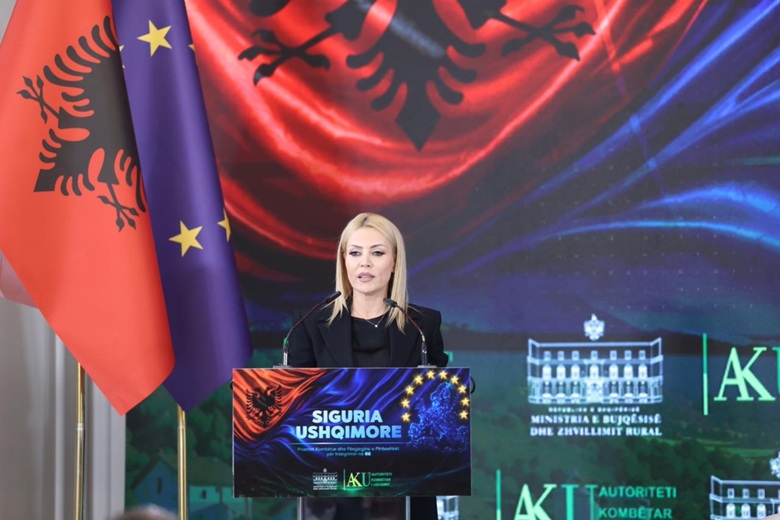
The room in Tirana on Tuesday was not staged for reassurance. Prime Minister Edi Rama, seated alongside EU Ambassador Silvio Gonzato, Chief Negotiator Majlinda Dhuka, and National Food Authority (AKU) Director Blerina Gjylameti, described Chapter 12 of Albania’s EU accession file, covering food safety, veterinary, and phytosanitary policy, as the most difficult and complex challenge the country will face on its way to membership. He then said, plainly, that no Albanian slaughterhouse currently operates the full EU-compliant process for animal by-product separation and treatment, and that the dairy sector in its present form would not survive EU market requirements. He named a defined group of operators to be brought into line: nine hundred establishments, to be scanned across every region of the country.
The message was consistent across the four speakers. Rama told the assembled operators that what awaits the sector is, in his phrase, a knife with two edges: a horizon of new possibilities for those who prepare, and an abyss of bankruptcy for those who do not. He said tomorrow will be fatal for any operator who has not yet understood that they are not in line with the standard. He located the government’s own concern with unusual candor. It was not, he said, the time available, nor the capacity of those who have already invested across the nine hundred sites. It was what he called “neglizhenca alla shqiptarçe,” Albanian-style negligence, the attitude of “we still have time,” of “we’ll find a way to slip the ball past the EU’s legs.”
The slaughterhouse sector drew the most operational detail. Albania has moved past the period when, in Rama’s words, livestock were slaughtered on sidewalks near the Kamza bend with blood running in the street. The current sector is materially better. But the EU compliance threshold, he said, is not “better.” It is the mandatory separation of animal by-products not intended for human consumption, categorized according to EU classification, and processed under EU procedure to eliminate any risk of contamination. That process, he said, is presently absent even from slaughterhouses that are otherwise well equipped and well operated. The legal instrument to close the gap, a law on animal by-products not intended for consumption, is being drafted jointly with the European Commission.
The market consequence Rama named was sharper than the usual export framing. The question, he said, is no longer whether an Albanian slaughterhouse can sell into Italy. It is whether it can continue to sell inside Albania once accession binds the domestic market to EU rules.
On dairy, Gonzato was the voice that gave the assessment its external authority. The EU audit, he said, had flagged the low quality of raw milk as a central finding, and improvement of that quality is a precondition for access to the EU market. Rama concurred and extended the point. The problem, he said, is the entire chain, not any single link. He has seen Albanian dairy operations equipped with machinery of the latest generation and certified in specific dimensions, but operating inside a chain that remains incomplete. The remediation, he indicated, will not be cosmetic.
Gonzato framed the broader accession moment in terms the domestic political debate has been reluctant to accept. Progress in Chapter 12, he said, is no longer measured by the adoption of legislation or the stated intent to adopt it. It is measured by functioning systems: accredited laboratories, a working categorization of food business operators, and the concrete upgrading of establishments into compliance. Albania has made meaningful progress, he added, but the six closing benchmarks for Chapter 12 are clear, and meeting them will require sustained political commitment and strong institutional leadership. He disclosed a €12.5 million EU support envelope channelled through the bloc’s food safety project in Albania.
Dhuka, the chief negotiator, set out the mechanics. The national programme for upgrading agricultural establishments begins with a full scan of all nine hundred sites across the country’s regions, focused on meat, fish, eggs, dairy, and their by-products, covering storage, transport, processing, and marketing inside and outside the country. AKU, she said, is already conducting the scan. The intent is diagnostic first, enforcement later. Rama reinforced the point. Inspections under the new regime, he said, will operate as a national mission of assistance rather than a punitive exercise, with inspectors leaving instructions and returning to verify implementation, and the old practice of surprise inspections initiated at the inspector’s own discretion brought to an end.
Gjylameti, speaking for AKU, delivered the non-negotiable line. No product that endangers citizens’ health, she said, will be part of the market. Four new laboratories are planned; the border crossing points, identified by Rama as one of the system’s weak links, will receive infrastructure investment, laboratory accreditation, and digital integration.
The principal accession news to emerge from the session was Rama’s confirmation that Albania and the European Commission are negotiating an extension of the deadline by which full food safety compliance must be achieved, pushing it past the moment of accession itself. The working figure, he indicated, is “five years plus.” Even that, he added, is a short horizon for what the sector has to complete.
The significance of the meeting lies less in any single announcement than in the register. A prime minister, a European Commission Ambassador, a chief negotiator, and the head of the food safety agency, speaking from the same table, described accession not as a political achievement but as an operational reform of nine hundred establishments, an incomplete dairy chain, and a slaughterhouse sector still missing the process EU law will require. They did so without euphemism, without deferral, and without the ceremonial rhetoric that has historically attached to the accession file in Tirana.
This is how Albania joins the European Union: not through declarations of alignment, but through the certification and remediation of every establishment in the food chain, with the clock running past membership itself and the only stated enemy the temptation to assume, once more, that the rules will bend.