A protester dragged across a cordoned beach forced the prime minister into his first full account of the Vlora resort. He gave it at length, and on his own terms.
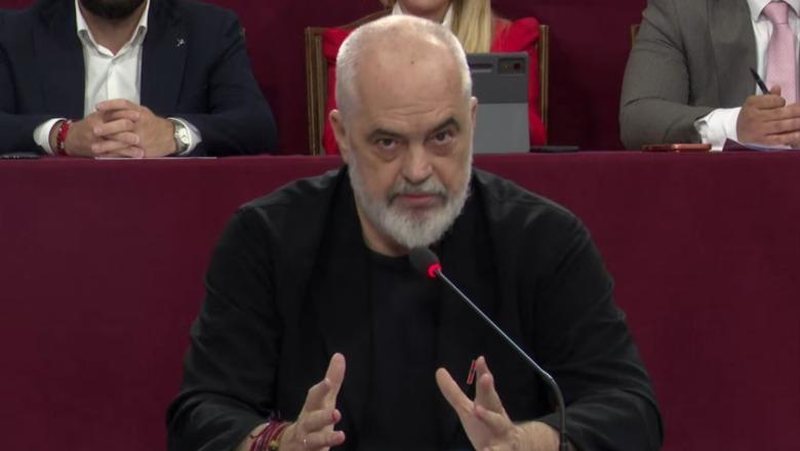
Edi Rama spoke about Zvërnec for the first time on Monday, and he did not speak briefly. Across more than an hour before the Socialist parliamentary group, the prime minister moved from contrition to defiance and back, distancing himself from the violence that put a protester on the ground on Saturday while refusing to surrender a single point on the resort that provoked it. He called the assault on the demonstrator disgusting. He called the project a four billion euro chance that Albania cannot afford to lose. He suggested, more than once, that he had thought about walking away from power altogether, and then made clear he had no intention of doing so.
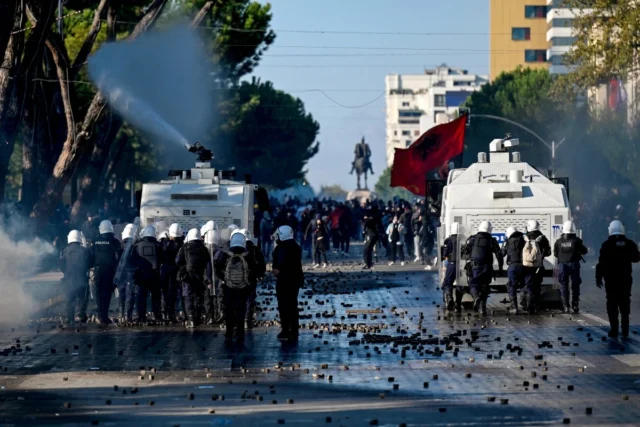
The occasion was forced on him. On Saturday, 30 May, residents of the village of Zvërnec gathered at a place called Portonovë, near Vlora, to oppose construction work tied to a planned luxury tourism development. The rally turned violent. Footage that spread within hours showed a private security guard striking and dragging a protester across a fenced off stretch of beach. Albanian police later said the demonstrator, identified by his initials as E.S., suffered bodily injuries while being moved by employees of the private security company, and that he had entered the cordoned site. The village head, Kostak Konomi, gave reporters a far graver account, describing the man as struck in the neck, losing consciousness, and coughing up blood at the hospital.
By Sunday the state had moved. The General Directorate of State Police set up a special investigative team, placed the entire command chain of the Vlora Regional Police Directorate under disciplinary proceedings, and acknowledged that the early account from local officers had not matched what central authorities later established. A guard from the firm Major Security was arrested on suspicion of unlawful deprivation of liberty and intentional minor injury; two further individuals tied to the security detail were placed under investigation, and the company’s license was withdrawn. Criminal proceedings were also opened against fifteen protesters accused of trying to tear down the site’s fence. The People’s Advocate opened its own inquiry, with representatives remaining at the Vlora commissariat into Saturday night to verify the condition of those detained. Interior Minister Besfort Lamallari said plainly that private property guards have no right to use force against anyone.
That was the ground Rama stepped onto on Monday morning. He opened by addressing the people who had turned against him.
“I want to begin with a direct message to all those who are outraged and have lined up even against me personally after seeing the disgusting act against one of the protesters in Zvërnec,” he said. “I have heard and read you, I understand you very well, I assure you that in your place I too would be outraged and would line up against the government and the prime minister.”
He went further, describing what he said should have happened on the beach. He said it would have seemed terrible to him that private guards, in full view of his own state police, behind a fence of barbed wire, could scream like animals, drag a man inside, haul him across the cordoned shore, and then have the police suggest the man had entered on his own and treat the violence as a relative thing. The police, he said, should have arrested the men who dragged the protester on the spot. He returned to the point twice, and called the conduct of the local security leadership no less repellent than that of the guards. The security company, he said, will not work in Albania again.
“There is no architectural project. It does not exist.”
On the substance of the development, Rama’s case rested on a distinction he repeated through the morning: that the company behind the project, Zvërnec South Adriatic Development, holds a development permit but not a construction permit, the latter pending an unfinished environmental study.
“In 2024 no architectural project was approved, and there is none today as we speak, however angry you may rightly be at what you have heard,” he said. “Today there is no approved architectural project. It does not exist. What you see in the films meant to provoke you are materials created on the logic of walk the dog.”
He laid out a chronology to argue the state had been the obstacle, not the enabler. The application reached the Territorial Development Agency on 10 September 2024, he said, and the National Territorial Council rejected it on 25 September, demanding lower building intensity and protection of the lagoon. The project advanced, by his account, only after those conditions were met. The investors then engaged five international architecture studios and a team of engineers and environmental experts who, he said, are still preparing the environmental study that does not yet exist. The fight, he argued, had been reduced to a single object.
“Today this entire war is being waged over a fence of barbed wire, for which the company has agreed to pay a considerable fine,” Rama said. The fencing, he insisted, followed lawfully from the development permit. “The fencing of the property was done on the basis of the development permit, not the construction permit. Fencing one’s property is the right of any owner once the development permit is granted.”
He described the conditions written into the project’s approval as a record of state rigor. The development would proceed only on private property with registered title, he said; the lagoon would not be touched; a marina present in the first and second versions had been struck out; a protective buffer from the lagoon line was mandated. “The lagoon is not touched, it is written. The development cannot include a marina, it is written,” he said. He named the hospitality brands he said had signed on, Aman and Cheval Blanc, and said the latter, present in Paris and Venice, would come to Vlora “if together we wish it welcome.”
A protected landscape that permits building
The protest had centered on the area’s protected status, and here Rama made his most technical argument. The Pishë Poro zone, he said, is protected, but at category five, a protected landscape that by law allows development and human habitation, not at the strict first or second categories.
“Pishë Poro is not a protected zone of the first or second category, but is classified as category five: protected landscape,” he said, citing a 2017 law he said aligned Albania’s categories with international standards. Categories five and six, he argued, are built as zones of coexistence between landscape and people, and category five “is not conceived as a zone without development.” He said nothing had been stripped from any protection: “We have made no removal from anything. Pishë Poro was a protected landscape and continues to be one.”
That account sits against a documented history the prime minister did not dwell on. Reporting based on government records shows the ecosystem’s status was downgraded in 2021 from a managed nature reserve to a protected landscape, and that the protected area was shrunk by more than five thousand hectares. Rama acknowledged a 2024 amendment to the law, which he attributed to a request from the country’s mayors seeking a balance between development potential and protection, and which he tied to the legalization of older structures rather than to Zvërnec. He drew a separate line around the Vjosa, insisting nothing was being built or destroyed at the river’s mouth, which he said holds the highest level of protection.
The quarrel with Athens
The sharpest exchange of the morning was not with the protesters but with Greece. Athens had issued a statement of deep concern over the Saturday incidents, referring to an injured Greek citizen and underscoring the rule of law, property rights, and what it called the fundamental freedoms of members of the Greek national minority. Rama professed astonishment at the framing.
“For the first time yesterday I heard that there is a homogeneous Greek population,” he said. “I had never heard this, perhaps because I am ignorant. I was astonished by the statement of the Greek Ministry of Foreign Affairs.”
His central claim was a distinction between private and state violence. What happened on Saturday, he argued, was an act of violence by a group of private guards, and not an act of state violence “as has happened with Albanians in the prisons of Greece, as has happened before with Albanians on the streets of Greece.” For a state to rise to its feet over a private assault in order to underline the ethnicity of the protester, he said, did not serve relations he described as again at their best. He folded the point into his wider argument about ownership: claims are legitimate, he said, but they are settled in court, because titles of ownership, not claims, are the basis of any activity. He reached back to a precedent in Rrjoll, where he said land had been bought from owners holding the relevant papers while others remained claimants.
Rama also pressed a question he plainly considered rhetorical, about why the Greek press had filled with the protesters’ cause. “How can the newspapers of Greece be your allies in the protection of Albania’s environment?” he asked. He suggested the attention from abroad had a source other than concern for Albania, and named it. The world was talking about the project, he said, because of the man who had promoted it, Jared Kushner, and the world, he added, “has accounts to settle and its own wars to wage.”
That naming points to what the dispute is built on. The Zvërnec development belongs to a broader portfolio pursued by Kushner’s private equity firm, Affinity Partners, which has advanced plans for an Aman branded resort on the former military island of Sazan and for several resorts on the Zvërnec peninsula running to nearly ten thousand units. Albania granted strategic investor status to a Kushner linked company for the Sazan project at the end of 2025, a status critics have argued served to bypass open tender and parliamentary debate. Records examined by investigative outlets trace Zvërnec South Adriatic Development, through an offshore structure registered in the Netherlands, to the Qatari billionaire brothers Ramez and Mohamad Al-Khayyat, who have confirmed a joint venture with Kushner. Rama, for his part, described the backers on Monday as one of Qatar’s most powerful companies, and was emphatic that they were not, as social media had claimed, Israeli.
“What do I need the chair for?”
Through the legal and procedural detail ran a current of something closer to a leadership appeal. Rama said the days since Saturday had, for the first time, made him consider bowing deeply, apologizing, and leaving for his village to hand the country to whoever the public would choose to defend it from foreigners. He did not mean it as a resignation. He framed the choice as one between his vision and the country’s stagnation.
“What do I need the chair for, the power, if I have to give up the vision I have shared with you all these years?” he said. He cast the project as Albania’s entry into a different class of tourism, asking why the country should look with envy at Greece’s Costa Navarino, at Sveti Stefan in Montenegro, at Croatia. Mass tourism with packed lunches, he said, produces more waste than revenue, and he would not leave it as the legacy of his mission. He wanted to lift gross domestic product toward thirty five billion by the end of the decade, and he wanted, he said, to leave things that would make Albania’s children proud.
He turned the protesters’ anger back on those he said had manufactured it. They had been manipulated, he argued, their patriotism exploited, drawn into a trap laid for his party and now for Albania’s future. He warned the protesters against following the writer Fatos Lubonja, and against a figure he derided only as “Berihani.” And he set the stakes in commercial terms that doubled as a threat. “If these investors leave, the problem is not only that Zvërnec is not built,” he said. “The problem is that others will not come for who knows how long, because they will say: when these ones could not manage it, there is no one to deal with over there.”
He returned, near the close, to the language of betrayal that had filled the networks since Saturday, the charge that he had sold the homeland. He rejected it as the inversion it was meant to be, the search for a traitor that had settled on the prime minister. He had not promised to avoid mistakes, he said, but he had promised never to betray.