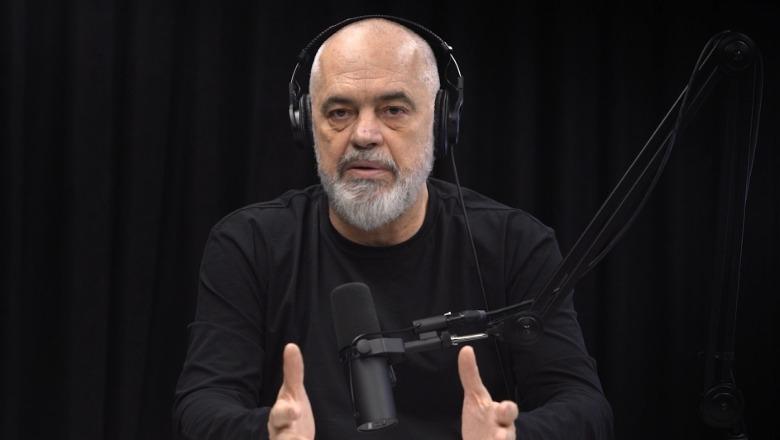
Prime Minister Edi Rama used his regular Sunday podcast, Flasim, to address four distinct policy and political matters: the parliamentary immunity vote on Deputy Belinda Balluku, fuel price stabilisation, the Porto Romano port project, and the Constitutional Court’s TikTok ruling. The weekly broadcast has become Rama’s primary vehicle for setting the political agenda outside parliament and for speaking directly to both domestic and international audiences.
Below is a full transcript of the PM’s weekly address.
Note 1: Oil Prices
The first note is unavoidably linked to the impact of the war waged by the United States and Israel — which we fully support — against the criminal regime’s machinery in Tehran, on oil prices. This is an inevitable rise across all global markets, happening throughout the world precisely as a consequence of the disruption of the value chain circulating through trade exchanges at a strategic point — the Strait of Hormuz.
Nevertheless, we will not stand idle in the face of this situation. As I have declared previously, we are today — also due to the conditions of this unexpected crisis — at the moment when we finalize the creation of a state factor with impact on the domestic oil market, which will play the role of market stabilizer, will contribute to price transparency, and will guarantee market supply, backed by a very important capacity: sovereign guarantee.
I strongly believe this will be a turning point in fulfilling yet another ambition and commitment made at the very start of the fourth mandate — that oil traded in Albania be a product far less affected by fluctuations in international markets. This is entirely possible.
In parallel, the Ministry of Economy has established a joint task force with the Minister of Finance, activating the tax and customs administration on one side to increase controls in the hydrocarbons market and prevent any abusive price increases in fuel, and on the other side to study quickly how to address the abusive phenomenon of food price increases. This operational group will focus with a detailed plan on the entire fuel trading chain, both wholesale and retail, while prices will be under continuous monitoring from relevant institutions.
The draft law on strategic oil reserves is already in public consultation. It coincides with this situation, though it was an initiative undertaken before this crisis arose. It envisages creating reserves spanning one to three months of oil supply. But as I said, our ambition goes further — I believe that in a few months citizens will begin to feel the start of a long-awaited change in the fuel market.
Note 2: TikTok and the Constitutional Court
This week the Constitutional Court issued an opinion on the TikTok matter, even though the case no longer existed — because as a result of the TikTok block some months ago, for reasons that have been made public and in accordance with the request of 95% of parents and teachers, we entered into constructive dialogue with the company. The company committed to and began implementing a series of new measures in providing this service to the Albanian audience.
Nevertheless, the Court continued on its own trajectory and ultimately concluded that the government had not proven that the block was the only effective measure.
Court decisions are naturally to be respected, but I do not think court decisions are in all cases beyond comment — because I believe it is good, even for the body of prosecutors and judges in Albania, to face the opinion of constructive criticism, so as to improve their work. Treating them as untouchable after processes have concluded does not help improve the quality of justice.
The fact is, thanks to that block, we now have algorithmic filters and age verification. We have a series of measures related to the language of violence, and Albanian itself — which was not even on TikTok’s radar until then — and we have genuinely constructive cooperation with the platform.
So the temporary ban produced precisely all these results. A multi-billion company came to the table with a small state whose entire value is less than the company’s own — and it is not the only state in this position. These companies are larger than many states combined in terms of capital they hold.
And here the Constitutional Court enters — like a wet blanket — and does not take into account the constitutional obligation that the Albanian Constitution clearly establishes: children have the right to special protection from the state and must be protected from any practice that could harm their health and development. Nor does it take into account the fact that the TikTok block was not only not challenged or questioned by international institutions including the European Union, but was on the contrary commented upon positively across many media platforms in many European countries and beyond — at a time when many countries are trying to take similar measures, and when the facts show that the algorithms of these platforms can produce harmful effects on children, from anxiety to self-harming behaviors, or to extreme displays of violence that can lead to taking another’s life.
In this context, state inaction is not neutrality, and the so-called freedom of expression, which is so greatly abused, has absolutely no connection to this case whatsoever.
In any case, the Constitutional Court has issued its decision — an unnecessary decision at best, because there was no longer any conflict and nothing left to discuss. Meanwhile, we have done our work and obtained what we expected from the TikTok block.
Note 3: Porto Romano New Port
I have a special note regarding an issue that has attracted media attention and which, like all such issues in our time, is shrouded in a great fog of foolishness, fantasy, nonsense, wickedness — in a word, disinformation. I am speaking about the new commercial and military port at Porto Romano.
We are not merely in our right — we are in our duty — to reorganize the country’s port network, to change the urban function of the Durrës area, to save Albania’s second largest city and its premier tourist city on the coastline from the gangrene at the center of its urban organism that is the old port. We must increase our processing, logistics, and geopolitical capacities, aligning with EU and NATO standards through the construction of a new strategic hub — not merely for Albania, but for the region and for the functioning of Corridor 8.
And yet all of this is obscured by the river of nonsense that Albanians are forced to endure every day, every hour, every minute — from the 700 political and media pressure cookers.
The idea of transferring the commercial port to Porto Romano and transforming the current Durrës port for the new function of a powerful driver of the new tourism industry is absolutely the most logical solution — impossible in earlier times due to the Albania that was, and entirely necessary for the Albania we are building day by day.
The new port at Porto Romano is not merely an infrastructure project. I repeat — it is a strategic regional and European project linked to the vital functioning of Corridor 8 and other logistical routes including the dry ports of Pristina and Skopje.
As I emphasized in recent days, in this process there has been no concern expressed by our allies — neither the United States nor the European Union. On the contrary, the project designed by the world’s largest company with an indisputable reputation, the Dutch Royal HaskoningDHV, is on NATO’s table and has passed all technical filters. It now awaits, together with several other major projects, the political filter — precisely because it is a project of considerable geopolitical value.
Not everyone wants this new port. Not everyone welcomes it — factors inside and outside the country, starting from the underground interests of those linked to trafficking, to political factors and third-party factors outside Albania’s borders. They cannot welcome it, because at best this is a new power entering the maritime commercial competition of the Mediterranean, and at the more sensitive level, this is a factor taking a share from the table where the profits of all maritime commercial activity in this part of the world are distributed.
A new port of these dimensions and ambitions elevates Albania to a different level on the region’s logistics map and turns it into a country that also holds a strategic transportation hub at the heart of Europe, as a connecting point between east and west.
Despite the difficulties the project has encountered, despite two unfinished processes, despite the withdrawal of the company that was very close to signing the contract and was expected only to submit its financial offer, but stated that under conditions of crisis and rising prices it could not provide a financial offer — we are ready to move to another plan, fast and aggressive, to guarantee the start of construction of this port, for which we have made available all the necessary budget.
Note 4: The Balluku Immunity Vote
The Albanian Parliament has put an end to a long discussion, debate, polemic, and confrontation regarding the request to authorize the deprivation of freedom of a member of parliament. The case of Deputy Belinda Balluku is, in my view and our view, a closed matter.
Parliament deliberated after treating with great responsibility and utmost care everything placed at its disposal, and did not authorize the request — determining that the request was part of a recklessness that cannot continue indefinitely, where people are treated as tools in the service of the fight against corruption, even when it is not a matter of corruption, not a matter of embezzlement for personal interests, not a matter of anything that could obstruct the development of investigations — and they are detained and put inside, practically turning Albania into the black sheep of the Council of Europe, of all Council of Europe countries (not just the EU), as the country with the most people held in pretrial detention — locked up without trial — than in post-conviction imprisonment.
58% of the population currently in Albania’s prison system has not been tried — they are in prison, living off Albanian taxpayers instead of living from their own work outside prison. Of course I am not speaking of all of them, because among them there are surely those whose liberty must be restricted in advance because they were caught in flagrante, have committed a serious criminal offense, are a social danger, and so on. But taken as a whole — since the Council of Europe has raised the alarm on this issue — we cannot be deaf to it. And in the absence of mechanisms to restrain this type of action, which is truly grave and is justified, as the Council of Europe report states, with general statements — we cannot with our own hands join in this recklessness.
A deputy is equal before the law. That is not in question. Like any other citizen, they can and must be investigated if there are grounds for investigation. But the freedom of a deputy, like that of any other citizen, cannot be restricted simply and solely with general statements, or with the theory that the prosecutor and judge are independent and can do whatever they want. They cannot do whatever they want when they knock on the doors of Parliament — and Parliament cannot pretend not to see, not to hear, not to think — and refuse to fulfil its role by protecting its own dignity, the dignity of the parliamentarians of the Republic of Albania, who cannot be treated as guilty before being declared so by a court, and cannot have their freedom restricted without any of the conditions pointing in that direction.
In this case, as is publicly known, we are dealing with a situation where the prosecutor — rightfully — raised a suspicion, started an investigation, and then filed charges for breach of equality in tenders around six years ago. On the other hand, there is no charge of corruption, no charge of misappropriation of funds, no scene of flagrante, no evidence pointing in that direction.
The Criminal Procedure Code is very clear: denial of the arrest authorization does not prevent the prosecution from continuing the investigation or requesting other measures. So the investigation continues and justice is not obstructed. On the other hand, the deputy no longer exercises any executive function. The entire request was filed when she was exercising executive functions — and despite the fact she is no longer in office, the prosecution continued to request the same thing, forgetting that nothing new had occurred, except the fact that she was simply a member of parliament with no capacity to influence anything regarding the investigations.
So, I repeat: arrest, as the most severe security measure, must be the last resort, not the first.
And I want to add here: all those crying over integration and EU membership supposedly being so close — these are the same people who until this moment were preaching day and night that integration and membership were very far away, that integration and membership were a dream I was selling to Albanians but that I myself did not believe. That we would never join the European Union. And suddenly the lids blew off all the pressure cookers because the dream was shattered at the last moment.
These people are, at best, ridiculous. At worst, they are not only ignorant but very wicked. But I assure you: our path toward membership is not blocked and will not be blocked for this reason.
I have had a very constructive discussion with some partners who have a different opinion — who have a completely different approach to immunity in their own countries, where no investigation can even begin without the parliament’s authorization. We do not have that kind of immunity in Albania. We have only a guarantee for the protection of deputies’ freedom. Everything else is hot air.