One day after the Balluku vote, the Prime Minister did not come to explain himself. He came to reframe the entire terrain.
By the Tirana Examiner News Desk Friday
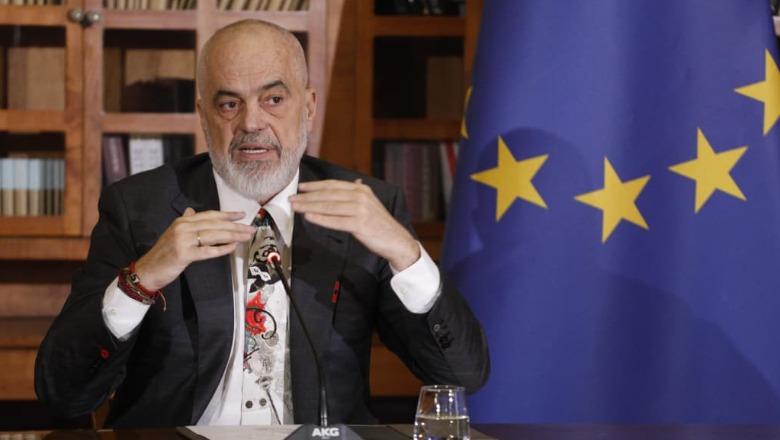
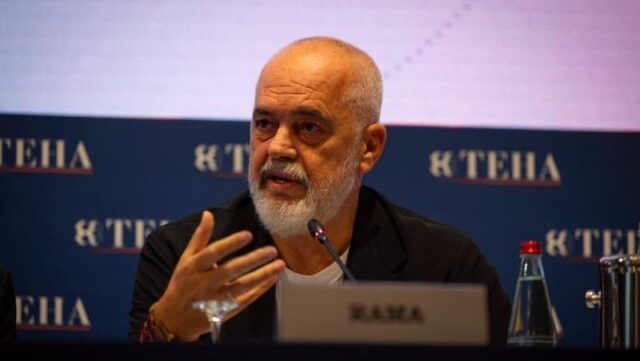
There is a version of Friday’s press conference that reads as damage control. Edi Rama, facing diplomatic blowback after his parliamentary majority voted 82-to-zero to shield former Deputy Prime Minister Belinda Balluku from SPAK’s arrest request, steps before cameras to soothe, to qualify, to manage. That is not what happened.
What happened instead was a methodical offensive on three simultaneous fronts: the legal framing of the Balluku vote itself, the media ecosystem Rama believes is distorting its meaning, and the international partners whose statements he is contesting not in their content but in their interpretation. By the time he left the room — after a confrontation with a journalist from the Berisha family’s television outlet that ended with Rama refusing to take any further questions from her — it was clear that the Prime Minister had decided the correct response to Thursday’s controversy was not retreat. It was escalation.
The legal argument, stated without apology
Rama’s position on the Balluku vote has not moved, and he made no effort on Friday to give it a softer edge for diplomatic consumption.
“SPAK’s request did not meet the conditions to be taken into consideration,” he said, “and the attempt to link the refusal to some other reason, or to give the refusal the dimension of a fact that will block Albania’s path to the EU, or that will obstruct the further implementation of justice reform, or that will impede the independent activity of justice — that is a shameful effort.”
The argument rests on a distinction SPAK’s critics say is being weaponised and Rama’s allies say is being ignored: that the parliamentary majority did not rule on Balluku’s guilt or innocence, or even on the strength of the underlying investigation, but on the procedural adequacy of the arrest request as submitted. The prosecution, Rama noted pointedly, has not charged Balluku with corruption. There is an ongoing investigation. That investigation, in his telling, proceeds without obstacle.
He went further and turned the moment into an instruction.
“I urge the prosecution to follow and investigate all the leads where it might be thought that the thorn of corruption could appear along the way.”
This is Rama at his most tactically acute. By positioning himself as SPAK’s active supporter — urging it to continue, to find what it is looking for, to dig until it hits something — he absorbs the institutional pressure rather than deflecting it. The majority did not shut down the Balluku case. It returned a deficient request. The case lives. Come back with a better one.
Whether that framing is legally honest or politically convenient is the question that will occupy courts, Brussels briefing rooms, and Albanian commentary for weeks. For now, Rama is not treating it as a question he owes anyone an answer to.
The three-front architecture
To understand Friday’s press conference as a single coherent performance rather than a sequence of disconnected responses, it helps to see what Rama was building across its two hours: a narrative in which Albania is a serious country under sustained assault — from an opposition willing to weaponise diplomatic statements, from media outlets he says launder money and manufacture outrage, and from Iranian state actors attacking its digital infrastructure daily. The Balluku vote is one episode within that larger frame. Rama did not present it as an isolated legal controversy. He presented it as the latest front in a permanent war against a government that keeps winning anyway.
This is not an accident of rhetoric. It is a structure.
The diplomatic reaction: contesting the interpretation
The statements issued Thursday by the EU Delegation and several Western embassies were, by any fair reading, pointed. They affirmed the centrality of anti-corruption work to Albania’s EU path, in the immediate wake of a vote that SPAK and much of the diplomatic community had been watching closely. What they did not do — and Rama’s entire argument pivots on this — was say explicitly that the vote blocks Albania’s accession. The gap between what was written and what was reported became his primary terrain.
“Beyond the way they have been painted in the caricatures of the media and political bazaar, our discussions have been constructive. There has been nothing resembling tension, pressure, or threats. These are things that do not happen at the levels where those discussions take place. Even the statements issued yesterday are very clear — but it depends how you read them.”
He returned to this when pressed on where his confidence came from.
“Because I speak on the basis of the facts I have today and the communications we have today. We have a discussion that took place — I do not deny it — but it was entirely constructive, and a path in which we do not see that anyone has come out and said that for this reason we cannot move forward.”
Then the sharpest formulation of the morning: “If the content of these statements resembled the echo, I would say we have a problem. If the goal were what the echo said it was, it would not have been necessary for the translators of the Albanian media to translate it for you.”
The word he used — qimbellinjtë, carrying connotations of petty thread-spinners, of people whose function is to manufacture meaning from nothing — was not diplomatic. It was a designation. A portion of the Albanian media, in Rama’s framing, is not interpreting diplomatic statements. It is converting them into ammunition, and the conversion is so systematic and so predictable that the original statements need to be read against the conversion rather than alongside it.
He is also, implicitly, asking something of his diplomatic interlocutors: if your words are being weaponised against a government you deal with constructively at the table, how do you feel about that? The question is never stated. It hangs in the air throughout.
Parliamentary sovereignty and the coming collision with SPAK
The most consequential passage of the press conference for the medium term may not have been anything Rama said about Balluku. It was what he said about the Criminal Procedure Code.
SPAK’s 2025 annual report, submitted to parliament, included a warning that potential legislative changes could impede the prosecution’s work. It was a shot across the bow, or at least a marker laid down for the record. Rama was asked about it directly. He declined to engage the substance and went instead for the standing.
“It is not SPAK’s job to tell parliament what to do. SPAK should see to its own work, we to ours, and Albania will be better for it. SPAK has our full support. Parliament is sovereign — it does not depend on SPAK, the embassies, or anyone else.”
The reform, he confirmed, is proceeding regardless of SPAK’s reported concerns.
“The change will be made — there is no discussion about it whatsoever. There is no chance that a prosecutor and a judge can suspend officials, because here you are not suspending the person, you are suspending the function.”
The legal distinction Rama is drawing — between personal detention, which falls within prosecutorial powers, and the suspension of an official function, which he appears to argue cannot be imposed by prosecution alone — will be tested when the draft amendments are published. What matters now is the signal: the parliamentary majority that rejected Balluku’s arrest request is the same majority that will vote through a reform SPAK has already flagged as potentially restrictive. Whether those two facts add up to an institutional pattern or to two separate, defensible decisions is the argument that will define the next phase of Albania’s justice reform story.
Rama, for his part, also indicated that the broader Criminal Code revision is moving forward with French and Italian justice ministry involvement, that the material is under active review, and — in language worth noting — that “there is no will, tendency, goal, or dream to reverse things that have moved forward.” The reassurance is genuine or it is preemptive. Possibly both.
The EU accession model, and the Vučić question
If the Balluku section of the press conference was anticipated, the extended defence of the joint Rama-Vučić editorial on EU enlargement was not. The piece — published earlier this week and co-authored with Serbian President Aleksandar Vučić — argued for an accession model that decouples candidate readiness from full membership with veto rights in the interim period. It drew immediate and sharp criticism in both Albania and Kosovo, where the optics of Rama lending his name to a joint project with Vučić landed badly regardless of the editorial’s stated argument.
Rama’s defence on Friday was substantive and, on its own terms, not easily dismissed.
“That editorial does not presuppose anywhere a withdrawal from EU membership. This is a topic that requires deepening.”
The structural argument he has been making for years, he said, runs as follows: candidate countries can satisfy every condition, close every chapter, and still find themselves blocked at the moment of entry by member states whose domestic political calculus has nothing to do with Balkan reform progress. France is his specific exhibit.
“In 2027 there are elections in France. France is a key country, and France ratifies the entry of a new EU member not like the others — with two-thirds of parliament or by popular referendum. For the first time, France finds itself in conditions where it cannot form a majority government because its parliament is fragmented.”
The argument has real force. The structural problem of enlargement fatigue within the EU is documented, the French constitutional threshold is genuinely high, and the political fragmentation Rama describes is accurate. A candidate country that completes the accession process and then finds itself blocked by a ratification crisis in Paris would have legitimate cause for grievance. Proposing a mechanism to address that risk is not inherently a capitulation to a lesser form of membership — it is, as Rama presents it, a hedge against an outcome worse than either alternative.
The problem is the co-author. Vučić is not a neutral voice on Western Balkans integration. His government’s relationship with Brussels is adversarial on rule of law, his relationship with Prishtina is the defining conflict of regional politics, and his domestic posture is not that of a leader guiding his country toward European norms. For Rama to make his structural argument about French parliamentary arithmetic alongside Vučić is to hand critics a vehicle for dismissal that has nothing to do with the argument’s merits — and Rama knows this well enough that the choice, presumably, was deliberate.
His response to the criticism on Friday dispensed with the nuance: “Let them go talk in Berlin. Let them ask there whether it is worth fighting for this, or whether we should shut up because we are out of the game. And let us hear what they tell them in Berlin.”
The Kosovo dimension of the editorial’s reception — where the optics of Rama-plus-Vučić on any subject produce an immediate and visceral reaction — received no acknowledgment whatsoever.
The Syri Tv confrontation
The most theatrically charged moment of the press conference was not about Balluku or Brussels. It was the extended confrontation between Rama and journalist Ambrozia Meta, who works for Syri Tv — the television outlet associated with the Berisha family and, as Rama made clear, currently under prosecutorial investigation for money laundering on the basis of a denunciation filed by state bodies.
The exchange began when Meta attempted to ask about a separate topic and continued to press as Rama tried to complete his answer. What followed was less a press conference moment than a direct statement of Rama’s position on the outlet itself.
“You abuse people, you abuse those you name in the lowest possible way, you abuse the facts, you give people lies every day and nobody says a word to you. You are making yourself the heroine for those who brought you here — you will be the heroine of the day.”
He did not stop there. “The money in that television is laundered to do what is done every day — people are drowned in lies and filth.”
And the close, which functioned as a declaration of non-engagement going forward: “I respond to citizens every day. I do not respond through televisions that launder money stolen from citizens and that enjoy the immunity of aggressors.”
Rama also mentioned a second, unnamed television outlet under investigation for large-scale tax evasion, and directed a pointed question at the Tirana Prosecutor’s Office: why, on both investigations, has there been no response?
This matters beyond the spectacle. Rama is not merely attacking political opponents through their media channels — he is attaching a legal predicate to the attack, and pointing at prosecutorial inaction as a failure that reflects on the system he ostensibly leads. It is an unusual posture: a prime minister publicly goading his own prosecutors to move faster on cases that would damage his main political rival. Whether it is a legitimate call for the rule of law or an attempt to use institutional pressure for political ends is, again, a question that depends entirely on which facts are established in court.
Iran, parliament, and the hole in the shield
On the Iranian cyberattack against the Albanian parliament — part of a sustained Homeland Justice campaign that Tirana has been contending with since 2022 — Rama offered an account that managed to be simultaneously reassuring and alarming.
“We have a cyber defense capacity that is among the best in Europe — and I do not say this myself, but we are invited and respected in European and NATO environments that deal with this.”
The qualifier arrived immediately after.
“Our problem is that we have not yet included the entire system within the defense network. Parliament has not included its part in our cyber defense system. Do not ask me for the reasons — they are as banal as they are unnecessary.”
The picture this paints is of a national cyber architecture that performs well where it has been deployed, and a legislature that has, apparently through institutional inertia rather than any principled objection, declined to integrate itself into that architecture. Iran, he said, attacks daily and has not succeeded against critical infrastructure. Parliament, it seems, does not qualify as critical infrastructure in its own administrative self-understanding.
Porto Romano, and the unnamed third factors
Briefly: on the withdrawal of the company awarded the Porto Romano port tender, Rama denied any pressure from Washington or Brussels and attributed the departure to global economic conditions. He then added a harder note — “there are places that do not welcome Albania becoming stronger, there were other factors that did not want this to be a success story” — and declined to name them.
The unattributed adversary has become a recurring feature of Rama’s public communications. It functions as a catch-all explanation for setbacks that is immune to disproof precisely because it is never specific enough to test.
What Friday was actually about
Strip away the individual topics and what Friday’s press conference reveals is a leader who has decided, consciously and with apparent calculation, that the correct response to the most significant institutional confrontation of his current term is not accommodation but consolidation. The majority is sovereign. The legal argument holds. The diplomatic reaction has been misread. The opposition is running on bad faith and laundered money. Albania is moving forward. The thorn of corruption will be found if it is there.
This is a coherent position. It may even be, on some of its individual elements, correct. The SPAK request may genuinely have been procedurally deficient. The diplomatic statements may genuinely have been less severe than their reported interpretation. The French ratification problem is real.
What it is not is a position calibrated for the audience that actually matters in the next six months: the European Commission assessors who will be evaluating whether Albania’s justice reform trajectory is still on track, and who will be reading not just what Rama says at press conferences but what the parliamentary majority does to the Criminal Procedure Code when the amendment text is finally published.
That is the document to watch. Everything else on Friday was preamble.
Tirana Examiner | tiranaexaminer.com | Clarity in a Capital of Rumors