the Newsroom
Some state visits matter for what is signed. Others matter for what is said, and where, and to whom. The Prime Minister of Albania’s five-day visit to the Republic of Korea, scheduled from 17 to 21 May and undertaken alongside Linda Rama and an official delegation, belongs firmly to the second category. Its substantive payoff will accumulate in the months ahead, in memoranda, investment conversations, and follow-up engagements. Its rhetorical and diplomatic payoff is already on the record, and it is considerable.
It is only Prime Minister Edi Rama’s second visit to Seoul. The first came in 2002, when he was Mayor of Tirana, and the contrast between the two encounters is one he opened his keynote with directly. “The first time I saw this cinematic city was more than two decades ago, as the Mayor of Tirana,” he told the audience at the Asian Leadership Conference, the annual gathering organised by the Chosun Ilbo group that brings together the political, business, and intellectual class of the Asia-Pacific. “I myself came from a lost city searching for itself, in a country emerging from one vanished world and trying, often chaotically, to imagine another. What I found then was already remarkable. But what I see today, returning after all these years, is something profoundly moving.”
The keynote was delivered alongside Prime Minister Kim Min-seok of the Republic of Korea and other international figures, and it set the register for the entire visit: warm, reflective, and unmistakably oriented toward Korea as a partner whose example Albania reads with admiration.
A keynote built on Korea
Few foreign leaders speaking in Seoul this year have offered Korea so unreserved a tribute. Rama framed the Korean experience as one of the defining demonstrations in modern history that nations are not prisoners of where they begin. “Korea is proof that history matters,” he said, “but that history alone does not decide destiny. And perhaps nowhere has this truth been illustrated more strikingly than here, on this peninsula.”
The two Koreas, he argued, became “one of the clearest demonstrations on Earth that the fate of nations is shaped not simply by where they begin, but by the choices they make along the way.” The Republic of Korea, in his framing, “became a symbol of renewal through openness, democratic resilience, and innovation.” That formulation, delivered to a Korean audience by a European Prime Minister, lands with weight precisely because it does not flatter for the sake of flattery.
Rama then placed Albania inside the same analytical frame, candidly invoking his country’s authoritarian past in order to make the recognition of Korea’s achievement land harder. “Albania, for a painful chapter of its history, was the North Korea of Europe,” he said. “And yet today, Albania walks another path. Not an easy one, imperfect of course, but profoundly different. A path of institution-building. A path of democratic modernisation. A path toward the European Union.”
By naming Albania’s own difficult chapter, Rama made the case that the two countries, although separated by continents, share something more than warm sentiment. “Although far geographically,” he told the room, “South Korea feels deeply close to countries like mine through its reminder that greatness is not reserved for those born into fortune. It can also belong to those who dare to rebuild, who choose openness over fear, determination over resignation, and optimism over fatalism.”
The East Asian inheritance, recognised
A substantial portion of the address was devoted to the broader Asian story, and to the recognition that the post-war transformation of this part of the world remains underappreciated in European political consciousness. Rama narrated it with care.
“Japan was rebuilding itself into an industrial marvel,” he said. “South Korea was transforming poverty into precision engineering. Singapore was proving that a city with no natural resources could outshine nations blessed with every advantage. Taiwan, Malaysia, Thailand, each writing its own chapter, on its own terms and in its own voice.”
The passage was a deliberate piece of diplomatic acknowledgement, the kind that registers in capitals because European leaders rarely deliver it without qualification. Rama then turned to ASEAN, the regional architecture that, in his reading, captured the wisdom of the Asian experience. “ASEAN was not born from sameness,” he said. “It was born from the understanding that cooperation is more powerful than confrontation, and that pragmatism ultimately defeats ideology.”
For a Prime Minister whose region has spent decades negotiating its own integration questions, the words carried a weight beyond protocol. “I wish that all the wisdom of leadership accumulated in this part of the world,” he told the room, “could serve my part of the world as a humbling source of knowledge on how to navigate differences not as reasons for conflict, but as forces of balance, in the mutual interest of progress and prosperity for every society involved.”
The aspiration carries real possibility for the Western Balkans. The Asian experience suggests that regional integration is built less through legal harmonisation than through accumulated habits of cooperation, supply chain interdependence, and the routinisation of dialogue. For a region negotiating six accession tracks and a still unfinished post-conflict settlement, that lesson is more than rhetorical.
A friendship across continents
One of the warmest passages of the keynote was personal. Rama spoke of his friendship with Min Suk Cho, the Korean architect whose work has long shaped contemporary discussions of the relationship between memory, urban space, and national identity. “I had the privilege of becoming friends with Min Suk Cho,” he said, “one of the greatest architects of our time, whose work I admire enormously, and who is also contributing to projects in Albania.”
The reference is more than personal. It is concrete bilateral substance. A Korean creative practice is already physically present in Albania, shaping built space in a country whose Prime Minister came to politics through the cultural and urban world. Through that friendship, Rama said, he has been reminded “that even countries separated by continents can sometimes confront strikingly similar challenges.” He posed the questions that animated the connection. “How do we preserve identity while embracing transformation? How do we build for the future without losing the depth of our memory? How do we solve urban, social, and human problems by looking at our different pasts through the eyes of our common future?”
The answer, he suggested, is sometimes found where one least expects it. “Sometimes, incredibly, a creative mind from the other side of the world can help illuminate answers to questions we tend to think are uniquely our own.”
The meeting with Prime Minister Kim, and the technology question
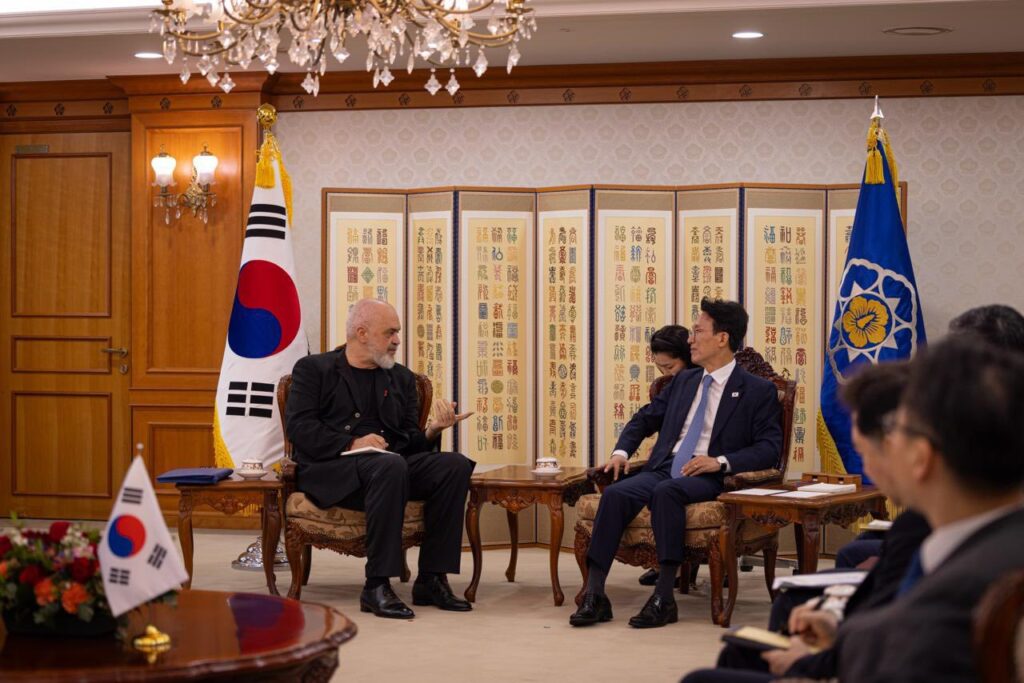
Alongside the keynote, the substantive bilateral encounter was the meeting between Rama and his Korean counterpart, Prime Minister Kim Min-seok. The conversation marked the 35th anniversary of diplomatic relations between Albania and the Republic of Korea, and it opened ground that both sides signalled they wish to develop.
Rama wrote afterwards, sharing photographs from the meeting: “With the Prime Minister of the Republic of Korea, Kim Minseok, we spoke about the 35th anniversary of the establishment of diplomatic relations, the similarities of our histories, and further cooperation, with a focus on technology, Artificial Intelligence, and tourism.”
The current bilateral trade picture, while modest, points to the room for expansion that both sides are now signalling. Albanian imports from South Korea reached 187.13 million dollars in 2024, dominated by vehicles at 134.52 million dollars, electrical and electronic equipment at 15.62 million dollars, and optical and technical instruments at 10.79 million dollars. Korean imports from Albania over the same period stood at 9.17 million dollars. The asymmetry is the asymmetry of two economies at different stages of integration into global value chains. What matters is that the conversation now extends beyond goods trade to the higher-value domains that defined the Kim Min-seok meeting.
The Korean Prime Minister gave that conversation a specific anchor. He highlighted Albania’s appointment of Diella, the country’s Minister of State for Artificial Intelligence, as a development of interest, and noted that Korea attaches considerable importance to AI and to high-end technologies. The framing matters. Diella, developed by Albania’s National Agency for Information Society in cooperation with Microsoft, is being deployed across four stages of the public procurement process, from drafting terms of reference to verifying submitted documentation, an attempt to bring algorithmic consistency to a domain that EU accession reports have repeatedly flagged. For a Korean Prime Minister, leading a country that occupies a strategic position in the global semiconductor and AI infrastructure stack, to identify this as a point of interest signals appetite for an engagement that goes beyond ceremony.
The agenda extended further. Rama is meeting with Lee Jae-yong, the Chief Executive Officer of Samsung, and with leaders of other major Korean firms, with conversations focused on economic cooperation and investment opportunities in Albania. He will also participate in an exclusive dialogue with leaders of the Asia-Pacific region, a forum that places Albania, however briefly, inside a regional conversation it has rarely been part of.
Leadership, and the arena
The keynote returned, near its close, to a reflection on the nature of leadership itself, in language unusual for the genre of state visit address. “Over the years, whether as mayor or later as Prime Minister,” Rama said, “I have learned that leadership is far less about certainty than we often pretend. It is rarely about having the comfort of clear answers. More often, it is about moving forward with imperfect knowledge, accepting doubt, learning constantly, and still finding the courage to act.”
He continued, in a passage that echoes Theodore Roosevelt’s celebrated 1910 Sorbonne address on the citizen in the arena: “True leadership does not belong to the spectator, comfortably judging from a distance, nor to those who prefer inaction when confronted by a frightening challenge. It belongs to the one who enters the arena, not because he is certain of coming out victorious, but because he dares greatly.”
It was, in context, a tribute to Korea as much as anything else. Korea, Rama suggested, is a country that has entered the arena again and again. “Korea’s journey is, in many ways, the story of a nation that entered the arena again and again, and where what did not kill it made it stronger, because it chose not merely to survive history, but to shape it, no matter the cost.”
The closing image
Rama closed with a Korean saying he said he had heard and loved. “After the rain, the ground hardens.” “Few countries in the world embody this better than Korea,” he said. “Here, hardship did not soften the ground beneath the nation. It made it firmer. With national determination. And also with creativity.”
He noted, as the speech approached its end, that Korea had recently surpassed Japan in GDP per capita, “an achievement that not long ago would have sounded like fantasy bordering on madness.” He continued: “What makes this achievement so extraordinary is the capacity of a nation to turn pain into strength, hunger into determination, destruction into energy, and historical trauma into an almost unbelievable force of collective ambition.”
The final line, delivered as a kind of benediction, was both Korean and universal in spirit. “If Korea could do it, then nobody has the right to say: it cannot be done, neither at the collective nor at the individual level. Feel blessed. And just do it.”
A bilateral relationship 35 years old is, by the measure of modern diplomacy, neither young nor old. What gives the Seoul visit its weight is that the conversation between Tirana and Seoul is moving from the protocols of acquaintance into the substance of partnership, on terms that both sides recognise: technology, artificial intelligence, tourism, and the cultural and economic infrastructures that turn distant geographies into working ties. The Prime Minister came to Korea to learn, and said so plainly. He also came to make the case that Albania is a country worth Korea’s attention. On the evidence of the visit so far, that case was made.