A judge has ordered pretrial detention for Commissioner Bashllari and one inspector, house arrest for two others, in the CopaCabana file. The structure has been demolished. The Interior Minister and State Police Director used the Saranda visit to address officers along the entire coast.
By Aurel Cara (Tirana)
A Tirana court on Monday ordered pretrial detention for Gëzim Bashllari, the suspended chief of the Saranda police station, and for one of his subordinate inspectors, in connection with the CopaCabana file opened last week by the Police Oversight Agency. Two further inspectors were placed under house arrest. The Construction Police completed the demolition of the unlicensed beach bar on the same day, issuing a fine of 11.7 million lekë against the registered owner, Arjola Dhrami Bajo, who remains a fugitive and has formally renounced her claim to use the beach.
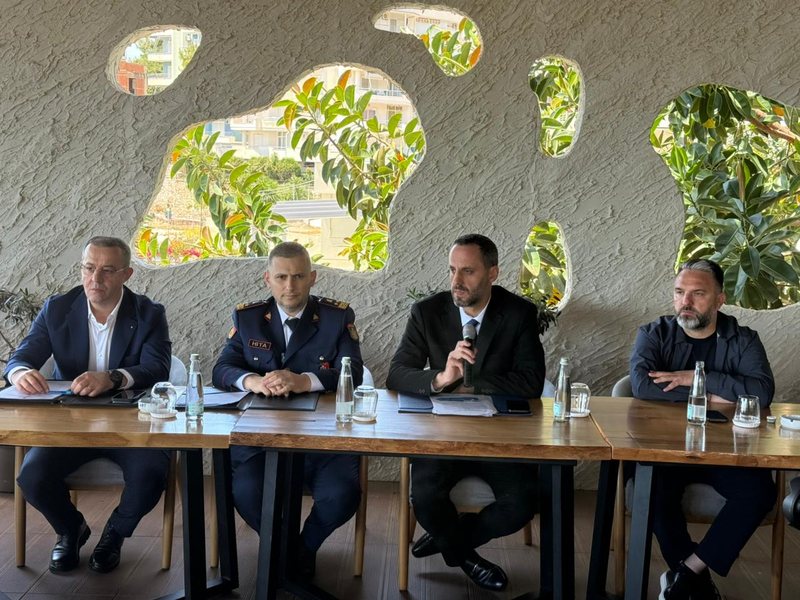
Hours after the court ruling, Interior Minister Besfort Lamallari and State Police Director Skënder Hita appeared together in Saranda for a meeting with police commanders, IKMT and other supervisory bodies. The choice to travel to the city rather than issue another statement from Tirana carried its own message. The CopaCabana case, opened by the Police Oversight Agency on Friday and analysed in this paper on 16 May as a demonstration that Albania’s reformed institutional architecture can produce a result when leadership chooses to use it, has now progressed to its judicial and physical stages. The minister and the director went to Saranda to address the next stage, which is everyone else along the coast.
Lamallari was explicit about that audience. “Saranda and the entire Albanian coast are national wealth,” he told the meeting. “If someone thinks public interest can be reordered along the lines of the private, they are very wrong.” He then framed the timing question that has defined coastal enforcement for two decades. “The rapid response of the police and the supervisory structures was the first message of the week, to show that this cannot be a game where we wait until the concrete is seven storeys high.” The seven-storey reference does work the rest of the sentence does not. It addresses the standard cycle in which illegal coastal construction is permitted to reach a scale that makes demolition politically expensive, then negotiated into legalisation. The minister was signalling that the cycle, in this government’s reading, has changed.
He addressed officers in uniform directly. There were two paths, he said, performing the job with honour or facing the consequences. “Anyone else who thinks they can do otherwise, let them do the maths themselves. This is why your colleagues are not at the table today, but are facing justice.” The reference was to Bashllari and the three inspectors, Andi Duro, Ajdin Ismailaj and Robert Çullaj, whose detention orders had been issued earlier the same day.
Hita’s presence carried the weight Lamallari’s words could not. The Director General’s referral of the original citizen complaint to the Police Oversight Agency, rather than internal handling within the chain of command, was the institutional decision that made the entire file possible. To then travel to Saranda and speak in the same room as the supervisory bodies whose officers had been arrested at his initiative is the kind of follow-through Albanian police reform has rarely produced. “No one is above the law, and the uniform of the State Police will never be used as a shield for illegality,” he told the meeting, describing the arrests as a matter of personal regret and institutional resolve. He pressed for coordination across IMT, the Municipal Police, IKMT and other agencies operating along the coast, arguing that the State Police alone cannot contain what the file describes. “Each of these institutions must take initiative, be decisive, and conduct periodic checks, leaving no space for tolerance.” The call was procedural in form. In substance it was an admission that the Saranda station is not where the problem ends.
The file’s underlying architecture has been documented. Coastal land that belonged to the executed Isuf Jaçaj, transferred under suspected duress to a nominal owner fronting for a criminal group based in Kamëz, developed without permits, protected by a paid local police layer. What Monday clarified is the prosecution’s reading of where authority within that scheme sat. The court’s decision to remand Bashllari and one inspector while imposing only house arrest on the two others is a finding about hierarchy. Pretrial detention removes the possibility of contact with subordinates and with the criminal interlocutors the prosecution is now mapping. House arrest does not, to the same degree. The differentiated regimes indicate that the prosecution has presented a theory of the conspiracy in which the station chief and one specific inspector carried the operational relationship with the criminal group, while the other two played enabling roles. That distinction will shape the rest of the file.
The demolition matters for a different reason. The CopaCabana structure no longer exists. This sounds procedural and is not. In the coastal enforcement files that have ended in negotiation rather than reversal, the physical structure has typically remained standing while the legal process consumed itself, generating the leverage on which legalisation deals are built. The destruction of the build, completed on the same day as the court orders and the ministerial visit, removes the asset whose protection generated the corruption in the first place. The criminal group named in the file, on the working hypothesis being pursued, no longer has the thing it paid a police station to protect. Whether other beach bars and other stretches of coast operate on the same method is the question Hita’s call for coordinated periodic checks was, in effect, conceding.
What Monday delivered is therefore not a closure but a recalibration of what the file is for. The institutional sequence described in this paper on Friday produced its first results: arrests, court orders consistent with the prosecution’s hierarchy, a structure removed from the coast, a minister and a director general in the room with the institutions that allowed the build to proceed. The remaining question is no longer whether the mechanism works. It is whether the mechanism will be used a second time, a third time, and on the stretches of coast where the criminal economy is more entrenched than in Saranda. The Interior Ministry has committed itself, on the record and in person, to that proposition. The coast will read the answer in what gets demolished next.