The Newsroom
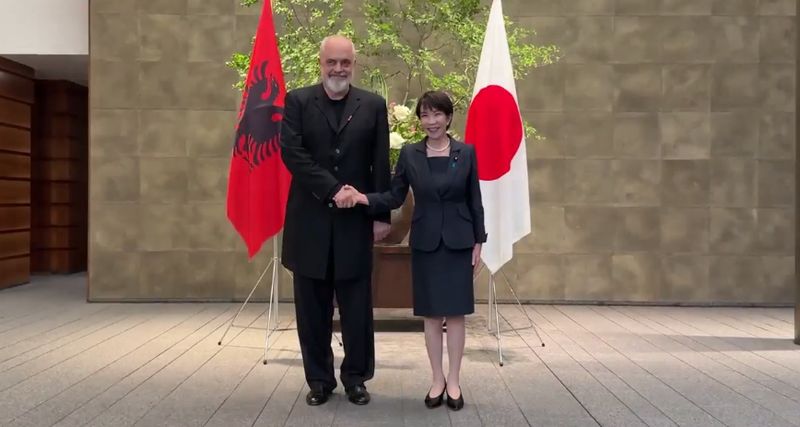
Prime Minister Edi Rama closed a four-day Asian tour in Tokyo on Friday with a state-style reception at Prime Minister Sanae Takaichi’s office. Takaichi pledged continued Japanese backing for Albania’s EU accession. Rama invited her to Tirana for the 2027 NATO summit.
The Tokyo leg followed an official visit to South Korea, with Rama traveling between Seoul and Tokyo from May 17 to May 22. He was accompanied by his wife, Linda Rama, and a government delegation that included ministers Delina Ibrahimaj and Ervin Demo. The agenda combined high-level political meetings with a sequence of economic encounters aimed at attracting Asian capital and technology partnerships to Albania.
Honor Guard, Anthems, and a Personal Tone
Tokyo prepared the visit visibly. Major streets had been lined with Albanian and Japanese flags for days before Rama’s arrival, a protocol gesture Rama himself amplified on social media with photographs of the red and black flying alongside the Japanese standard along central thoroughfares.
At the prime minister’s office, Takaichi received Rama with the national anthems of both countries, followed by a review of troops in white ceremonial dress carrying both flags. Takaichi greeted members of the Albanian delegation individually before the two governments sat opposite each other in the cabinet hall.
Takaichi opened the bilateral with a direct endorsement of Albania’s European trajectory.
“I welcome with all my heart Prime Minister Rama’s visit today. I am very happy to meet you today for the first time,” she said. “Albania is an important partner with whom we share common principles and values. We are pleased that the EU accession negotiations are progressing steadily. Japan, within the framework of the cooperation initiative with the Western Balkans, will continue to strongly support Albania’s accession to the EU.”
She continued: “I express respect to Albania for the active contribution it makes to regional stability. I thank you for supporting the vision of a free and open Indo-Pacific.”
Rama’s response mixed formal acknowledgment with an explicit invitation.
“Thank you for the welcome I will not forget,” he said. “I have had the opportunity to be part of many ceremonies, but today’s is special. This is my second visit to Japan. With great pleasure we await the strengthening of this relationship, based on shared values and principles, for the world in which we wish to live. It is true that I have seen the Indo-Pacific strategy and we fully support it. With great curiosity we await to explore various possibilities of how we can grow closer to Japan.”
He then formalized the headline of the visit.
“Next year in Tirana we will organize the NATO summit, so I want to invite you to that summit. When you come it will be the first time a Japanese prime minister visits Albania on a state visit. It would be a pleasure to welcome you and to take ‘revenge’ for this very warm welcome you have given us, which has left a mark.”
He closed on a personal note.
“Allow me to congratulate you on your fantastic victory. It is impressive to see a woman at the head of the government, you are the second after Margaret Thatcher. Thank you very much and best wishes to you and your people.”
The comparison is unusual. Thatcher led the United Kingdom, not Japan, where Takaichi is in fact the first woman to hold the office. The remark appeared intended as a general tribute to female leadership.
According to Jiji Press, Takaichi reciprocated the spirit of the meeting by stressing that the security of the Euro-Atlantic region and that of the Indo-Pacific are inseparable.
At UN University: “We Insist, and We Will Marry the EU”
Earlier in the day, Rama delivered the most substantive speech of the visit at the United Nations University in Tokyo, in a panel discussion titled “Albania’s Path Toward EU Membership: The Role of Japan.” He used the platform to announce the convening of the eighth intergovernmental conference between Albania and the European Union the following week, and to set a public timeline for closing accession negotiations.
“In fact it is history that repeats where reason is replaced and where isolation replaces cooperation. That is why when communism fell, Albanians made a choice that was not only political but existential. They chose democracy, openness, transatlantic ties,” Rama told the audience.
“For us European integration has never been a bureaucratic process and a technical negotiation. Nor has it ever been access to an ATM. It is a national aspiration, a choice of civilization, a commitment to belong fully to a family of democratic nations.”
He then framed the timeline.
“Albania today is closer than ever to the EU. We have never seen it be this concrete and real at any moment in our modern history. We have entered the decisive phase of our journey toward the EU, and next week we will have a key intergovernmental conference with the EU that opens a new phase of closing chapters and closing negotiations within a year and a half.”
The “marriage” metaphor, familiar from earlier phases of accession, returned as the central image of the speech.
“We insist, and we will marry the EU,” Rama said, arguing that integration is no longer only an Albanian or regional demand. “The full integration of the Western Balkans and of Albania is not simply a request of ours, or of the region, but a strategic need for Europe itself. Albania has proven that not only is it a stable and reliable partner, but also that it loves the EU so much. We want to marry, we insist, and we will marry. We are aligned with the EU’s foreign policy, a committed NATO ally.”
The Council of the EU separately confirmed that the eighth intergovernmental conference between Albania and the bloc will take place on May 26 in Brussels.
“From the North Korea of Europe” to NATO Member
Rama used the Tokyo stage to compress three decades of Albanian transformation into a single comparison certain to travel.
“During the 2019 earthquake Japan stood by us and we will never forget that. What makes Japan priceless for us is the power of its example as an inexhaustible source of inspiration,” he said, referring to the November 2019 earthquake that killed 51 people in Albania. “Japan has become an important partner in Albania’s European integration. The bridges of knowledge prove more durable than those of steel.”
He continued: “Today Albania is the most pro-European society on the continent. We are in love. From the North Korea of Europe, to candidate country for the EU and NATO ally, within the span of a single lifetime lived, this is something quite important.”
He extended the inspiration metaphor to Japan’s postwar recovery.
“Our curiosity and partnership extends far beyond Europe. We have much to learn from Asia. The wisdom of the Western Balkans holds very special value, for coexistence among nations. Japan offers lessons in something even more extraordinary, on the power of resilience. Few nations have experienced such destruction and have achieved such a recovery. Few nations have experienced so much transformation. Greatness is not measured by the absence of setbacks, but by the ability to rise again.”
Rama closed on a lighter register.
“I was aware of holding this speech on Friday, and Friday is very dangerous to give a speech, because everyone can hardly wait to leave, not to listen to a speech. I am sorry that we did not manage to bring a little sun to Tokyo, because in Albania there is a lot of sun. But you can come and enjoy it.”
The Seoul Leg: Samsung, AI, and “A Small Nation’s Grand Strategy”
The Japanese visit was the second half of a tour that began in Seoul on May 17 and ran for four working days in the South Korean capital. The stated objective was deepening cooperation in development, technology, and innovation.
Rama opened the Seoul program with a welcome dinner organized by the Center for Asia Leadership and the Harvard Club of Korea, bringing together South Korean political, governmental, and business figures. The substantive meetings included a bilateral with South Korean Prime Minister Kim Minseok and a separate encounter with Samsung Chairman Lee Jae-yong.
At the opening ceremony of the Asian Leadership Conference, Rama delivered remarks alongside Kim Minseok and other international figures. He then appeared as a featured guest on a panel titled “Conversation with a Leader: An Era of Great Transformation: The Grand Strategy of a Small Nation,” addressing the challenges facing small states under geopolitical pressure and the role of artificial intelligence and digital innovation in governance.
The Seoul agenda also included sequential meetings with executives of major South Korean corporations focused on economic cooperation and investment opportunities in Albania.
The Diplomatic Setting
The Tokyo bilateral occurred at a moment when Takaichi, who took office in October 2025 as Japan’s first woman prime minister, is reorganizing Japan’s relationships with European partners. According to Japanese government sources, she is planning visits to Britain and Italy ahead of the G7 summit in France in June, her first trip to Europe since taking office.
Rama’s invitation to Tirana for the 2027 NATO summit, if accepted, would mark the first state visit to Albania by a sitting Japanese prime minister. Takaichi did not commit on the spot. Her emphasis on the inseparability of Euro-Atlantic and Indo-Pacific security tracks closely with Japan’s broader posture toward NATO partners, though whether it translates into a Tirana visit will depend on her schedule in a year that already includes Britain, Italy, and the G7.
Rama is scheduled to return to Tirana ahead of the May 26 intergovernmental conference in Brussels, where Albania’s negotiating teams will face the test of converting the rhetorical timeline announced from Tokyo into closed chapters on paper.