Tirana Examiner Newsroom
Prime Minister Edi Rama used a visit to Vlorë on Monday to deliver a blunt warning to the tourism sector, offer the most detailed public update yet on the contested Sazan Island project, and frame Albania’s EU accession push in explicitly urgent terms, telling a Socialist Party assembly that Brussels had refused even a three-day delay to parliamentary proceedings.
The visit, which included an inspection of works on the Lungomare 4 promenade and participation in the local PS assembly, covered three substantively distinct registers: a market signal directed at hoteliers and operators, a clarification on a project that has generated sustained public controversy, and a political argument for why the May local elections must return a Socialist majority.
On pricing: a warning framed as self-interest
Rama addressed tourism operators directly and without diplomatic padding. Establishments that overcharge relative to what they deliver will damage not only their own businesses but the broader reputation of Vlorë as a destination, he said. The logic he offered was historical: markets that capitalized on initial demand surges by raising prices and letting service quality slip had found themselves holding stranded investments when the surge passed.
“If it remains a stain on Vlorë that you pay more than what is offered, you have dug your own grave,” Rama said.
The remarks sit within the government’s declared pivot toward elite tourism, a positioning that carries its own internal tension: premium branding requires price points that reflect quality, but the warning against abuse implicitly acknowledges that the quality floor is not yet reliably high. Rama also called for expanded marina capacity across the coast, citing the Vlorë marina as an ongoing project and describing a planned development in Shëngjin, and urged private investors to pursue structured parking agreements with landowners, calling it a profitable and underexploited sector.
On Sazan: still in negotiation, and redesigned
Rama confirmed that talks over the development of Sazan Island, linked to Jared Kushner’s investment vehicle, remain open and that the project has undergone material revision since its initial conception.
“Sazan is Albania’s and will remain Albania’s,” he said, adding that the Albanian state will hold a stake in whatever company eventually invests in and administers the island. The original proposal, which drew criticism from environmental and civic groups, has been scaled back: the current iteration envisions substantially less construction and a cultural and artistic profile rather than a resort model. Rama rejected characterizations of the project as a privatization of public space, saying there would be no closed resort and no privileged enclave.
The framing was careful. Rama did not specify the Albanian state’s equity share, the timeline for concluding negotiations, or the identity of the counterparties beyond the general reference to an investment company. The assurance that the island “will remain Albania’s” functions as a political commitment; its legal architecture was not elaborated.
On EU accession: urgency as governing principle
The most pointed remarks of the day came during Rama’s address to the PS assembly, where he recounted a phone call he placed personally to Brussels requesting a postponement of the parliamentary session at which 27 EU-related laws were voted through, some requiring a qualified majority of 84 votes.
Brussels said no. Rama presented that refusal as evidence of the pace the accession process now demands, and used it to draw a contrast with opposition disruption tactics, asking the audience to consider what would have happened to the integration timeline if those 84 votes had required negotiating under conditions of parliamentary obstruction.
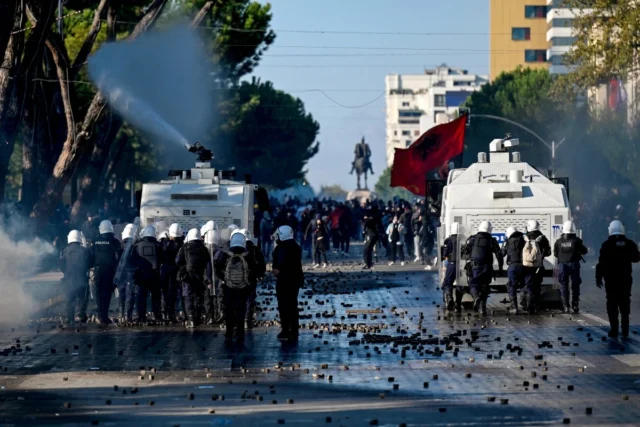
“Imagine if we had needed Molotov cocktails to get 84 votes,” he said. “Imagine what fate Albania would have had in the integration process.”
The 11 chapters opened in 11 months were cited as proof that the EU door is currently open, a condition Rama attributed directly to Socialist governance and one he argued would be foreclosed by any political disruption ahead of the local elections. The opposition’s earlier claim that EU accession was an impossibility, and its more recent claim that Rama himself blocked an entry that was within reach, was dismissed as tactical incoherence.
The political framing was transparent: the EU process as both achievement and ongoing vulnerability, requiring unbroken Socialist majorities at every level to sustain momentum. Whether that argument persuades an electorate whose attention is partly fixed on service prices and unresolved development controversies will be tested in the weeks ahead.