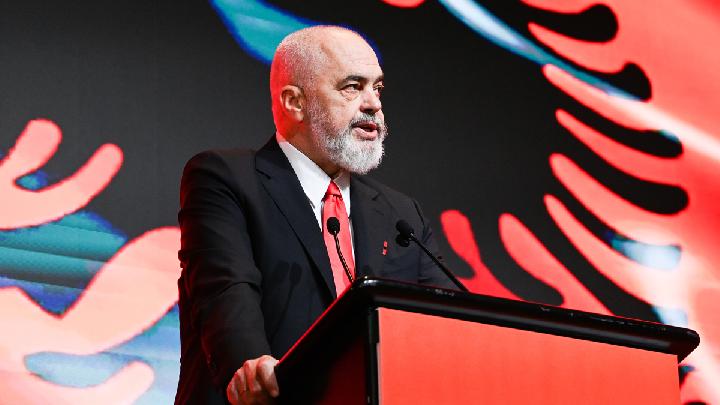
The accusations are repeated every day. The proof is still awaited. Until then, the judgment of a prime minister must begin from what he built, not from what his opponents say about him.
Albatros Rexhaj
There is an Albania that my generation remembers without needing to search for it in archives. It was the country where the asphalt ended where the mud began, where the power died in the evening as if out of spite, where a journey from the south to the north was measured in days and in prayers, not in hours. It was the country where your shoes tore before you reached anywhere, because the road itself was an enemy. Whoever has forgotten that Albania either never lived through it, or has an interest in forgetting it.
I begin there deliberately. Because any judgment of a man who has governed for more than a decade must begin from the point where he took the country, not from the point where we would wish it to be today.
Now they say he is corrupt. They say it in the square, they say it in the studio, they write it beneath every photograph that falls into their hands. Rama the thief. Rama built nothing. Rama took everything for himself. I have heard it so many times that the word has lost the weight that once made it an accusation, and has become a refrain. Refrains prove nothing. They only repeat until the ear accepts them as true out of exhaustion, not out of conviction.
Let me say it plainly, under my own name, pleasing no one and expecting no one’s forgiveness for it: Rama is not corrupt.
I know what will come after that sentence. The list will come. Zvërnec, the seizures, the files, the foreign names. But everything I have written I have built upon a single principle, and I will not abandon it today merely because doing so would be convenient: an accusation is not a verdict. Suspicion is not proof. A man does not become a thief because his opponents call him a thief in the most watched hour of the evening. Until the day someone brings proof and not slogans, I refuse to call him corrupt.
Yes, there are ministers and officials facing accusations. Fine, let them come. Let us wait and see whether this justice we call new is truly new, or merely the old face washed with cold water. Let us see whether there too, behind the new offices and the grand words, prosecutors hide who pursue one man to his last breath and forget another on purpose, seduced by interests that have nothing to do with the mission an entire people entrusted to them. But even if every minister were to walk out with a file in hand and be convicted, this does not touch Rama. Because whoever loves a country builds it with the people he has, not with the people he dreams of. And love, wherever it goes, shares the same fate: it makes you believe, and to believe means leaving the door open even to the one who will one day betray you. To have chosen the wrong man is not theft. It is a wound. And the wound, unlike theft, is punished in no court, because it comes from the heart, not from the hand.
But let us leave the word corruption where it belongs, in its smallness, and move to the real question, the one no one in the square wishes to ask because the answer spoils the celebration.
The question is this: what was built, and to what stage was the country carried?
No state in the world has risen into prosperity all at once. This is not opinion, it is history. First the base is built: the infrastructure, the capital, the physical link between people and markets. Then this base strengthens the state as a structure, makes the apparatus capable of collecting, of distributing, of defending. And only at the end, upon this floor of concrete and institutions, comes the third stage, the one the ordinary person feels in his pocket: prosperity for all. The countries we know as successful passed through these stages in order, and never without a figure who carried on his back the weight of the most invisible stage, the one that builds the foundation no one photographs.
Albania today has the base, the indispensable strategic nucleus. It has the roads, it has the connections, it has a structure of state that twenty years ago was a dream. This did not happen on its own. This new Albania, with all its flaws, and it does have flaws, is someone’s child. It was born of someone. And that someone is not those who stand today in the front rows of the square, waiting for the child to grow on its own just enough to take it in their arms before the photographers.
Because here is where the cruelty hides, and I use the word knowingly.
They know the base has been laid. They know the hard stage, the one of mud and concrete, is over. They know what comes now is the sweet stage, the stage of the fruit. And precisely at this moment they choose to brand the builder a failure. The logic is cold and perfect: you declare a failure the one who built the foundation, you deny him his work, and then you sit upon that work and call it your own. Corruption here is not the diagnosis. It is the tool. It is the key with which the door of inheritance is opened.
And let us be honest about something the ballad, the one that circulated across our screens today, said, without meaning to, more precisely than any analysis: the deepest wounds do not come from the kicks of the crowd. They come from the hands you once trusted. From the faces that once sat beside you. Whoever has governed knows that the enemy of the state rarely comes from outside; he grows within, at your own table, with the morning smile and the evening knife.
I am told this stance is a taking of sides. That by refusing to divide the blame equally between the builder and those who want only to inherit, I have chosen a camp. But I have not chosen a party. I have refused a comfortable lie, the lie that demands of the commentator a scale forever balanced with two equal pans, even when one pan holds decades of work and the other holds only noise. To equate the builder with those who want to tear him out, this is not impartiality. This is fear disguised as virtue.
One day the speeches will fade. The newspaper headlines will yellow. The anger will dissolve with the years, as every anger dissolves. And then no one will ask who shouted loudest, who threw the first stone, who climbed fastest into the chair. Only one question will remain, as simple as a child curled up: who built what was left standing?
The crowd will go home. The banners will come down. The square will empty as it always empties.
The country will remain.
And the country, the country that today is called a failure by those who wait to inherit it, will carry the marks of the hands that raised it from the mud. History does not ask thieves what they took. It asks builders what they left.