The Albanian prime minister says other European states have shown interest in the migrant center model, but insists the agreement remains a one-off concession to Italy
Anna La Rosa (il Giornale)
Republished and translated by Tirana Examiner
Entering Edi Rama’s office feels like a scene change. After undergoing extremely strict security checks—leaving behind your phone, watch, and any other belongings—you pass through corridors marked by a cloister-like silence. Then the door opens, and the atmosphere shifts abruptly. Across the walls, splashes of red, orange, yellow, green, blue, purple, and pink move in irregular forms, without hierarchy yet in a kind of joyful harmony.
Another surprise follows. An imposing figure, with the physique of a former basketball player, dressed in a black polo shirt, black trousers, and white sneakers: for a moment he is intimidating, but his smiling expression quickly puts you at ease. Your eyes move from a rack filled with brightly colored ties—his own designs—to a desk crowded with markers and chalk. For Rama, the son of a painter and sculptor, art and politics are tightly intertwined. We sit down, and he resumes drawing.
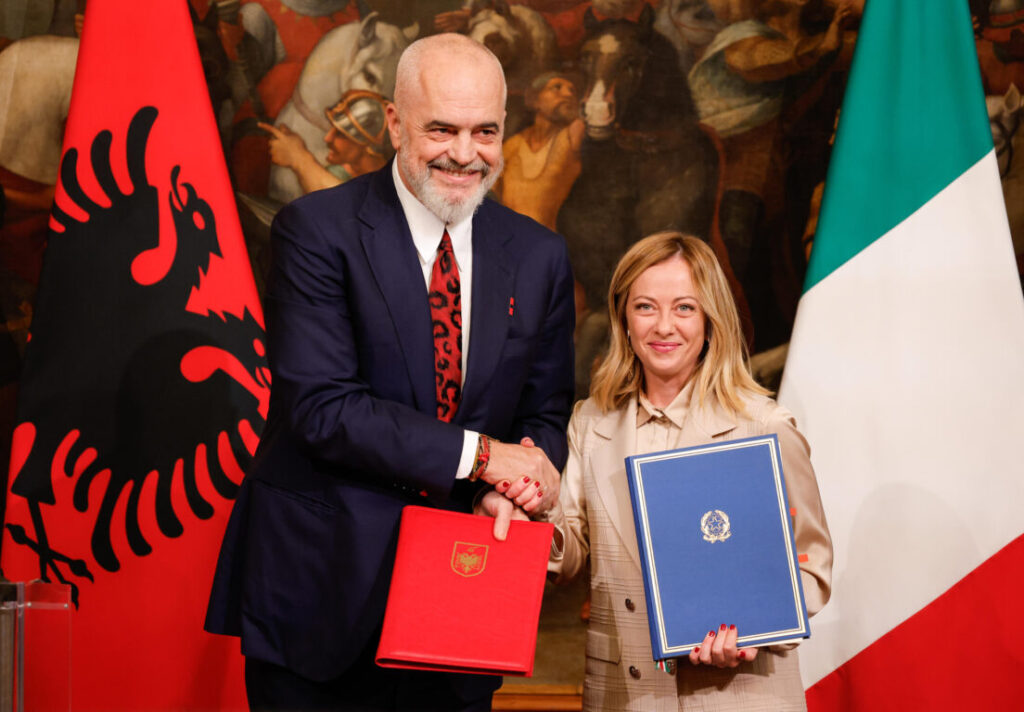
Before meeting Giorgia Meloni in Rome on Thursday, you described her on Instagram as a “sister”—motra in Albanian. How did it go?
“Very well, as always. Once again I had confirmation that your Prime Minister has a clear strategic vision of the relationship between our countries, to which she devotes particular attention despite numerous domestic and international commitments.”
You reviewed the implementation of the Italy–Albania agreements on migrants. Now that the centers have also been declared lawful at the European level, other countries are looking at this model and approaching you?
“After the decision confirming their legality, requests also came from other European countries. But I want to be clear: it is an exclusive concession to Italy. The agreement with Rome cannot be replicated elsewhere.”
You were mayor of Tirana from 2001 to 2011 and have led the country since 2013. What was Albania like then, and what is it like today?
“When I began this work, Albania’s GDP was less than €10 billion. Today it stands at €27 billion. We had 2 million tourists, including Albanians returning from trips. Today, actual tourist arrivals are 8 million.
Foreign direct investment stood at €400 million. Today it exceeds €1.5 billion. How is institutional modernization progressing?
“We have improved the justice system through the evaluation of judges and prosecutors, including those involved in corruption. The separation of judicial careers—which you submitted to a referendum—we have had for some time, as do most European countries. We have separate councils for judges and for prosecutors. When we were drafting the reform, we said: we must not repeat Italy’s mistake.”
In services and public administration, what progress has been made?
“For years now, there have been no queues for certificates or licenses in public offices. Everything is handled through phones and computers. We have not yet digitized marriages, fingerprints, and the cadastre, where order still needs to be restored. After the end of the communist dictatorship, property rights were distributed chaotically, and illegal constructions were later legalized. Apart from the cadastre, everything will be digitized by 2028.”
The appointment of a virtual minister, Diella, created through artificial intelligence, has drawn global attention. Has it improved efficiency?
“It has already helped significantly because it serves as the digital assistant for all Albanians. We are preparing a simplified new version: requests will no longer need to be typed—people will simply speak via video call, and the assistant will provide the service.”
Will Diella also handle public procurement?
“Yes, we are well advanced toward having public procurement managed by artificial intelligence, without direct human involvement, and therefore more transparent.”
How has the special relationship with Italy—longstanding and not only geographic—been strengthened under Prime Minister Giorgia Meloni?
“All Italian governments have been respectful and open. But since this government took office, we have moved from ideas on paper to concrete projects in key sectors such as infrastructure, energy, defense, and healthcare.
We have an agreement with Fincantieri: through a joint venture we will build small and medium-sized ships for export, thereby expanding its production capacity.
We also have excellent relations with Leonardo, with a package of defense activities. We have signed a strategic agreement that allows us direct engagement with Italian excellence and enables us to bring their expertise here in healthcare, education, and training. There is also another important project related to port activities.”
Albania’s urban transformation, with buildings designed by internationally renowned architects such as Liebeskind and Boeri, contrasts with narratives portraying the country as dominated by crime and money laundering.
“Albania is a fairly safe country. Everyone who comes here says so and immediately changes their view on this issue. We are addressing corruption and money laundering seriously. The negative phase is already behind us. Now the task is to dilute the ‘poison’ that remains in certain narratives—reports that cast mud on us and portray our development as the product of organized crime.”
Are the €560 million invested in private construction in 2025 traceable?
“It is absurd to describe these architectural projects—both those under construction and those under approval—as blatant examples of money laundering. All transactions for these projects pass through banks, and the vast majority of banks here are international. To claim otherwise is disgraceful.”
Albania has been a NATO member since 2009 and is now part of a “Board of Peace” initiative backed by Donald Trump. At the same time, tensions with Iran have escalated. How do you view the current geopolitical situation?
“We are living in a delicate moment for Western democracies, which appear to be in decline while new powers are emerging. But Europe’s and, above all, America’s resources remain strong.
At the risk of being unpopular, I believe Trump is an opportunity for Europe to finally wake up. If, as Trump says, God has a plan in his election, it is not only about saving America but also about Europe, which cannot continue living off past glories. Trump acts as a prod for Europe because he exposes its weaknesses. But the remedy must come from Europe itself.”
In recent weeks, we have seen very harsh tones in international debate—for example, the exchange between Donald Trump and Giorgia Meloni following remarks about the Pope. Without entering into specific positions, how is this aggressive language changing political discourse?
“The problem facing democracies today is the public communication of the political class, which reflects something far deeper within our Western societies. Social media have broken down all boundaries of decency and created a toxic environment. It is a nightmare for me to imagine what the next generation of Western politicians and leaders will look like.”
Will you ban social media for minors in Albania?
“They cannot realistically be banned without identification and individual responsibility for what is written. How can you know who is behind a profile—whether it is the father or the son?”
You had previously blocked TikTok but later restored access. Why?
“We expected a harsh reaction. Instead, their executives came to us with openness, to listen to our concerns and work together to fix what was not working. When I asked TikTok’s Director of International Relations why they did not engage in similar discussions with other countries, the answer was: ‘Because they did not ask.’ Albania is the only country to have addressed these issues with us.”
Rama pauses briefly, takes a blank sheet of paper and two crayons—blue and orange—and begins drawing again. Amid his many institutional responsibilities, does he find time to paint?
“I always paint because it is separate from speaking and communicating: while I speak and communicate, I paint. Even here, at this desk, I paint.”
Those ties you design—are they for sale?
“No. I make them for my own pleasure with a school friend, since we were young. I design them and she prints them, but not for sale.”
Initially published by Il Giornale