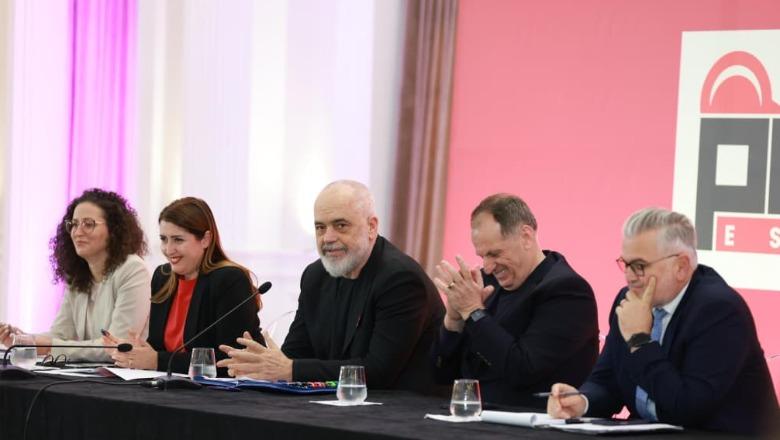
The prime minister spent the first weekend of April moving between a mayoral summit at the Palace of Congresses and a party assembly in Unit 12. The two events together form the clearest signal yet of how Rama intends to frame the run-up to the 2027 local elections.
Aurel Cara | Tirana
Prime Minister Edi Rama opened the weekend with a mayoral working session on Friday at the Palace of Congresses, then moved Saturday to a Socialist Party assembly in Unit 12 of Tirana. The two events were distinct in register but continuous in logic: Friday set the administrative agenda, Saturday translated it into electoral currency.
Together they constitute the formal launch of what Rama is calling the “Works for Albania” tour, a structured coordination exercise between central government and left-aligned municipal administrations that will likely run through the pre-campaign period ahead of the June 2027 local elections.
The mayoral session: a cascade of directives
Friday’s gathering at the Palace of Congresses was framed as a working meeting with mayors across the country, and Rama used it to issue a dense sequence of instructions spanning flood defence, fire suppression, waste management, parking infrastructure, professional education, land regularisation, cultural tourism, civil emergencies, digital services, housing, and credit access. The breadth was deliberate: this was governance performed as competence, and the list was long enough to function as a pre-campaign inventory of state activity.
On flood defence, Rama announced a joint framework document between the Agriculture Ministry and the Defence Ministry for critical infrastructure resilience. He asked mayors to transmit to Local Government Minister Ervin Demo their assessments of weak points in local flood protection systems, covering canals, embankments, and drainage infrastructure. The Defence Ministry would contribute both financing and engineering forces; Rama said a plan had already been made to increase internal capacity so that much of the necessary physical work could be carried out directly by the Albanian Armed Forces’ engineer units.
On fire suppression, Rama acknowledged what he called “inherited deficiencies” in municipal fire-fighting logistics. He announced that a recently established public-private company within the Defence Ministry’s system had received a mandate to begin domestic production of fire-fighting vehicles, which would then be allocated to municipalities. He described the growing severity of summer fire seasons as a reason to treat this as urgent and recurring rather than episodic.
A fleet of canal-cleaning vehicles, funded with what Rama described as substantial financial support from the government of the United Arab Emirates, was also announced. The fleet will be distributed to municipalities on the basis of criteria Rama did not fully specify.
On waste, Rama announced a task force between central government and municipalities to address collection and processing problems, particularly in tourist zones outside urban cores during the high season. The Environment Minister and the Local Government Minister were jointly tasked with producing a short, medium, and long-term plan covering everything from mass public awareness to structural interventions.
On parking, Rama announced a national programme for parking logistics, targeting dense residential blocks in large cities where informal parking had generated what he called a “jungle” dynamic. The programme would involve agreements with property owners, underground and above-ground construction, green space on upper levels, and an architectural quality requirement. Rama was explicit that structures visible above ground should constitute “architectural added value” to the city, not merely functional storage.
On professional education, Rama instructed mayors to identify gaps in vocational school capacity and to map needs for dedicated boarding facilities. The government’s existing programme of technology laboratories in schools, currently at over 300 installations, is targeted to reach 1,000. Rama instructed municipal administrations to organise access systems so young people could use the laboratories outside school hours, framing after-hours access as a distinct municipal responsibility separate from the school timetable.
On land regularisation, Rama called on every municipality to establish a dedicated legal assistance office to support the State Cadastre Agency. He acknowledged widespread complaints about the cadastre but attributed a large portion of them to procedurally defective applications rather than institutional failure. Citizens, he said, are currently paying notaries for legal guidance they should be able to obtain free of charge through a municipal office. A coordinated prioritisation system, under which earlier applicants are processed before later ones and municipalities define priority zones transparently, was presented as the framework for making the process fairer and more predictable.
On the address system, Rama called on mayors to engage seriously in completing the national address database finalisation process, noting that a legal mechanism to penalise individuals who refuse to cooperate with local authorities in registering their addresses would be introduced. The Interior Ministry’s coordination of this process would be led by the Local Government Ministry.
On digital services, Rama noted that administrative units have generally opened access points for the e-Albania platform, but said that not all municipalities have organised this adequately, with the result that citizens who are entitled to free digital services are paying intermediaries to access them on their behalf.
On cultural tourism, Rama announced that the Culture Ministry is underway with a process of identifying, expropriating, and converting historic buildings in old urban centres and rural settlements across the country into small museums. He asked mayors to identify candidate buildings in their areas, share them with the Culture Ministry and the Institute of Cultural Monuments for classification, and develop musealization plans. He used the absence of a museum dedicated to rakia, Albanian wine, or Albanian olive oil as illustrative examples of the kind of product-specific cultural infrastructure that could attract visitors and generate economic return.
On civil emergencies, the Local Government Ministry and the Defence Ministry were jointly tasked with working with municipalities to strengthen local emergency response capacity.
On credit access, Rama announced that an agreement had been finalised with the Bank of Albania that day to relaunch the sovereign guarantee programme and the central bank’s credit line, expanding the programme’s scope from its original focus on villages, agriculture, agrotourism, and agro-processing to cover all small and medium enterprises seeking to grow. He described a doubling incentive programme for enterprises in the agro-processing and agribusiness sectors as the first application, while signalling that broader SME access would follow.
On urban planning, Rama announced a significant legal reform that would merge three currently separate agencies: territorial planning, territorial development, and housing, into a single structure. He indicated that affordable housing, not just social housing, would become a stated priority of the merged body, consistent with commitments made during last year’s election campaign. He also noted that the Planning Agency would make foreign architects working in Albania available to municipalities for project support at no cost.
On the Mountains Package, Local Government Minister Ervin Demo reported before Rama’s remarks that more than 50 percent of municipalities had approved their priority zones, with 272 priority zones now designated across 32 municipalities and more than 500 applications received. Several municipalities have entered the 45-day public notification phase. Demo said the targets remain achievable and that some municipalities have requested expansion of their priority zones. Rama added that in one unnamed municipality, the ten investments already calculated under the package sum to five million euros, the capital coming from diaspora members.
The Unit 12 assembly: Europe as electoral argument
Saturday’s event in Unit 12 was a party assembly, and its logic was different: here Rama was speaking to the Socialist base, and the register shifted from administrative inventory to political mobilisation.
The central argument was that EU membership is an imminent historical opportunity whose realisation depends on keeping the Socialists in power. Rama described the current moment as one in which “the stars of fate have aligned,” attributing this not only to Albania’s own reform performance but to a broader European strategic interest in expansion that has created a window of external willingness the country has never before enjoyed. “The EU wants to take us into itself,” he said. “This is extraordinary. We must do everything in our power to ensure the door closes only after we are inside.”
He cited Albania’s negotiating record as evidence of momentum: all negotiating chapters opened within eleven months, a pace he said no other candidate country had matched. He dismissed opposition claims of a negotiating blockage as political fabrication designed to undermine national interest, and framed continued Socialist electoral dominance as the only reliable guarantee that the accession process would not stall.
The electoral argument was direct. Rama said the 2027 local elections were not merely a routine cycle but a foundation-setting exercise for the country’s European trajectory. He told the assembly that the Socialists have the capacity to win every polling station if they organise properly, and that where they have failed to win in the past it was a function of internal organisational failure rather than genuine competitive weakness. The performance directive was blunt: the coming two to three months must be used to build the base for a deeper victory than previous cycles.
On economic credibility, Rama returned to several familiar metrics: tourist arrivals rising from roughly two million to twelve million, with the clarification that the earlier figure had included Albanian passport holders returning from abroad, who are not counted in the current methodology. He cited systematic wage increases; pension increases; the new seniority pay scheme for teachers, doctors, military personnel, and police; and growth in state revenue. He rejected claims that corruption has increased, arguing that rising revenues, rising wages, and rising numbers of beneficiaries from public procurement competitions are structurally incompatible with a worsening corruption environment. “Whoever says corruption has grown is telling a very big lie,” he said.
He did not spare the opposition. Those who are not Socialists, he said, “are so blind they confuse opposing us with the national interest and the common good of the country and all our children.” The framing was characteristic: the political contest is not between competing visions of Albania’s interest but between the Socialists’ correct reading of that interest and everyone else’s blindness to it.
What is being built
The two events together reveal the architecture Rama is constructing for the pre-2027 period. The mayoral working session serves multiple functions simultaneously: it gives left-aligned mayors a coordinated agenda, it creates a visible governance record to run against in the campaign, and it demonstrates the practical advantages of having a mayor aligned with the central government at a moment when significant resources are flowing through municipal channels. The Mountains Package, the UAE-funded fleet, the laboratory programme, the parking scheme, the credit line relaunch, and the agency merger all carry allocative decisions that mayors can present to voters as direct returns on political alignment.
The Saturday assembly served a different but complementary function: it bound the EU accession narrative tightly to Socialist continuity, framing any vote against the Socialists as a vote against Albania’s European future. This is not a new argument in Albanian politics, but the specific historical moment gives it more operational weight than it has carried in previous cycles. The opening of all negotiating chapters in under a year, whatever its deeper significance for actual accession timelines, is a concrete accomplishment that is difficult to dismiss. Rama is making it the centrepiece of a political argument whose internal logic is simple: the window is open, only we can walk through it, do not change horses.
The opposition does not appear in these two days as a substantive interlocutor. It is invoked only as a cautionary counterexample and a mobilising foil, its arguments dismissed without engagement.
The pace of the coming weeks will test whether the administrative agenda announced Friday translates into visible municipal action or remains at the level of announced intention. Several of the directives, including the weak-point assessments for flood infrastructure, the legal offices for the cadastre, the address system compliance mechanism, and the museum identification process, require mayors to take active steps before any central resource flows. Whether that follow-through materialises will be one of the first tests of whether “Works for Albania” produces governance or produces imagery.