The Albanian prime minister says Tirana is looking at measures taken in France and Italy against violent demonstrations, warns of criminal and financial consequences, and renews his offer of dialogue with protesters. Interior Minister Ervin Demo says police are using hundreds of hours of footage to identify masked perpetrators.
Tirana Examiner Newsroom
Prime Minister Edi Rama said on Saturday that violence during the recent protests in Tirana had been carried out by people radicalised by ANTIFA, religious extremists and criminals operating under the cover of student demonstrations. He announced that his government would shortly present new security measures drawing on steps taken in France and Italy, alongside measures addressing the cost of living, housing and social inequality.
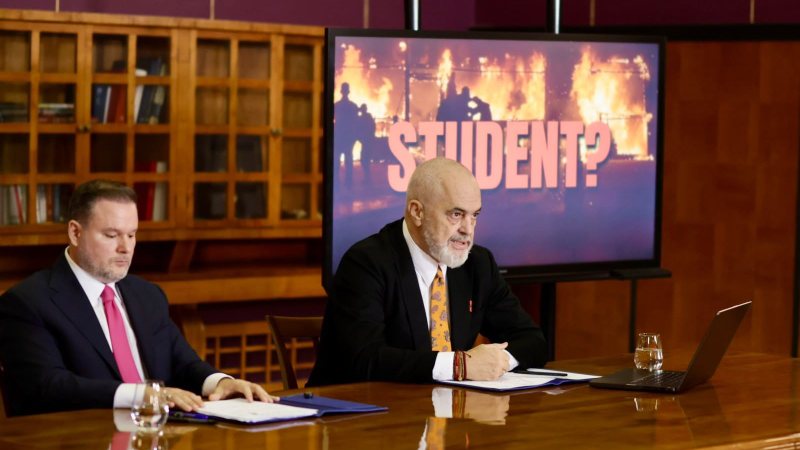
Speaking at a press conference alongside Interior Minister Ervin Demo, Rama described the attacks on public institutions and private property as “urban terror” and said those responsible were seeking to force the government into submission.
Rama said the government would distinguish between citizens demonstrating over legitimate economic and social grievances and groups accused of using the demonstrations to organise violence.
“We are working intensively to address both sides of this coin,” he said. “We are very attentive to the real reasons and causes that make many people, regardless of whether they vote for me or not, feel the need to protest, as long as they distance themselves from violence.”
“That urban terror was caused not by a large mass of people but by people radicalised by ANTIFA, religiously radicalised and radicalised by crime, in order to use violence.”
The French and Italian precedent
Rama linked the violence in Tirana to disorder in France and Italy, whose governments have also faced violent demonstrations.
“Given that at the same time, in all three of our countries, the plague of ANTIFA’s urban terror has appeared with its own blind force,” he said, the Albanian government was examining measures taken by its European counterparts.
He described individuals who had allegedly infiltrated the protests as “people incited and paid to stir religious division, civically radicalised, people with criminal records inserted into the crowd, masked as students in order to use violence.”
“Looking at the steps they took in Italy and in France, we will come out very soon with proposals and with very concrete measures,” Rama said.
On security, he said the government was acting “in cooperation with our partners and looking at the steps they took in Italy and in France.”
The prime minister did not specify the proposed security measures or give a date for their introduction.
Criminal and financial consequences
The prime minister warned that the government’s response to violence would be sustained and that consequences would extend beyond those who physically carried out attacks.
“All those who echo violence, or use violence, must understand that as intensive as the urban terror was, that long and that insistent will be what comes from the side of the state,” he said.
“Whoever thinks he brings the state to its knees makes the most mistaken calculation.”
He said people using student demonstrations as cover for violence would face consequences.
“Whoever thinks that by hiding under the mask of the student he can bring here the urban terror of ANTIFA and do the work of those who want Albania divided along religious lines and want it cut off from its glorious history of tolerance and understanding must be clear that he will pay in all forms: criminal for its direct perpetrators, and financial for those who glorify and propagate it.”
Rama did not explain what legal provisions would be used to impose financial liability on those he described as glorifying or propagating violence.
The unnamed “professor”
Rama alleged that a core group of protesters had been ideologically radicalised by a public figure whom he declined to identify. Albanian media, including Tema, read the reference as pointing to Arlind Qori, the leader of Lëvizja Bashkë.
He described the group as “an ANTIFA group there, ideologised by the well-known ‘professor’, the well-known ‘preacher’ of violence whom everyone knows and whom I do not even want to name.”
The prime minister accused the group of exerting pressure on other participants.
He said its members possessed “a truly striking ability and capacity to put others into psychological terror and to force others to follow behind them.”
He identified another alleged component of the violence as individuals with criminal backgrounds.
“Then there was another component too,” he said, “a component of criminals who were present, gallows-and-rope people, who did their part in that protest.”
Rama said he expected the protesters themselves to confirm his account in time, and spoke of forces behind the movement without identifying them.
“I am convinced that the days and months will bring to light the testimony of those protesters themselves, when they free themselves from this whole vortex of an entirely imaginary revolution, behind which stand also forces that do not want Albania’s progress,” he said. “That is little, but it is very certain.”
Lëvizja Bashkë had not responded to the prime minister’s remarks at the time of writing.
Four months of protests and private contacts
Rama rejected suggestions that his government had ignored demonstrators who had gathered outside the Prime Minister’s Office over the preceding four months.
“I want to tell you all that whoever says that until today I have been, and we have been, indifferent to those who came for four months beneath the window of my office forgets that in fact, for four months, I have heard more than anyone else, and as much as they have heard each other, everything they have said,” he said.
“Because I was working upstairs in the office, and they were swearing, insulting, threatening below the office, without ever saying anything concrete and without ever asking for anything concrete, indeed continually refusing to sit down and talk.”
The prime minister said he had personally contacted several participants, including through telephone calls and private messages, but would not release the correspondence.
“I have said it, I do not intend to show message exchanges with a number of them who were down there.”
“I have also communicated by telephone, I have invited them, and what has characterised them is fear of one another: the wish to talk, but fear of one another, fear that they would be labelled traitors, fear that they would then suffer the consequences of the violence of the others.”
According to Rama, that fear had prevented some protesters from accepting an invitation to talk with the government.
He also described a conversation the previous day with a medical faculty lecturer whose political views differ from his own.
“Yesterday I had a friendly telephone conversation with a lecturer at the Faculty of Medicine, known for his positions on the other side of the political spectrum,” Rama said.
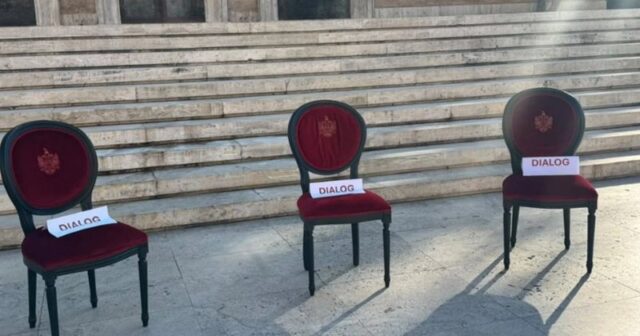
“I told him that a protest is held in order to be heard. To sit at the table.”
Rama said he had asked why the academic had joined the demonstrations.
“The reasons he gave me were all things connected with entirely specific and legitimate reasons. I told him, we sit down and discuss it.”
The prime minister did not identify the lecturer.
“Insisting on protest is senseless”
Rama said peaceful protest was a democratic right but argued that dialogue should take precedence when the government was prepared to engage.
“Any protest held in order to be heard becomes a problem when the government, when the authorities, when the institutions do not want to listen,” he said.
“Whereas when the institutions, the government, the authorities say we are here, we are ready to listen to you, we are ready to talk, we are ready to understand and to reach understanding, then insisting on protest is senseless, if that is its purpose.”
“While the freedom to protest is an undeniable right, violence is a punishable crime.”
He said demonstrations organised by citizens should provide a route for presenting grievances rather than forcing a change of government.
“A protest is not held to overthrow the government, or to overthrow the governing majority, by violence,” Rama said.
“Naturally, when this protest is not the protest of a political party but the protest of a segment of citizens, then its meaning is that we sit down and talk.”
He said the government would continue working simultaneously on social demands and public security.
That included “guaranteeing security, order and calm by taking measures against the violent, taking measures against anarchy, taking measures against the idea that I am free to protest and in the name of that freedom I can take from everyone else the freedom to move, the freedom to work, the freedom to live, the freedom to take their children to school, and so on.”
Cost of living, housing and meritocracy
The prime minister acknowledged that economic pressures and the demand for greater social opportunity were legitimate concerns.
He said the government was preparing measures on the cost of living, housing affordability, merit-based advancement and social redistribution.
“The needs of that part of society that needs a more aggressive approach by the Government to the rising cost of living are my absolute focus and the Government’s,” he said.
“It would be better still if we had a dialogue with those who want to articulate these needs and their ideas on how these needs can be addressed.”
“We will present day by day what is our daily reflection on what a part of society is trying to tell us.”
Rama described a section of society demanding greater government assistance as “unquestionably respectable and respected”.
He said those citizens were asking for “more support”, “more merit in the ladder of promoting ability” and “more opportunities to find housing without having the breath squeezed out of them by the cost of housing in Tirana”.
They were also calling for “more redistribution and, let us say, social equality”, he said.
“We are absolutely focused, and we will soon make known what the measures we will take will be.”
Rama added that the government had heard from people who sympathised with the demonstrations without necessarily taking part in them.
“We will present what is our general reflection on what a considerable part of society is trying to tell us, simply and only by sympathising with a protest in which it sees the need, and sees the way, to make the government even more attentive.”
No detailed proposals, funding commitments or implementation dates for the social measures were announced at the conference.
Demo: police identifying masked perpetrators
Interior Minister Ervin Demo said police investigators were using images from television coverage, social media, security cameras and public and private institutions to identify individuals involved in violent incidents.
“We are advancing quickly as regards the identification of all the violent persons, and in fact they have been filmed themselves by the images of the public media, or the cameras of institutions, or the footage they themselves have posted through social networks,” Demo said.
“We have in fact day by day cases which are identifiable even when the protesters have hidden their faces with masks; we have still managed to identify all the protesters who committed acts of violence. This process will continue.”
The minister described several categories of material being examined by investigators.
“There is a series of information sources being used, starting with those that are public, with the coverage the various media have had of the protests that took place, likewise the social networks, and at the same time all the images from those public or private institutions, private or public property, that were vandalised during these days have been included.”
“This process is fortunately today being eased by technology itself, to make it faster.”
Demo said the volume of recorded material available to investigators was substantial.
“There are hundreds of hours of footage from different sources, but through technology we are advancing quickly in identifying the violent persons,” he said.
“The State Police will work every day for as long as it takes to bring before justice all those who destroyed public property, all those who harmed private businesses, and the police is doing this, thanks also to technology, faster and more precisely.”
The minister did not specify the identification technologies involved or provide a breakdown of arrests and prosecutions during the conference.
Fresh violence reported at the Education Ministry
Rama left the Prime Minister’s Office shortly after 11:30, after renewing his invitation to the protesters for dialogue. The full text of his remarks was later published under his name as an opinion piece titled “Peaceful protest is a democratic value and a civic challenge that is maximised through dialogue and reflection.”
By early afternoon, protesters had gathered outside the Ministry of Education on Rruga e Durrësit, including individuals wearing masks.
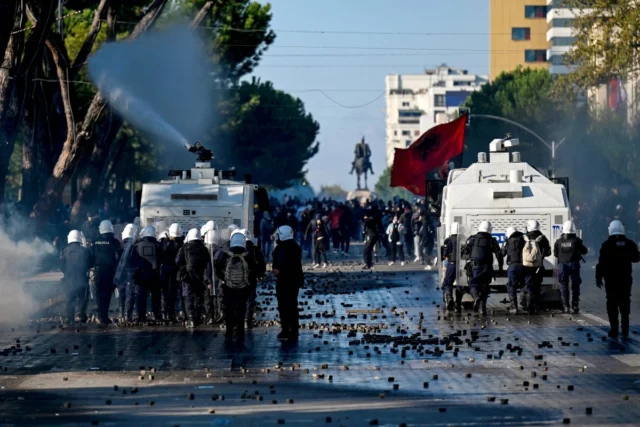
Rubbish bins were set alight, paving stones were removed from the pavement and stones and other hard objects were thrown towards police officers.
At 13:21, the State Police issued a statement warning of calls for violence and attacks on officers, including messages concerning gatherings of masked individuals equipped with Molotov cocktails and sticks, and set out the measures it had taken.
Police Director General Hita inspected deployments on the ground and instructed officers to remain calm, assist citizens in need and act in accordance with the law.
The same outlet reported that a national demonstration called by the opposition Democratic Party had attracted a relatively small group of party supporters, with party leader Sali Berisha absent and students not joining the gathering.
The government had not announced the contents of its planned security and social measures by early Saturday afternoon.