Three times Albania was on its knees, in 2019, 2020 and this October. Three times the help came from the one European country that does not go to church. The capitals that preach the Gospel to the Balkans stood in the doorway and made it worse.
By Maringlen Cara (Tirana)
There are three rules in the Gospel that every European schoolchild once knew. Help the one who has fallen by the road. If you cannot help him, do not pile more weight on his back. And when you enter a man’s house, say peace to that house and respect it as his.
Europe wrote those rules into its cathedrals and its treaties. For nine days in Tirana, one European country kept them. It was the one that does not go to church.
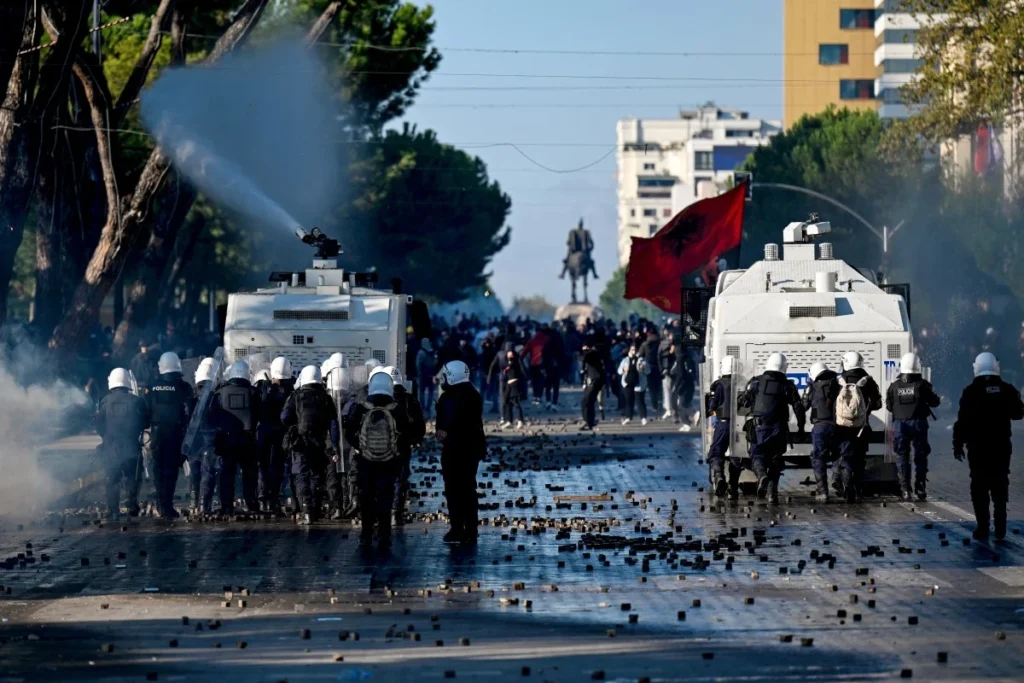
When the masked crowds came for the Ministry of Education, then for the Prime Minister’s office, then for banks, shops and the courts, the Albanian State Police stood between a city and its burning, with equipment wearing out faster than it could be replaced. Turkey sent what was needed. A Turkish military transport landed on Monday with water cannon trucks, the visible part of a week of support that kept the police able to hold the line without shooting anyone. One other country from the same part of the world helped too, quietly, and asked not to be thanked in public. Its wish is respected here. Turkey did not ask.
This is the third time.
In November 2019, when the earth moved under Durrës and Thumanë, Turkish search-and-rescue teams were digging on the day of the earthquake. The 504 homes Turkey built in Laç were for families whose houses had fallen on top of them. Laç is a Catholic town, under the pilgrimage church of Saint Anthony. The Muslim country built the Catholic families their houses. The Christian capitals pledged theirs in February, at a donors’ conference in Brussels. Ankara arrived in November, with its hands.
In March 2020, when the virus came, the European Union locked its masks and gowns inside its own borders. The export ban on protective equipment adopted on 15 March covered the Western Balkans too, in the weeks when Albania had almost nothing. Edi Rama called Ankara. The only airline still flying out of Tirana was loaded in Istanbul, Turkish ambulances followed, and a Turkish Armed Forces aircraft brought Red Crescent supplies in May. Brussels reopened its doors later, with a press release.
Christ’s harshest words were for those who tie up heavy burdens and lay them on other men’s shoulders while refusing to lift a finger themselves. The Delegation in Tirana lifted no finger for the police and laid the burden on them: it hurried to condemn the officers while the officers were under attack, and found no word for the men attacking them. Tirana had to burn for the Delegation to discover the word “violence”. The Foreign Ministry spokesman in Berlin sided with the protesters from the podium. The American embassy managed three sentences. None of them said, then or since, the one sentence that would have cost nothing and might have emptied the boulevard: regime change through violence is unacceptable. Every masked man with a metal bar heard that silence as permission. That is not failing to help. That is making it worse.
The third rule is the oldest. Ambassadors are guests. The German embassy saw the fire as an opening and tried to impose on Albania a governing formula no Albanian voter had chosen. The EU ambassador gave to the opposition the most valuable photograph on the day the capital burned and let the photograph do the talking. The guests of this country spent the week measuring its rooms for new tenants.
In the three moments when Albania was on its knees, the European that acted like a Christian was the Muslim. Turkey helped. It did not make it harder. It respected the house. The capitals that preach the Gospel to the Balkans failed on all three counts, and on the last two they did not stand aside. They pushed.
The Samaritan in the parable was the outsider, the one the priest and the Levite crossed the road to avoid. He bound the wounds, paid the innkeeper and moved on. Nobody asked which god he prayed to. Albania will not forget who stopped on the road this October, or who walked past and then wrote a statement about the man in the ditch.
Thank you, Turkey.
Maringlen Cara writes on religion, law and public life in Albania and the region. A Catholic and a constitutional conservative, he holds that a church which serves the state stops being a church.