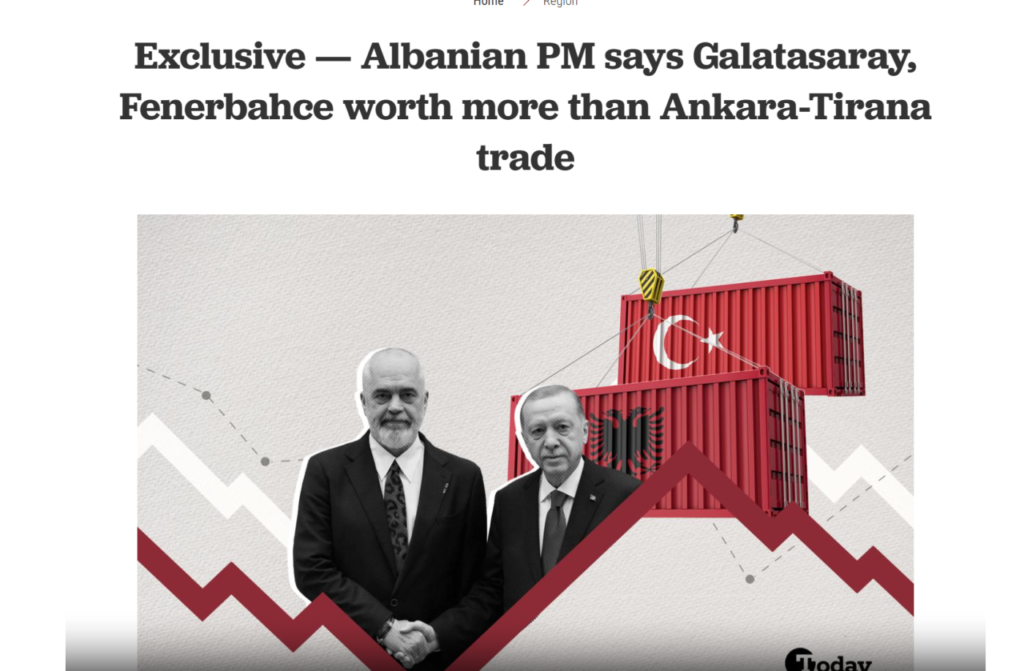
Albania and Türkiye share a warm bilateral relationship, a record of political solidarity, and a personal rapport between their leaders that Rama describes as genuinely easy. What they do not share, the Albanian prime minister told Türkiye Today this week, is an economic relationship that matches any of that — and Rama is no longer content to leave the gap unaddressed
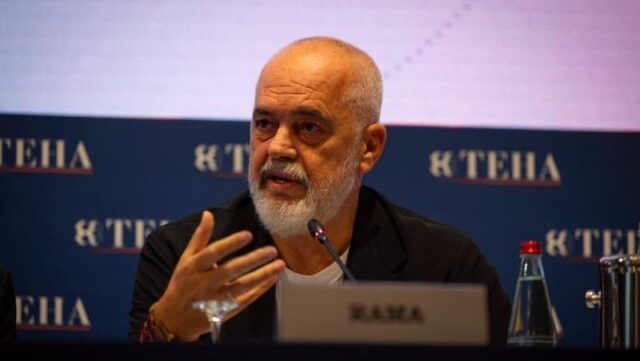
Albanian Prime Minister Edi Rama has offered one of his sharpest public assessments of Türkiye’s economic presence in the Balkans, telling Türkiye Today in an exclusive interview published Thursday that the relationship between Tirana and Ankara is politically robust but economically hollow — and that Ankara bears responsibility for closing the gap.
The headline remark came when Rama reached for a football analogy to illustrate what he sees as a structural imbalance. “I didn’t make the counts of the value of Galatasaray and Fenerbahce, but I’m afraid that taken together, that value is higher than the trade value between Türkiye and Albania, and it is not enough,” he said. “We should at least overcome the Turkish league.”
The line was designed to land — and it did. But the broader argument Rama was making deserves more than the soundbite. His critique was not of the relationship itself, which he described warmly, but of the gap between Türkiye’s political weight in the region and its economic footprint. That gap, in his telling, has become the defining problem of the bilateral partnership.
Rama was careful to separate the personal from the structural. He described President Recep Tayyip Erdogan as a “great friend” and praised him in terms that are, for Rama, unusually direct: “He is very straightforward; yes is yes, no is no.” The personal rapport, he said, is genuine. But it is also, in a sense, part of the problem. “The biggest, indisputably higher product that Türkiye has exported to the region is President Erdogan and his popularity,” Rama said. “I don’t know if he likes what I say now, but I say it is not enough. It should be something beyond him.”
The figures give the remark some grounding. Bilateral trade between Albania and Türkiye exceeds $1 billion, with a stated target of $2 billion. Turkish investment in Albania is estimated at roughly $3.5 billion. By the standards of a small Balkan economy, these are not trivial numbers. But Rama’s argument is less about the absolute figures than about what is missing: a flagship project, a structural anchor, something that would make the relationship legible in economic terms independently of who is in office in Ankara. No such project currently exists. Rama said so plainly: there is no “biggest, indisputably higher product” on the economic side to match Erdogan’s political brand in the region.
He pressed the point further with a remark aimed as much at Belgrade as at Ankara. Dismissing what he called the “nonsense” of accusations of Turkish neo-Ottoman ambitions — a charge Serbian President Aleksandar Vučić has leveled repeatedly — Rama turned the argument on its head. “I am sure, by being someone obsessed with numbers and figures, the president of Serbia can very well see that Türkiye invested more in Serbia than in Albania and Kosovo taken together.” The observation was dry, but the implication was pointed: if Türkiye harbored expansionist ambitions toward Albanians, the investment record does not show it.
On Serbia and Kosovo, Rama was characteristically unsparing. He rejected Vučić’s recent claims that Albania, Croatia, and Kosovo were forming a military alliance targeting Belgrade, attributing them to what he described as Vučić’s unresolved psychological fixation on Kosovo’s independence. “President Vučić is someone really with great knowledge, great intuitions, very much looking forward to many things, but he has his own nightmare: it is Kosovo. That is it. Full stop.” When the nightmare overwhelms his judgment, Rama suggested, Vučić says things that do not hold up. The supposed alliance, he noted, is weaker in practical terms than existing Serbia-Croatia defense arrangements.
His prescription for Belgrade was the same one he has offered before, and it has not changed: release Kosovo, and the nightmare lifts. “By letting it go, your nightmare will be over.” He was careful, however, not to foreclose engagement. Vučić, he said, remains “someone with whom one can talk and can build together based on common objectives” — a formulation that keeps the diplomatic door open while declining to pretend the fundamental impasse does not exist.
On Albania’s EU trajectory, Rama allowed himself no equivocation. The country decoupled from its neighbors last year to open all remaining negotiating clusters in record time; the target is full membership by 2030. Asked whether Albania has a contingency if Brussels stalls, he was flat: “There is no Plan B.” He acknowledged the frustrations of the process — “painful,” sometimes “humiliating” — but framed the accession framework itself as valuable independent of its endpoint, a mechanism for institutional reform that Albania needs regardless of what Brussels ultimately decides.
The interview, conducted by Türkiye Today’s Mustafa Cuhadar, ranged across the Dayton Agreement’s anniversary, regional security dynamics, and Albania’s bilateral relationships. What distinguished it was less any single disclosure than the register Rama chose throughout: a leader sufficiently confident in a partnership to make public demands of it, and sufficiently clear-eyed about the region to say, without diplomatic padding, what he actually thinks
For the interview CLICK HERE