Tirana Examiner Newsroom
Over two days this week, Prime Minister Edi Rama moved through Berat, Fieri, Lushnja, and toward Vlora in a series of party assemblies and public meetings grouped under the banner “Punët për Shqipërinë,” Works for Albania. The tour, the first sustained post-election circuit since the Socialist Party secured 83 seats on May 11, was designed to consolidate the mandate and communicate a governing agenda directly to party structures and citizens simultaneously. What emerged across the four stops was a coordinated message architecture, not a series of discrete events: the same arguments appeared in Berat on Thursday evening and in Lushnja on Saturday afternoon, sharpened each time they were repeated.
The Agricultural Package
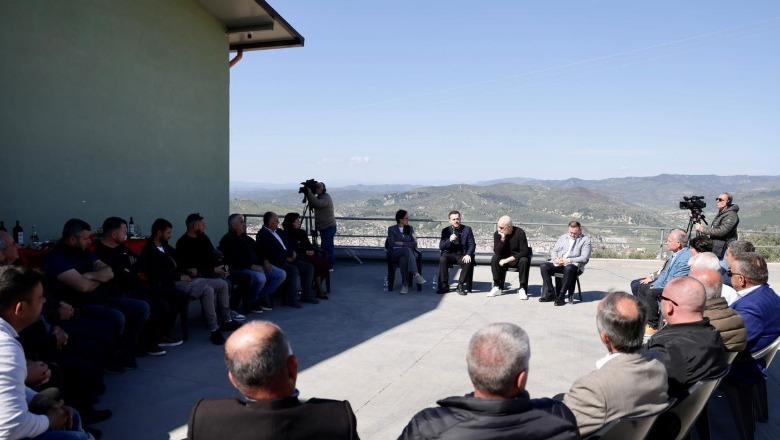
The most concrete policy announcement of the tour came in Lushnja, Albania’s agricultural heartland, where Rama appeared alongside Agriculture Minister Andis Salla and Economy Minister Petrit Malaj to meet directly with farmers. He announced that the government will launch a new support package by the end of April: bank credit of up to two million euro per farmer, with the state entering as guarantor through a sovereign guarantee mechanism. The framing was deliberate. Rama told the room that Albania now has small productive realities capable of scaling, and that the guarantee scheme is designed to make that scaling possible without requiring farmers to carry the full credit risk alone.
The Lushnja meeting also served as the most detailed public explanation yet of the government’s decision to eliminate the fuel tax exemption for farmers, a measure that has drawn sustained criticism from the opposition and from farming communities since it was announced. Rama’s argument, made at length and with evident frustration, ran on two tracks. The first was structural: the old scheme allocated the subsidy based on land area rather than on actual agricultural activity, meaning that in many cases the beneficiaries were landowners rather than the tenants who actually worked the land. The second was European: the EU does not operate fuel subsidy schemes of this kind, and Albania’s accession trajectory makes maintaining the scheme increasingly difficult to justify in Brussels. The replacement, he said, is a ten percent cashback on invoiced agricultural sales, meaning the support follows the transaction rather than the land title. A farmer who sells produce and presents the invoice receives ten percent of the invoice value back from the state, which can then be spent on fuel or anything else. The policy logic is cleaner; the political problem is that it requires farmers to formalize transactions they have historically kept informal.
Pensions and the 2030 Commitment
In Berat on Thursday, Rama addressed a meeting with pensioners before the party assembly, and the pension trajectory he outlined there was the most specific he has been on the subject. The commitment is structured as annual doubling of the increment: whatever increase pensioners received in January 2025 will double in January 2026, triple in 2027, quadruple in 2028, and reach five times the original increment in January 2030. He tied this explicitly to the fiscal stability of the social insurance scheme, acknowledging that previous governments, including his own in earlier terms, could not make this commitment credibly because the scheme’s foundations were not solid enough to support it. The pension promise is now, he said, one hundred percent guaranteed in the budget.
In Fieri on Saturday, the wage indexation announcement was added to the same frame: the government has begun indexing public sector wages and has legislated seniority recognition for public employees. Both measures were presented as overdue corrections rather than new initiatives, which is accurate but also conveniently positions them as inherited problems finally resolved rather than policy choices made under political pressure.
The Corruption Argument
Across all four stops, Rama deployed a consistent syllogism on corruption that is worth examining carefully. The argument: corruption cannot be rising, as the opposition claims, because the economy is rising simultaneously. GDP growth, rising budget revenues, increased numbers of companies participating in public tenders, and rising wages are offered as structural proof that systemic corruption is not the dominant force in Albanian public life. In Berat he added that an EU report expected to be published in the coming days will rank Albania first in the Western Balkans on anti-corruption metrics, though he did not identify the report or the specific mechanism being cited.
The argument has political force as a rally register. As analysis it has a well-known vulnerability: corruption and growth are not mutually exclusive, particularly in economies where construction activity and foreign direct investment are the primary growth drivers, and where rent extraction can be embedded in project flows without appearing in aggregate output figures. The opposition has not yet effectively articulated this counter, which is partly why Rama keeps using the syllogism. In Fieri he sharpened it further, saying that corruption in Albania does not make the law and does not dictate outcomes, which is a meaningfully different claim from saying corruption does not exist.
The European Negotiations
The most politically charged thread of the tour was Rama’s categorical denial that Albania’s EU accession negotiations have stalled. In Lushnja he called the opposition’s claim “a lie with seven tails,” deploying a folk idiom that signals not merely falsehood but elaborate, deliberate fabrication. He said Albania is proceeding according to the EU’s plan and placed Albania alongside Montenegro in the accession rankings, a comparison that implies meaningful progress on cluster openings.
The Montenegro framing is analytically significant. Montenegro has been the Western Balkans’ accession frontrunner for over a decade and has a substantially more advanced chapter status than Albania. Placing Albania alongside it is either an accurate reflection of recent cluster-level progress or a rhetorical overreach, and the distinction matters for anyone tracking the actual IBAR deliberations and the positions of the nine EU member states that have complicated the common position in COELA.
Rama also went further than at previous stops in attacking the opposition’s lobbying activity in European capitals, describing it as parties going around Europe to “dismember their own country in a foreign language.” The formulation was the sharpest of the tour. Democratic Party leader Gazmend Bardhi responded the same day, rejecting Rama’s dismissal and tying the negotiation difficulties directly to the Balluku immunity vote and its diplomatic fallout, which remains the opposition’s strongest documented argument on the European file.
What the Tour Accomplished
Four cities in two days, with Vlora scheduled for Monday, is a high operational tempo for a post-election consolidation circuit. The tour’s function is not primarily to announce policy, though the agricultural package and the pension trajectory are genuine announcements. Its primary function is to occupy the public narrative at a moment when the opposition is attempting to use the European file and the corruption debate to erode the mandate. Whether it succeeds in that function will depend less on what was said in Lushnja and Fieri and more on what the EU actually publishes in the coming weeks.