Sputnik Srbija has told its readers how to hear the EU’s new ambassador before he has said anything. Belgrade tested the method on KFOR’s commander three weeks ago; the platform is one Brussels asked it to close.
by Ardit Rada (Tirana)
Sputnik Srbija does not load in Kosovo. It loads in Tirana, in Serbian, for an audience that rounds to zero, which is why we read it here. On the evening of 3 September, the day after Dirk Schuebel took office as the European Union’s ambassador in Prishtina, the portal published its assessment of him under the headline “History repeats itself: what does the German bring to Prishtina.” The illustration was a computer-generated image of three flags. The analysis was supplied by Stevica Deđanski of the Centre for International Cooperation, and its first finding did not concern anything the new ambassador had said or done.
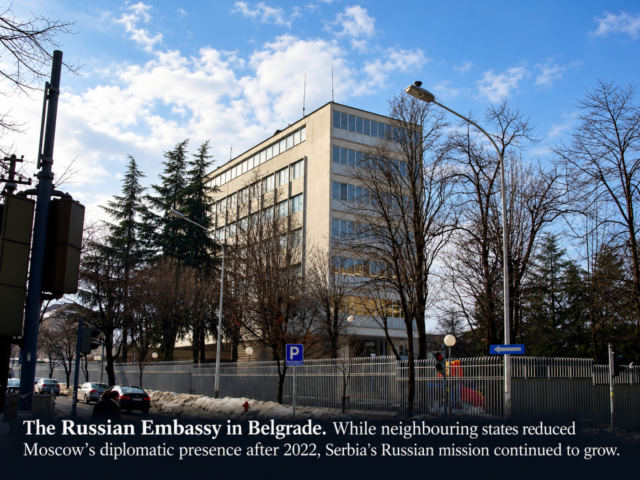
A word on the venue, because the venue is part of the message. Sputnik Srbija is Rossiya Segodnya’s Belgrade newsroom, staffed by journalists paid from Moscow and publishing in Serbian since 2015. Its content is free to republish, and the tabloids closest to the Serbian government, Informer and Večernje novosti among them, republish it routinely; in Republika Srpska the public broadcaster does the same. Montenegro banned the outlet in April 2022. Serbia has chosen to frame its continued presence as a question of sovereignty. On 26 June Serbia’s information minister, Boris Bratina, told RT Balkan that EU calls to block RT Balkan and Sputnik amounted to censorship. On 8 July, after eight member states declined to open Cluster 3, Aleksandar Vučić named shutting Russian media as one of the two objections and said Serbia would not do it. What follows, then, was published on a platform Belgrade has chosen to keep at the price of an accession cluster.
“The Germans are old Serbian ‘friends’ through history, and that is already a sufficient signal of what we can expect,” Deđanski said. The quotation marks around “friends” are his. Sufficient signal: the biography came second, the mandate and the first-day statement after it, and all were read in the light of the first. Only afterwards did the text turn to Schuebel’s postings, and there it selected one item. As EU ambassador in Minsk he “was accused by Minsk of interfering in the 2020 presidential election.” The accuser goes unnamed. It was the Lukashenko government, after an election the EU declined to recognise, and the charge was the one levelled at every Western mission that autumn. Schuebel stayed in Minsk when member states withdrew their ambassadors; he was summoned and invited to leave in June 2021, four days after the Ryanair sanctions; his accreditation was not renewed. The credential Sputnik presents as a stain is that Aleksandr Lukashenko wanted him gone.
The frame was ready before the man
Deđanski’s central claim is that the appointment is “the European Union returning blows to America,” which, under the present administration, has decided to “listen, more or less, to Serbia and the Serbs in Kosovo on basic human rights.” Germany and Brussels, he says, are now “trying to return things to their settings, which is that Serbia is recognised nothing and Prishtina is glorified.” In the same passage he concedes that Washington’s new understanding has brought “not too much help.” We note the concession because it is the one place the text touches its own evidence.
The method has a recent run in Bosnia, and its record there is worth exactly one paragraph. Before Christian Schmidt arrived as High Representative in 2021, Milorad Dodik announced that Republika Srpska would “consider Christian Schmidt a tourist.” In June 2023 its assembly stopped applying his decisions and complained that the state Constitutional Court was tainted by three foreign judges, a German, an Albanian and a Swiss. In September 2025, in Moscow, Dodik compared Schmidt to Hitler. When Schmidt announced his departure this May, Dodik wrote that he “leaves Bosnia and Herzegovina the same way he arrived: with no legitimacy.” When Schmidt used the Bonn powers, that was the German imposing; when he refrained, he remained the tourist. No outcome existed that would have moved him out of the category, because the category was assigned at passport control and not in office.
A frame that works in both directions
Deđanski’s sentence about “settings” contains a two-way valve. Anything the EU Office does that Belgrade dislikes will now be attributable to the German’s inherited bias, a reading that needs no evidence because history has already supplied it. And anything Belgrade obtains, from the dialogue, from Brussels, from Washington, will be measured against what a fair broker would have delivered, with the German standing as the reason the measure fell short. The frame cannot lose. A concession secured is a concession the German tried to withhold. A concession refused is a concession the German blocked. The ambassador arrives pre-convicted of the first category and pre-credited with the second, and neither depends on a single decision he has yet taken.
The source, prepared
The person attacked matters less here than the office. Schuebel holds three posts, ambassador, head of the EU Office and Special Representative for Kosovo, and through them he becomes one of the principal channels by which Brussels will know what is happening in the north, in the Serbian parallel structures, in the next security incident, in the dialogue. His reporting will reach the External Action Service and the member states as the Union’s own account. Deđanski’s text is addressed to that account before there is an account to dispute. Once the constituency Belgrade’s media reach has been taught that the reporting officer is a German with inherited motives, every finding that conflicts with Serbia’s version acquires a ready answer that does not engage the finding. The argument will not need to defeat the evidence, only to identify the passport of the man who reported it.
Belgrade tried the same substitution on another international office three weeks ago. On 17 August, speaking at the Tiršova clinic about the reopening of the Ibër (Ibar) bridge, Vučić did not refer to Major General Özkan Ulutaş by name or by rank, and did not mention NATO. “To radi Turčin, komandant KFOR-a,” he said: the Turk is doing this, the KFOR commander. Three days later his letter to the NATO Secretary General named the same officer as “General Özkan Ulutaş,” with rank and surname intact. The register was chosen by audience. For Brussels and Mark Rutte, the institution; for the domestic public, the ethnonym that explains the decision before the decision is examined. With KFOR it was the Turk. With the EU Office it is the German. The novelty in the Schuebel case is timing. The discounting mechanism has been installed before there is anything to discount.
Where the operation is conducted is what makes it remarkable. Serbia holds candidate status and is negotiating clusters. Its government has refused, on the record and to the outlet in question, the Union’s request concerning Russian state media, and its president has accepted a blocked cluster as the cost. One of the outlets kept under that protection has now published the case against the Union’s own representative in Kosovo, on the ground of his nationality. Brussels describes Russian information operations as a security threat in its own strategic documents. Its enlargement policy has treated Belgrade’s decision to host and defend one as an accession-management problem. Deđanski’s article removes the distinction between those two files: the Russian platform Brussels manages in Belgrade is now being used to prepare the case against Brussels’s own representative in Prishtina.
What Brussels actually sent
Here we should be fair to the reading, because a biography is a legitimate document and Brussels chose this one on purpose. Schuebel’s predecessor, Aivo Orav, came to Prishtina from Skopje and Podgorica. Schuebel comes from the Russia Division of the External Action Service, which he headed twice, with Moldova, Kyiv, the Eastern Partnership desk and Minsk between. Kosovo is his first Western Balkan posting. The Belgrade-financed portal Kosovo Online noticed this on 13 July, the day the Council appointed him, and ran its profile under the headline “advocate of sanctions against Russia.” The reading was accurate. The Council placed a diplomat whose most recent expertise is Russia on the Balkan file that sits beside the one candidate refusing to align with the Union’s Russia policy, and Schuebel’s first message in office thanked Kosovo for its voluntary alignment with the Common Foreign and Security Policy.
So Belgrade’s outlets understood the appointment on the day it was made, and understood it correctly, seven weeks before Sputnik reached for the German angle. In July the signal was named as capability: a sanctions specialist posted beside a non-aligning candidate. In September the same biography was re-issued as bias. Brussels conceived the appointment as one thing. Belgrade has spent the interval translating it into the other, and the translation is now in circulation among the audience that matters to Belgrade, before Brussels has publicly explained its own intent at all.
The finding
Deđanski closes with the observation that whoever does not understand what this appointment says “will never understand, we speak in vain.” We agree that the appointment speaks. The rest of his text is an instruction to the audience on how to hear the next two years: any report from the EU Office in Prishtina that displeases Belgrade was written by a German, and any outcome that pleases Belgrade was extracted from one. Bosnia shows how long such an instruction can hold. Schmidt left with Dodik claiming the exit as vindication of the entry, and nothing in between was permitted to count.
The German brought to Prishtina a career spent watching Moscow. That is the biography. The passport was added afterwards, in Belgrade, for local use. Serbia is teaching Brussels, in advance, why the evidence from its own man in Prishtina should carry a discount. The lesson runs on a platform Brussels asked Belgrade to close and Belgrade declined to close, even at the cost of an accession cluster; the cost changed neither the platform nor the behaviour it enables. Belgrade has been given reason to believe that discrediting what the Union sees is cheaper than answering what the Union finds.
Ardit Rada is Tirana-based journalist covering politics, governance, and institutional developments. Focused on the intersection of domestic political dynamics and Albania’s European trajectory.