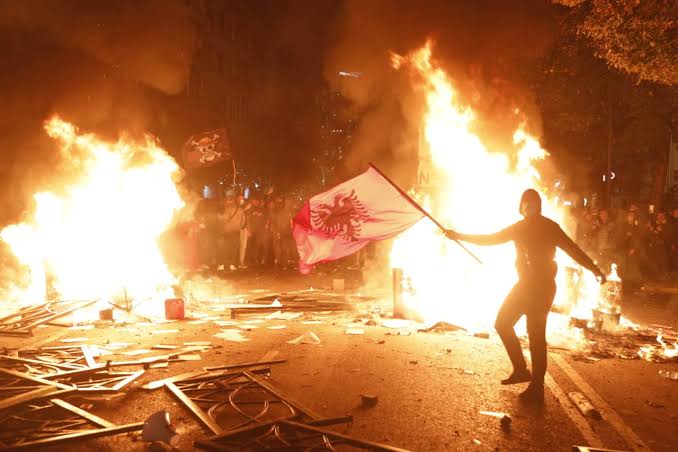
The street is chanting “Rama in jail” and throwing petrol at a ministry, and the flag of the Holy See is lying on a Tirana pavement. Jorida Tabaku has told the embassies it was self-defence. The EU Delegation, which finds a sentence within the hour for every misfiled document in this country, has not found one for any of it. In Luxembourg, Albania closes chapters. In Tirana, the Union’s own missions watch a mob try to remove the government and say nothing, and by the rule they wrote, silence is a position.
Editorial Board
Jorida Tabaku walked out of the Blloku i Sigurisë on Wednesday morning and told the cameras what she had found inside: people who had attacked nothing, who had stepped in to shield other protesters from the police, and whose arrest proves a state that is strong with the weak and weak with the strong. Then she left. She had come from the hospital the night before. She has now visited the injured and the detained, and she has not visited the Nunciature.
The police record of the same night runs differently. Nine hours. Molotov cocktails and stones at the Ministry of Education. The stalls of Pazari i Ri set alight while the people who own them tried to beat out the flames. A pole climbed on Rruga e Durrësit so that the security cameras could be smashed. A cash machine broken into in front of the cameras that still worked. The flag of the Holy See torn off the Apostolic Nunciature and dropped on the pavement. Sixteen arrested, forty-nine under investigation, six still in hospital, a nineteen-year-old in surgery, an eighty-four-year-old from Kukës with a broken leg. On Wednesday the masked men were back before the announced hour, pulling up railings and forcing the Ministry’s door.
None of this is about laboratories. The chant at the Ministry is “Rama resign” and “Rama in jail”, one hundred and thirty-five days of it by the protesters’ own count, now with petrol. A crowd that stones a ministry to make a prime minister resign is not asking for conditions. It is attempting a regime change by force, and it is doing so in the only capital of the Western Balkans that closed a negotiating chapter this week.
Tabaku is the Democratic Party’s voice to the embassies. When the ambassadors want to know what the opposition thinks, she is the one across the table. Her account of Tuesday night is the account they have heard. It is also the account they have chosen to live with. In two days the United States Embassy has managed one text, a notice telling its own citizens that the protest had turned violent and that they should stay away, the kind of thing an embassy issues before a storm. The European Union’s missions have not managed even that. The EU Delegation, which finds a sentence within the hour for any Albanian prosecutor who misfiles a document, has found none for a molotov thrown at a ministry. Not one member-state embassy has said the words “Holy See”, although every one of them has quoted Article 22 of the Vienna Convention at this government, and more than once.
These are the people who spent twelve years teaching Albania that a statement is a position and the absence of one is a position too. They wrote the rule. They applied it to every minister, every judge, every police chief in the country. It applies to them. By their own rule, Brussels’ missions in Tirana have taken a side, and the side is the one Tabaku described to them: the masked men are victims, the fires are not worth mentioning, the flag on the pavement did not happen. Two days of silence while a regime change by force is attempted on their doorstep is agreement, given in the form they taught us to read.
The same afternoon, in Luxembourg, Albania closed Chapter 20. Marta Kos congratulated the country. The Irish foreign minister told it to keep the pace. Brussels and the capitals want Albania in the Union. We believe them. We do not believe that the people they have posted to Tirana want the same thing. A mission that wanted Albania in the Union would have said so on Tuesday night, when a diplomatic premises in its own city lost its flag to a mob, because that is what the Union is: a set of rules that a mob does not get to suspend. A mission that says nothing has stopped representing its capital and started representing the street it lives on. There is an old word for diplomats who do that. It is not a compliment, and it is the right word.
In Luxembourg, Albania is a candidate that closes chapters. In Tirana, the Union’s own missions are standing beside a regime change by force, explained to them by a party whose principal interlocutor has just called the molotovs self-defence. The capitals want one Albania. Their missions have settled for another. The distance between the two is now the most important fact in this country’s European file, and it was not Albania that created it.