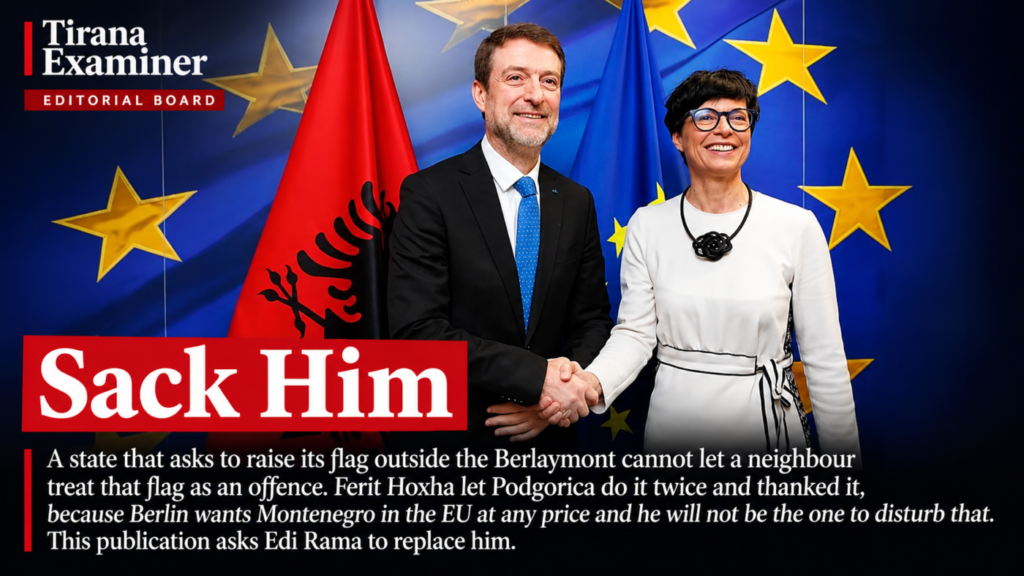
A state that asks to raise its flag outside the Berlaymont cannot let a neighbour treat that flag as an offence. Ferit Hoxha let Podgorica do it twice and thanked it, because Berlin wants Montenegro in the EU at any price and he will not be the one to disturb that. This publication asks Edi Rama to replace him.
Tirana Examiner Editorial Board
Albania’s foreign policy has one aim it states every day: a place in the European Union, with the red flag and the black eagle in the line outside the Berlaymont, next to Montenegro’s. A state that wants its flag in that line cannot tolerate the criminalisation of its national symbols by anyone, least of all by the candidate standing next to it. The flag that is an offence in Kotor cannot be an equal in Brussels. Either Albania’s symbols are what Albania says they are, everywhere, or the membership it asks for is a membership for a state that has already agreed it is less. Ferit Hoxha has agreed to less twice this autumn.
On 20 August, Podgorica police charged two residents of Tuzi and two 16-year-olds under the public-order law for displaying, in the police’s own words, the flag of another state, the Republic of Albania. On 31 October a misdemeanour court in Kotor reprimanded four 17-year-olds from Durrës for showing the eagle with their hands, which the court called the symbol of another state and an ethnic insult; the woman who punched one of them got a warning. Each time, the Republic whose symbol it was said nothing. In August the ministry let the police release pass. In November its embassy announced the boys had been released without punishment and appreciated the cooperation of the Montenegrin authorities; its ambassador called the judges honourable, the case isolated, and invited more school trips. No note to Podgorica, no request for the decision, no sentence stating that the eagle is not an insult. Six weeks after Tuzi, the minister was in Pržno, on Montenegro’s coast, at the Berlin Process ministerial, posting his deep appreciation for Germany’s support.
Silence of that kind is a concession. A foreign ministry that does not object when a neighbour penalises its flag has agreed that the flag is negotiable, in Albania’s name. Montenegro’s culture minister had explained the doctrine in September: the same flag is a minority symbol in the hands of a Montenegrin citizen and a foreign state’s symbol in the hands of an Albanian one. By that doctrine the four in Kotor were Tirana’s to protect and nobody else’s. Tirana thanked instead.
Friedrich Merz has said Montenegro is practically ready for membership, and the Commission’s package of 4 November calls it the leader of the process and may be its last regular report. Berlin wants Montenegro across the line in this cycle as the proof that enlargement works, and a note from Tirana about four children and a flag is a disturbance to that proof. Hoxha knows what Berlin wants and supplies it: silence, and appreciation. Albania’s dignity is handled as a cost, paid in advance so that nobody’s timetable is disturbed, and he is not the one paying. Four boys from “Naim Frashëri”, the school he visited in April to tell its pupils that Europe starts here, paid in a Kotor cell. Thirty thousand Albanians of Montenegro, whose flag Podgorica’s police call foreign, pay each time Tirana lets a release like August’s pass.
Edi Rama should read the country before his foreign minister’s next thank-you. The Albanians of 2026 are not the Albanians of 2013. The generation that filled the boulevard this autumn, whatever one makes of each of its demands and however it ended, showed what the political class had stopped expecting: a sovereign reflex, pride in the nation stated without apology, and a rejection of foreign interference in every form it could name, up to and including investments sold as strategic. These are not their parents, who carried the inferiority complex of the 1990s into every room with a foreigner in it and called it realism. They will not accept a foreign minister who carries it for them. His duties run to his own people, to the four in Kotor and the thirty thousand in Ulcinj and Tuzi, and not to the capitals he reports from. A Foreign Ministry that sells national pride to buy a quiet file in Berlin has nothing left to sell the next time, and no flag left to raise.
The prime minister appointed this minister and he can replace him. He should, with someone who understands that a flag which can be an offence in Kotor has no business asking to fly in Brussels, and that nobody in Berlin or Podgorica respects a minister who does not respect his own country. Mr Rama, sack him.