Ambassador Wendt announced his assessment on Thursday and promised to meet the business community. One of the voices he will hear speaks in his government’s name, lists his embassy as a member and seats his officers on its board. A second letter to the man in the chair.
by Albatros Rexhaj (Tirana)
In September I wrote to you about the empty chair, and said that this town would come to your office with complaints drafted for a regent. On Thursday you told Albanians how you intend to use the chair: three priorities, an assessment over the coming months, meetings with elected leaders, officials, business representatives and ordinary citizens before you decide on a path. It is a sober message, free of lectures, closed in Albanian, and I take it at its word. Before the assessment reaches the business community, I have one question for you. Who speaks for the United States government in Tirana: you, or somebody else as well?
The American Chamber of Commerce in Albania is a non-profit association registered under Albanian law, and like any such association it may say whatever it likes about the fiscal package, the protests, the courts or the government, as loudly and as often as it chooses. I would defend its right to do so. My objection is to one thing only: a private association presenting itself, and being allowed to present itself, as an extension of your embassy.
On 22 October, while the glass was still being swept off the boulevard, a statement went out telling “all actors” to reject violence and create the conditions for “a meaningful dialogue through which legitimate concerns can be addressed in accordance with democratic mechanisms.” A week later another told the Government to reconsider its fiscal package, publish its impact assessments and explain any departure from a strategy agreed with the IMF and the EU, because “this is particularly important for American companies.” Neither came from your embassy. Both came from the chamber. The town read them, as the opposition read the chamber’s business index in June, as the American view.
The chamber’s bylaws require that the president or vice-president be a US citizen or represent a US-controlled firm, and that a majority of the seven directors be one or the other. I pulled the commercial-register extracts for the companies the directors sit for. The president, Grant Van Cleve, represents Prodigy sh.p.k., a training company founded in October 2023 with a million lek of capital, 65 percent owned and run by an Albanian national; he holds 35 percent, and the company does not appear on the chamber’s published member list. The vice-president’s company, Trifolium, is wholly Albanian-owned, with 100,000 lek of capital and 32 million lek in payments from the state treasury since 2023. The treasurer’s, Grant Thornton Albania, is 80 percent his, with 16 public tenders won, eleven of them red-flagged by Open Procurement. The secretary’s, Antea Cement, is Greek, through a Cypriot holding whose beneficial owners the register could not identify. Two more seats are held for Novartis, which is Swiss, and for Financial Union Tirana, an Albanian agent of Western Union.
The seventh is held for Eralb Invest 2, the Albanian vehicle of a Swiss-Serbian renewables venture that holds strategic-investment status for a €1.2 billion wind and solar park in Tropojë. The project was announced in October 2023 as a “historic agreement” with General Electric, which is not a partner in the company and would only supply the turbines. On 12 January this year the Prime Minister presented it as “delivered by the American company CWP,” with your chargé d’affaires at his side, and the company received a preliminary permit. The register shows the Albanian company is Dutch-held, the venture Swiss and Serbian. Not one US-controlled company sits on the board of the American Chamber of Commerce. The only American thing in its boardroom is one man’s passport.
Below the board it is the same. The chamber’s own survey says 59 percent of its members are Albanian-owned. Of the 292 entries in its directory, I count six to nine businesses controlled from the United States, two of them tobacco and pharma; eight Albanian franchisees of American brands, from Marriott to Burger King; ten schools, foundations and NGOs that live on American money; and some 250 Albanian groups, European banks and telecoms, and local law and consulting firms. Your State Department puts American direct investment in Albania at $490 million, under 3 percent of the foreign stock. Your embassy’s own post in February credited the chamber’s members with 25 percent of GDP, and both figures are right, because the 25 percent is Balfin, Kastrati, Credins, Vodafone and Intesa Sanpaolo, and none of it is American.
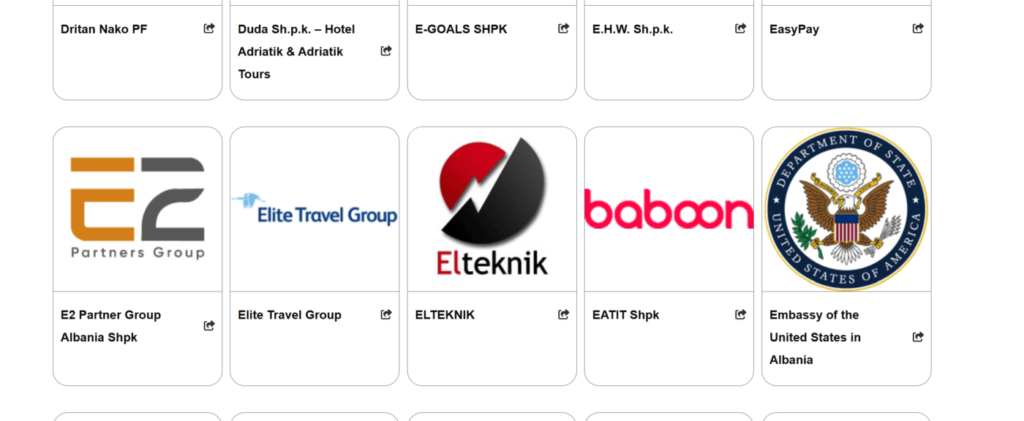
Between EATIT sh.p.k. and Endrit Xhaferaj, under the Great Seal of the United States, the chamber’s directory lists as its 292nd member the Embassy of the United States in Albania. The chamber’s bylaws admit as members companies in the commercial register and NGOs in the court register, and forbid financial aid from any government. A foreign mission is neither, and cannot pay the dues.
The listing is not the only cause for concern. Article 14.14 of the same bylaws designates “the Deputy Chief of Mission and the Commercial Officer of the U.S. Embassy” as ex officio members of the chamber’s board, and Article 24 requires every public statement to be approved in advance by that board. A private association in Tirana wrote two officers of the United States government into its governing document, filed it, and published it. No one at your embassy challenged it. A member of the board has told this publication that the officers attend, and that statements like the one of 22 October get the embassy’s nod beforehand.
An embassy is an arm of the United States government; it joins nothing and sits on nothing in its own name without authorisation, and there is a procedure for that. I checked the American Chambers in Croatia, Serbia, Kosovo, Bosnia, Montenegro and North Macedonia: not one lists the US embassy as a member, and none has its officers in its statute. In Tirana the chamber simply wrote them in, and it stood. If a statute can seat your Deputy Chief of Mission on the board of a private association because the association says so, then any organisation registered tomorrow can do the same, and the United States will sit on its board until someone at your mission reads the document. That it was allowed to happen is an oversight. That it continues, with your embassy also on the member list under its seal, while you promise to meet “business representatives,” is worse.
The representatives you will meet under that name are Albanian conglomerates, Greek cement, Swiss pharma and three directors whose own companies invoice the Albanian state, speaking through a body that borrows your government’s name, seats your officers by its own decree and lists your embassy as a member. Nobody at your mission has ever said in public that the chamber does not speak for the United States. On 4 November your embassy announced $40 million for Albania’s cyber defences and praised the country’s digital resilience; in February the chamber had called the same institution a risk to national security. The two voices now contradict each other in the open.
In September I wrote that the town wants a regent, not a partner. While the chair stood empty, a private association took the seal, hung it in its directory, wrote the embassy’s officers into its statute, and spoke. Your assessment is the right moment to take the seal back. Three sentences would do: the United States is not a member of the American Chamber of Commerce in Albania; its officers hold no seat on the chamber’s board, whatever the chamber’s statute says; and the embassy alone speaks for the United States in this country. The chamber can then go on saying whatever it wants, in its own name. I thank you for your message. I ask you to say which of the two voices is yours.
Albatros Rexhaj is an author, playwright, and analyst with a background in national security studies and nearly three decades of experience in political and security affairs.