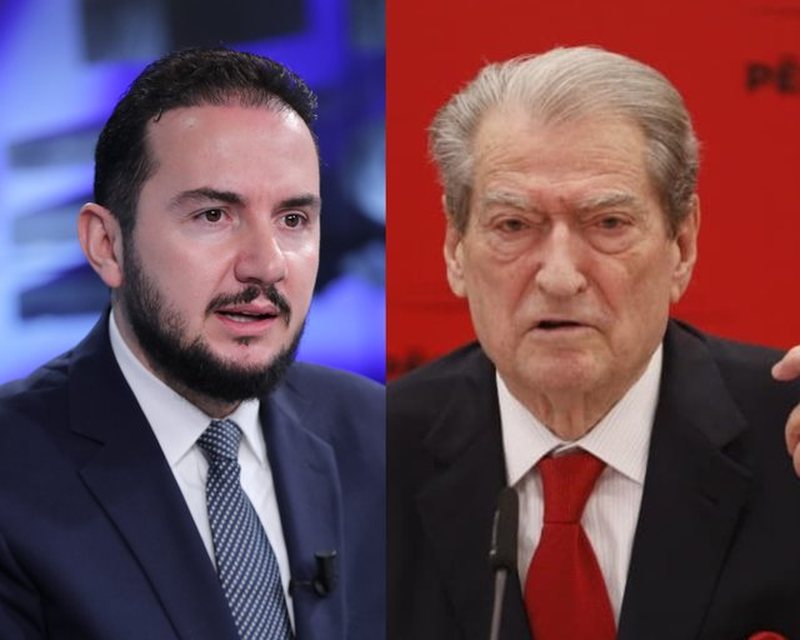
The former deputy’s decision to speak on record marks a new phase in a feud that is now drawing internal Democratic Party dissent into the open.
by the Newsroom (Tirana)
A former senior figure in the Democratic Party went on record Tuesday to cite the British appeal record on Sali Berisha’s non grata designation, framing the DP leader’s exclusion from the United States and the United Kingdom not as a political grievance but as a determination grounded in law.
Ervin Salianji, speaking on the RTSH program “Trialog,” said that proceedings in the United Kingdom related to Berisha’s appeal against the Home Office decision had, according to his account, affirmed the basis of that designation, which he said cited alleged links to criminal networks and their use for political influence. Salianji said he had deliberately kept the matter out of public debate until now, but that the facts required stating. He also called on Berisha to seek psychiatric evaluation, a formulation that was provocative in register if not in legal weight.
The non grata designation itself is not new. What is new is the explicit invocation of the British appellate record as evidence that the designation has been tested and upheld by a UK court, rather than treating it as a political act open to contestation. Salianji’s framing, if it holds under scrutiny, would shift the burden of rebuttal from the Albanian political arena to a foreign legal record.
Salianji also raised two figures whose names have circulated in Democratic Party internal disputes: Ergys Agasi and Suel Çela. He said media outlets with pro-Berisha editorial lines had not mentioned Agasi’s name until after he was declared wanted, and asked why. On Çela, he said accusations had already been made publicly by Lulzim Basha and Gazmend Bardhi that Çela had been used to threaten people on Berisha’s behalf during the period when Berisha was consolidating control of the party.
Berisha responded the same day, first during a meeting with farmers in the Berat district and then in more extended remarks. He described Salianji not as expelled but as self-expelled, and laid out his account of the separation. He said Salianji had been dining with Ergys Agasi at the same time Berisha was publicly attacking Agasi as one of the darker figures connected to the current government. He said Salianji had used Suel Çela to intimidate Democrats into supporting him at a gathering in Elbasan. He said Salianji had appeared publicly alongside opposition candidates the day before elections and had been the subject of sixteen news items produced from the Prime Minister’s office within a four-hour window, which Berisha described as disqualifying.
Berisha also recounted a conversation he said took place before Salianji’s release from detention, in which Salianji told him he could leave prison early if he signed a document pledging not to harm Fatmir Xhafa. Berisha said he advised against signing, on the grounds that doing so would constitute an admission of guilt. The account is unverifiable from the public record, but Berisha offered it as context for what he characterized as a longer pattern of poor judgment and divided loyalty.
The meeting in Berat produced an unexpected moment when farmers in the audience challenged Berisha directly. One participant said the party could not call itself democratic while treating dissent as grounds for expulsion. Another called for the unification of internal factions. Berisha held his position, drawing the distinction between holding a different opinion within party forums, which he said carried no consequences, and acting in alignment with political opponents, which he said crossed a different line entirely.
The exchange in Berat is notable not for what it resolved but for what it revealed. Internal criticism of Berisha’s management of the Salianji case reached him in a public forum from the party’s rural base, not from Tirana political operatives. That is a different kind of signal.
The dispute now runs on two tracks simultaneously. On one track, it is a factional conflict within the Democratic Party, with accusations of infiltration, threats, and collaboration with the government trading in both directions. On the other track, it is a dispute about the legal and factual standing of the non grata designation, a question that Albanian political coverage has largely treated as settled or untouchable. Salianji’s decision to put the UK appeal record into public circulation reopens that question, with consequences that will depend on what that record actually contains.