After a night of violence in Tirana, the EU Delegation found specific words for the police and none for those who attacked the city’s institutions.
Ardit Rada
The European Union Delegation in Tirana did not issue a statement on the violence of 13 October. It answered a question. Report TV asked, and at 12:55 on Wednesday, a day and a half after the first molotov hit the Ministry of Education, the Delegation gave the channel seven sentences. They are short enough to read one at a time.
The first expresses concern “regarding the violent escalation of the protest”. The sentence has no subject. The protest escalated, violently, on its own.
The second and third say that freedom of assembly and expression are fundamental rights and core European values, to be respected and exercised peacefully. Nobody disputes this. Nobody who threw petrol on Tuesday night was exercising it.
The fourth is the only sentence in the text that names an actor: “We are aware of allegations of excessive use of violence by the police against protesters and journalists.” The police. Shqiptarja’s file records journalists being stoned by protesters on Tuesday. That is not the injury to journalists the Delegation chose to mention.
The fifth asks that police actions be proportionate and that “these cases” be investigated as a priority. The cases are the police cases. There is no sentence asking that anything else be investigated.
The sixth encourages “all parties” to de-escalate. The seventh says that constructive dialogue between all actors involved is “the only way forward”.
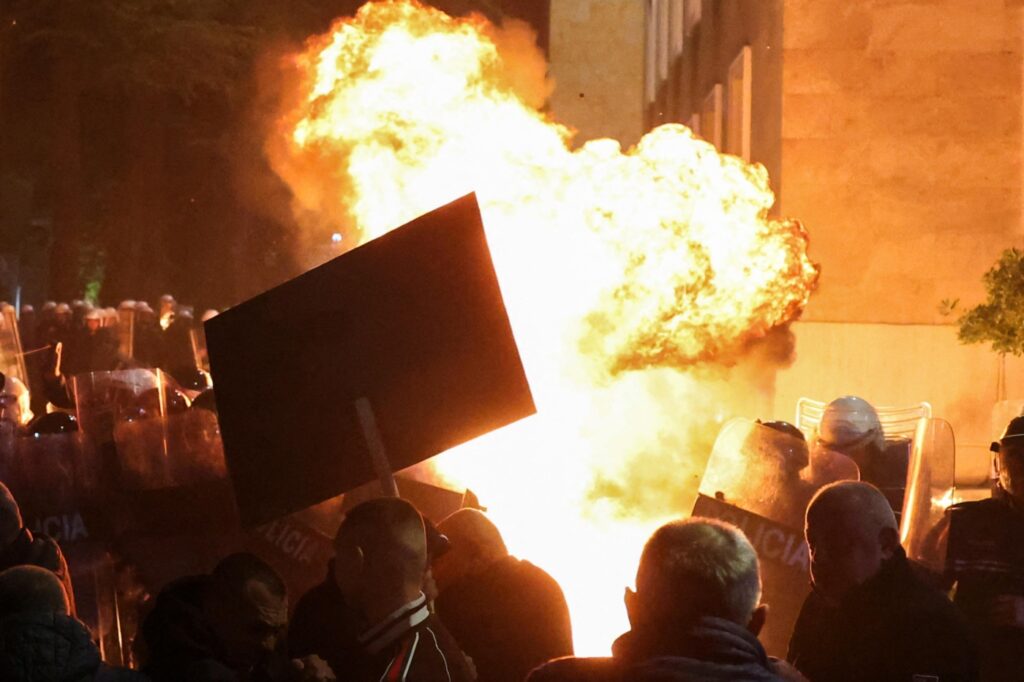
Tuesday, by the police record. Nine hours of violence. Molotov cocktails and stones at a ministry. The stalls of Pazari i Ri burned while their owners tried to put them out. Security cameras smashed from a pole. A cash machine broken into on camera. Sixteen arrested, forty-nine under investigation, six in hospital on Wednesday morning, one in surgery. And the flag of the Holy See torn from the Apostolic Nunciature and left on the pavement.
None of it is in the text. Not the word molotov, not fire, not the market, not the machine, not the Nunciature, not the Holy See. The only acts the Delegation can see, two days in, are the acts of the police.
The Nunciature is the one item on Tuesday’s list that touches the Delegation directly. It stands in Tirana under Article 22 of the Vienna Convention, the article that makes a mission’s premises inviolable and obliges the host state to protect them. The Delegation stands in Tirana under an establishment agreement with Albania that gives it the same inviolability. When a mission’s flag is pulled down by a crowd, every other mission in the city has a professional interest in saying so, because the precedent set on one gate is a precedent for all of them. The Albanian foreign ministry said so by nine on Wednesday morning, condemning the act as a breach of that inviolability and citing the article. The Delegation, asked four hours later, did not mention the Nunciature, the Holy See or the article. A mission that will not speak for the inviolability of another mission’s premises has decided that something else matters more than the rule it lives under. The seven sentences say what.
Every instruction in the statement has an addressee. Be proportionate: the police. Investigate as a priority: the state. De-escalate: all parties, which in a confrontation between a government and a masked crowd means the government, because the crowd does not read Delegation statements. Dialogue is the only way forward: a government whose interlocutor on the street has chosen violence over the political process. There is no instruction in the text to anyone who threw anything. The state receives specific demands. The men who brought the petrol receive an appeal to everybody.
The asymmetry has beneficiaries. The crowd that will be back at the Ministry tomorrow has been told that the police are the ones under scrutiny. The opposition that visited the detained this morning and called their arrest proof of a state strong with the weak has been handed “dialogue is the only way forward”, which in Tirana’s political vocabulary means the government must come to the table while the street keeps its pressure on. The government has been told to investigate itself. Nobody who planned Tuesday night could have written a more useful text.
This morning the Editorial Board of this newspaper wrote that Brussels’ own missions in Tirana are standing beside a regime change by force. That was a reading of a silence. The Delegation has since ended the silence, and the text it chose to end it with reads the same way: it treats a government defending its ministries and a crowd attacking them as parties of equal standing, directs every demand at the first, and finds no words for the second even when the second has torn down a diplomatic flag. A diplomatic mission knows the weight of the words it uses and the words it leaves out. These were chosen.
On Tuesday, in Luxembourg, Marta Kos congratulated Albania on closing Chapter 20. In Tirana, the Union’s own Delegation was asked a more immediate question about the rule of law, and its answer will be read by the government, the opposition, the police and the people preparing the next demonstration. None of them needs a diplomat to explain what was left out.