Tirana Examiner | Analysis | Hajdi Xhixha
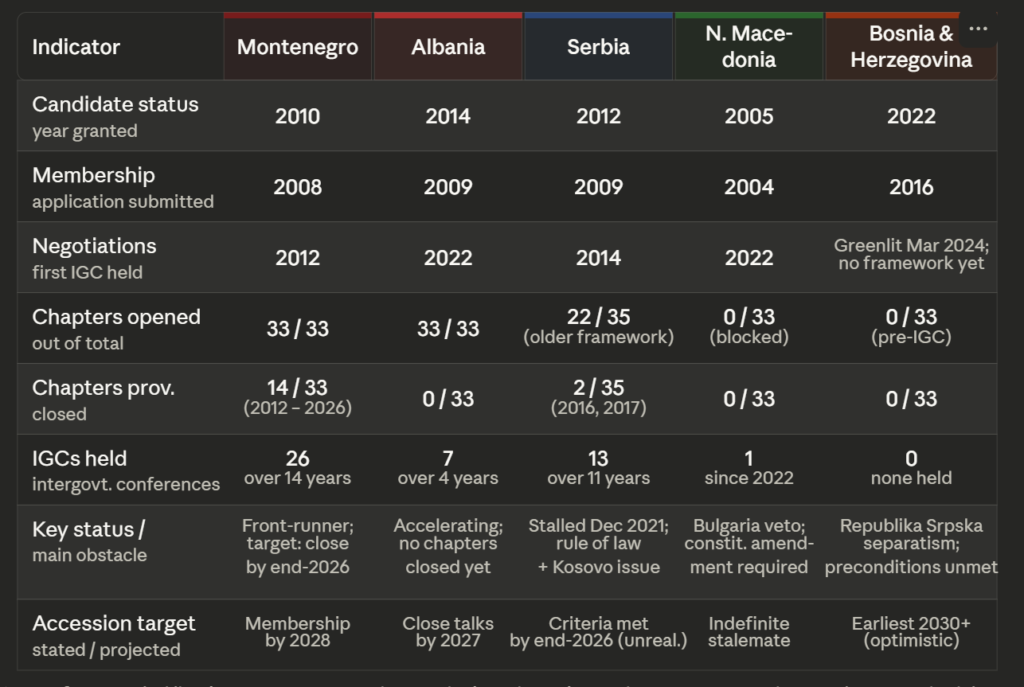
In March 2024, the European Council greenlit accession negotiations with Bosnia and Herzegovina. Fourteen months later, no negotiating framework has been adopted, no intergovernmental conference has been held, and the president of Republika Srpska has publicly declared his governing objective to be the secession of his entity from the Bosnian state. The EU responded by continuing to describe Bosnia as a candidate country on a European path. This is not diplomacy. It is a genre of fiction, and the Western Balkans has been living inside it for thirty years.
The fiction is not uniformly applied. There is a real enlargement process underway, and for two of the six countries in the region it is producing results that deserve to be taken seriously. But the habit of treating six radically different situations as variations on a single theme, the Western Balkans integration process, has done more to obscure the structural realities than to advance them. What the data shows, when you read it without the framework’s flattering light, is a region that has fractured into distinct categories that no amount of summit language will reassemble.
The two that are moving
Montenegro opened accession negotiations in 2012. It has provisionally closed 14 of 33 chapters. It is the only Western Balkans candidate to have met the interim benchmarks for the rule of law chapters, 23 and 24, which function as the gate through which the closing process for all remaining chapters must pass. Three chapters were provisionally closed in 2024, six in 2025, two already in 2026. The trajectory is real and the 2028 membership target is not fantasy. What remains to be tested is whether the political conditions that produced this acceleration, broad coalition commitment and external geopolitical pressure converging at the same moment, survive the harder chapters ahead. They may not need to. The structural position has not been this strong at any previous point in the process.
Albania opened negotiations in 2022 and completed the opening of all 33 chapters by 2025. Marta Kos called the pace unprecedented. She was right. What she did not say, and what the data also shows, is that zero chapters have been provisionally closed. The opening phase and the closing phase are not the same exercise. Opening requires political will and a Commission willing to recognize it. Closing requires meeting benchmarks on rule of law, judicial independence, and anti-corruption that cannot be unlocked by will alone, that must be demonstrated in practice, and that have historically separated the countries that complete this process from those that do not. Albania’s 2027 closing target is plausible. It has not yet been earned. That distinction matters.
The contradiction at the center
Serbia has been negotiating since 2014. Eleven years. Thirteen intergovernmental conferences. Twenty-two chapters opened. Two provisionally closed. No progress since December 2021.
The reason is not bureaucratic. The reason is Chapter 35.
Unlike every other chapter in Serbia’s negotiating framework, Chapter 35 is not a policy domain. It is titled “Other Issues” and it functions as the conditionality mechanism through which the EU monitors the normalization of Belgrade’s relations with Pristina. Serbia’s accession framework states explicitly that progress across the entire negotiation is conditioned on visible and sustainable improvement in relations with Kosovo. This means that Serbia cannot, under the current framework, complete its accession process while maintaining that Kosovo recognition is a permanent red line. Belgrade has not only maintained that position. It has made it a foundational principle of government.
The contradiction is not hidden. It is not a matter of interpretation. It is structural, it is written into the framework, and it has been operating for over a decade while both Brussels and Belgrade continue to speak about EU integration as a shared strategic goal. At some point this requires a more honest vocabulary. Serbia is not on a path toward EU membership under conditions it has committed to refusing. It is parked, by its own political choice, at a position it presents as membership-compatible but is not.
The domestic picture, democratic backsliding, mass protests, a civil society that suspended cooperation with the government in early 2025, a media environment under sustained pressure, does not create conditions for a reversal of this calculus. The question is not when Serbia will accelerate. The question is what would make the Chapter 35 contradiction politically unsustainable in Belgrade, and whether the enlargement momentum of its neighbors generates that pressure or simply allows Belgrade to free-ride on regional credibility it has not built.
The ones the architecture is eating
North Macedonia has been a candidate since 2005. One intergovernmental conference has been held since formal negotiations opened in 2022. Zero chapters have been opened.
This is not North Macedonia’s failure of ambition. It is the consequence of a decision made in 2022 to embed Bulgaria’s bilateral demands into the negotiating framework itself, through the French proposal, as a formal accession condition. The implementation of the 2017 friendship treaty between Sofia and Skopje is now written into the process such that every subsequent stage requires unanimous Council approval, and Bulgaria’s interpretation of compliance will arise at every intergovernmental conference for as long as the framework stands. A bilateral historical dispute, whose core claims most serious historians of the region regard with considerable skepticism, has been granted the procedural force of EU accession law. The VMRO-DPMNE government elected in May 2024 has refused to pass the constitutional amendment that would satisfy the immediate condition. That refusal will not soften. The process has no visible exit.
Bosnia and Herzegovina’s situation requires less analysis than it does an honest acknowledgment of what has occurred. The European Council said in March 2024 that accession talks should open. The preconditions for opening them do not exist and show no trajectory toward existence. The entity whose cooperation is required for a functional Bosnian state is governed by a man whose stated political goal is the dissolution of that state. Calling this a candidate country on a European path does not make it one. It makes the label do work the process cannot.
Kosovo and the problem the EU cannot solve
Kosovo applied for EU membership in December 2022. Five EU member states, Cyprus, Greece, Romania, Slovakia, and Spain, do not recognize its independence. Candidate status requires unanimity. There is no mechanism for resolving this on any foreseeable timeline.
This is not primarily about what Kosovo has or has not done. Kosovo’s reform record compares favorably to several countries that hold formal candidate status. The EU exercises real conditionality over Pristina through pre-accession instruments and the Stabilisation and Association Agreement, and that conditionality has produced measurable results. None of this changes the arithmetic. The five non-recognizing states have distinct reasons for their positions, reasons rooted in bilateral sensitivities and domestic constitutional politics that do not respond to Kosovo’s accession readiness. The geopolitical urgency argument that has accelerated integration thinking for Ukraine and Moldova does not travel to Kosovo, because the recognition problem predates the current security environment and is not a function of geopolitical alignment.
The Brussels Agreement and its successors have governed Kosovo-Serbia normalization since 2013. Core commitments from both sides remain unimplemented. The EU’s leverage over Belgrade on Kosovo specifically is constrained by the fact that non-compliance has carried deferred rather than terminal consequences for over a decade, a calculation Belgrade has every rational incentive to maintain. Kosovo’s EU path depends, in the final analysis, less on Pristina’s performance than on a political reconfiguration among five EU member states that no enlargement policy instrument can compel.
The EU knows this. It does not say it. Instead it speaks of dialogue, of constructive engagement, of the European perspective. This is the same genre of fiction that opened this piece.
The EU’s own unresolved question
There is a final variable that belongs in this analysis and rarely appears in it. Whether the EU can absorb additional members without resolving its own internal architecture questions, on qualified majority voting, on budget and structural fund formulas, on institutional representation, remains open. The Commission is developing pre-enlargement policy reviews and has confirmed enlargement as a priority in the framework for 2028 to 2034. Political will at the European Council level is higher than it has been in fifteen years. Whether it is sufficient to produce the institutional readiness that makes practical accession executable is a different question, one that the leading candidates will encounter as a constraint regardless of their own preparedness.
For countries genuinely close to the door, the final obstacle may prove to be not what they have done but what the EU is able to receive.
The verdict
One country is in its closing phase with a credible membership horizon. One is in aggressive opening mode with its hardest test still ahead. One has been negotiating for eleven years and is structurally prevented from completing the process by a commitment its government will not reverse. One has zero chapters opened because a bilateral dispute has been given the force of accession law. One cannot open formal talks because the political conditions for doing so move in the wrong direction. And one cannot become a candidate because five EU members do not recognize its existence, on a timeline that no one controls and no enlargement instrument can change.
The process is called Western Balkans EU integration. It is, in practice, several entirely different situations sharing a name. Treating them as a single phenomenon has been useful for summit communiqués. It has not been useful for the people waiting.
Hajdi Xhixha is a professor of international relations at UBT and a contributor to the Tirana Examiner.