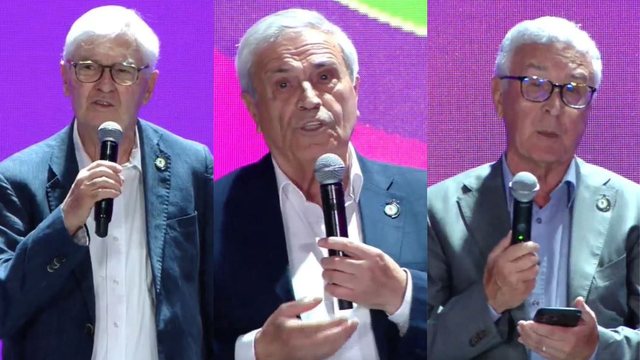
At a Palace of Congresses gathering, the prime minister praised the party’s grassroots organisers, recounted his own entry into the party, and drew a sharp line between the Socialists and the opposition over the jailed mayor of Tirana.
Hundreds of Socialist Party members, among them serving and former senior officials, gathered at the Palace of Congresses on Tuesday to mark the 35th anniversary of the party’s Tirana branch. The occasion produced its most striking line when Prime Minister Edi Rama told the hall that his party would not press for the release of the jailed mayor of Tirana, Erion Veliaj, however unjust it considered his detention.
“We are not seeking the release of the prisoner Erion Veliaj, because this is not our cause,” Rama said, adding that Albania holds no political prisoners and that, however painful Veliaj’s absence and however unjust the arrest might appear to the Socialists themselves, the party was there to build a state rather than to bargain for one of its own. Rama presented that posture as the dividing line between his party and the opposition, returning to a formula he used throughout the evening: a government enters history not by building roads but by its capacity to build a state.
Veliaj, who has led the capital since 2015, is in custody as proceedings against him continue. Rama’s remarks marked the party’s most explicit public distancing from the case.
Praise for the party’s canvassers
Much of Rama’s address was given over to the party’s patronage workers, the grassroots canvassers who maintain direct contact with voters, whose work he said he valued above all others. He singled out the former parliamentary speaker Gramoz Ruçi as the party’s chief among them.
Rama described Ruçi as a figure who had kept his standing for 35 years without social media of any kind, no Facebook, no Instagram, no TikTok, who had never sent a text message since mobile phones appeared, and who had given, by Rama’s count, “three and a half” media interviews in his career. What set Ruçi apart, Rama said, was that he answered every citizen personally, by telephone rather than message, an old operator’s habit of leaving no written trace, and that no one else in the party held the breadth of contacts Ruçi carried from the north of the country to the south.
Rama also drew a moral boundary around that work. Contribution to the party, he said, should never be turned into a claim for favours for oneself, one’s family, or one’s relatives, and he criticised members who expected the party to find a job for a son in law in return for their service. The Socialists were in their fourth governing term, he argued, precisely because voters understood the party recognised such a limit.
In a passage that drew on coarse language, Rama said that anyone who called themselves a socialist had a thousand and one reasons to curse the party, yet one large reason for pride, since the Socialist Party stood on the roll of contributors to the national cause alongside the country’s nineteenth century revivalists.
A personal history, and old scores
Rama traced his own path into the party, recalling that it was Musa Ulqini who handed him his membership card without the permission of the then leader Fatos Nano, in a period when he was living in a single rented room with a kitchen on Rruga e Elbasanit. He spoke of Nano’s years of political imprisonment, crediting him with emerging from prison seeking a state rather than revenge.
Rama also turned to the early years of pluralism, telling Ruçi in a lighter exchange that he was not sure whether it had been part of his plan to wreck the Democratic Party by sending communist informers into its ranks. On compensation for those jailed under the communist regime, Rama argued that without the Socialists in government from 2013, surviving political prisoners would have died without receiving what they were owed, because others had jumped the queue ahead of them.
He closed that thread with a note of self deprecation about the attacks directed at him, telling the audience that they might yet be told he ate children, and that he was warning them himself so they would not be surprised.
Ruçi looks to a fifth term
Accepting one of the evening’s gold medals, Ruçi told the hall he was convinced the party would secure a fifth governing mandate, calling the fourth “too little.” He urged members to back Rama’s vision for a European Albania and the government’s 2030 horizon, and left the party’s incoming leaders two instructions: to love the ordinary member and to respect the voter, standing by them in good times and bad, and where a problem could not be solved, at least to grieve it with them. He declared the party’s victory in 2029 certain.
The party honoured a series of senior figures with gold medals for their contributions over the years, among them Ruçi, the former president Rexhep Mejdani, the party’s first parliamentary group leader Namik Dokle, the former prime minister Ylli Bufi, the former Tirana chairs Musa Ulqini, Halil Lalaj and Besnik Baraj, and the founders and former deputies Valentina Leskaj, Anastas Agjeli, Hamdi Jupe, Maqo Lakrori, Luan Shaullari and Sajmira Pino.
Balla: tourism, statehood, and justice reform
Taulant Balla, political leader of the Tirana region and head of the Socialist parliamentary group, used his remarks to back the planned Power Holding investment at Zvërnec, which he said would place Albania in what he called the “Champions League” of international tourism.
Balla cast the Socialists as the main builders of the modern Albanian state and opened by quoting Nano’s pledge at the party’s founding on 12 June 1991. He said the party had won 15 of 20 electoral contests over 35 years and nine of ten with Rama at its head, and that the economy in 2025 stood roughly three times larger than in 2013. He ran through a list of milestones the party claimed: the rejection of the 1994 draft constitution, the denunciation of the 1996 elections, the rebuilding of the state after the collapse of 1997, the 1998 constitution, the contribution to Kosovo’s liberation, the NATO Membership Action Plan in 1999, the start of Stabilisation and Association Agreement talks in 2003, the protests of January 2011, candidate status in 2014, and the 2016 justice reform, which he called the most important in 104 years of Albanian statehood.
Since that reform, Balla said, the country had split into two camps, those who defended it and those who opposed it, a division he mapped directly onto support for and opposition to his party.
The evening opened with a short film tracing the party’s history from the Nano era through Rama’s tenure as mayor of Tirana, set against footage contrasting the capital before and after 2001. It closed with a performance by the group West Side Family, who reprised a song they had once recorded with Rama.