27 April 2026 hearing, Council of High Prosecution
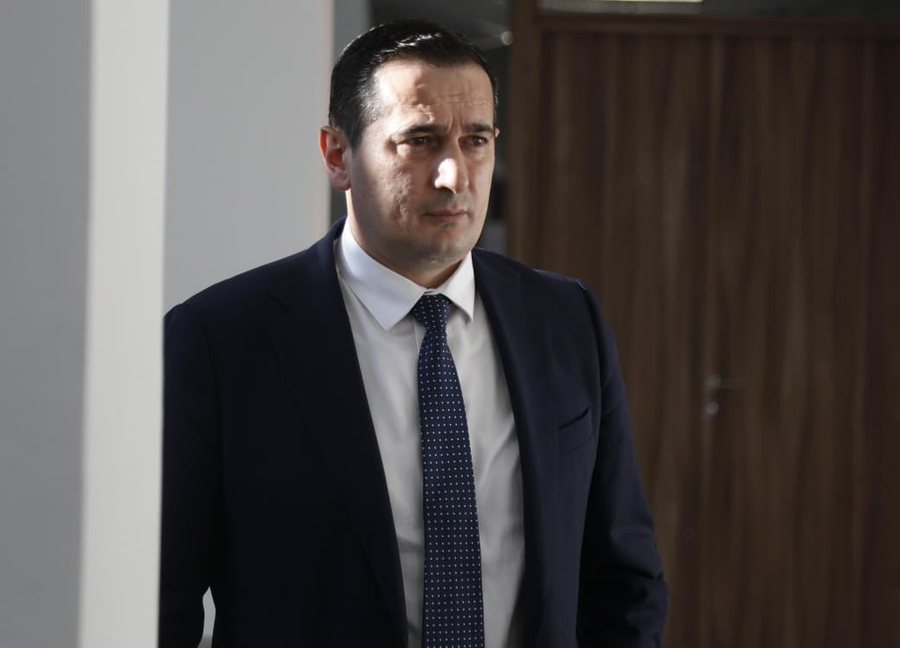
Klodian Braho, who took over SPAK from Altin Dumani on 11 December 2025, presented his first annual report to the Council of High Prosecution on Monday, 27 April 2026. The hearing, held under Article 105 of Law 97/2016, ran approximately one hour. Braho was accompanied by BKH director Joni Keta. The report covered work performed in 2025, when the institution was still under Dumani’s leadership; Braho thanked his predecessor in the opening remarks. The annual report had already been deposited in Parliament earlier.
Braho opened with an institutional self-positioning frame, telling KLP that SPAK had continued to consolidate its constitutional and legal role as the central institution in the fight against corruption and the laundering of criminal proceeds. He placed the year’s work explicitly within the recommendations of Parliament, the Council of Ministers, and the European Commission progress report, alongside the increased use of special investigative techniques. This is the legitimacy frame from which he later defended the institution against the prospect of legal restriction.
Headline operational data for 2025
SPAK handled 871 criminal proceedings in 2025: 294 newly registered, 39 consolidated, and 577 carried over from 2024. Reporter.al gives the total as 870; the discrepancy of one is unresolved across the coverage but most outlets carry 871. Total volume rose 4.9 percent year-on-year. Closed investigations remained flat at 216, identical to 2024.
On corruption, Braho reported a 17.7 percent rise in new investigations and a 12.2 percent rise in completed investigations. Twenty-four proceedings with 147 defendants were sent to court for high-level corruption, alongside ten proceedings with 13 defendants for lower-level corruption. Six new proceedings were opened against 16 senior officials. Of 30 senior and former senior officials investigated during 2025, more than half (18 persons) were referred for trial, and 10 received final convictions.
In organized crime, new registrations dropped from 101 in 2024 to 74 in 2025, but completed investigations rose 3.4 percent (from 58 to 60). Persons under investigation rose 11.5 percent and persons referred to court rose 36.6 percent, indicating a shift toward larger and more structured criminal organizations. Suspensions of investigations rose 93.7 percent and cases sent to trial fell 14.3 percent, which Braho attributed to procedural complexity.
Citizen complaints accounted for 33.5 percent of all proceedings opened in 2025, which Braho framed as evidence of public trust. Referrals from State Police rose roughly 70 percent and referrals from other public institutions rose roughly 15 percent, while complaints from political subjects fell about 50 percent and from legal entities about 75 percent.
Asset seizures and cryptocurrency
Total seizures and confiscations in 2025 reached 45.4 million euros, of which 12.4 million euros were cryptocurrency seized from criminal groups. Braho raised the absence of a state mechanism for managing seized cryptocurrency and called for the creation of a dedicated national wallet, an issue Dumani had previously flagged. Top Channel separately reported 24 million euros blocked under specific procedures.
The political rhetoric warning
The most consequential exchange came in response to a question from KLP member Arta Mandro on whether political rhetoric directed at SPAK constitutes a threat. The full formulation that drew most coverage was given as a direct, extemporaneous answer to her, not as part of the prepared statement, which is a relevant detail for reading the signal.
Braho drew a distinction between rhetoric as such and rhetoric coupled with legislative action, and he articulated a second-order causal chain about the effect on organized crime.
In translation: “Political rhetoric does not in itself constitute any threat; it is simply political rhetoric. It becomes a concern if this rhetoric is accompanied by a situation of legal changes that may affect the competencies and independence of the institution. I find that there is no such situation at this moment.”
He continued: “We have brought to attention the fact that rhetoric, although not problematic in a direct way, awakens and may serve as a cause to increase aggression against SPAK from organized crime, because the perception is created that the institution is unprotected.”
And the conditional warning: “If we have such a situation, if we encounter drafts and legislative projects, we will make our voice public, and we will convey the concern to the KLP as well.”
Reporter.al rendered the formulation as “political rhetoric may turn into a catalyst for violence,” and 360grade.al read it as a structural warning aimed at the Manja initiative on Article 242. The phrasing matters: Braho did not say current rhetoric is harmless. He said it is harmless until paired with legal restriction, at which point it activates a perception of institutional weakness that organized crime can exploit.
Pretrial detention: the 53.4 percent reduction
Braho devoted significant time to the use of custodial pretrial detention as a security measure, presenting data that addresses the practice that has been the most contested point in public debate about SPAK’s enforcement methods. The reduction occurred during 2024 to 2025, both years under Dumani’s leadership, with Braho now presenting the trend in his own institutional voice.
In translation: “Custodial detention is the measure of last resort. The security measure of detention has decreased by approximately 53.4 percent. For 2025, regarding criminal offenses of corruption, this measure represents only about 3.45 percent of the total persons under investigation (about 5 percent in 2024), while for organized crime, this security measure represents 21.4 percent of persons under investigation (down from about 31 percent in 2024).”
The headline number, 53.4 percent, applies to overall requests for the measure compared with 2024. The disaggregation shows the corruption category has been brought to 3.45 percent of investigated persons, a substantial movement on the specific practice that has drawn the most public criticism, including from Prime Minister Edi Rama.
Workload, prosecutor numbers, and BKH expansion
KLP member Vatë Staka asked whether the workload now requires structural relief. Braho declined the procedural-relief framing but accepted the workload diagnosis.
In translation: “The workload is high, and it will continue to grow further, but I think the number of 20 prosecutors is sufficient. The good news is that we will begin recruiting 40 additional investigators for BKH. It is a high number that will affect the reduction of the workload and the increase of quality.”
Twelve investigators are currently active in financial-investigation work, with four more expected (Top Channel coverage; the figure should be verified against the official transcript before being cited as financial-investigator-specific). The competition for ten new judicial police officers has concluded, and Braho indicated another OPGJ procedure is planned. He flagged that prosecutors lack legal advisers (only the director currently has one), which he called a structural gap requiring correction.
Mandate expiration of the first generation of special prosecutors
Braho conceded for the first time publicly that the upcoming end of the nine-year mandates of the founding cohort of special prosecutors, with no possibility of re-candidacy, will affect investigative tempo. His framing was deliberately measured.
In translation: “How the change of prosecutors will affect us, we don’t want to be pessimistic, but realistic. The way an experienced prosecutor investigates and represents in trial, one who knows the case, who may have conducted a three-year investigation and a two-year trial, is very different from a prosecutor who arrives on day one and faces a criminal group, given that they do not yet have the prior experience of investigating and participating in trial.”
He called the resulting slowdown a temporary problem.
Legislative requests
Braho stated there is no urgent need for major legal changes but identified specific calibrations. The most substantive is the corruption threshold. Currently set at 50,000 leks (new currency, roughly 500 euros), Braho argued it is too low and inflates SPAK’s caseload with cases that should not occupy the institution. The same applies to public procurement thresholds, which he also asked to raise. He flagged separately a need for legal regulation on mobile-phone seizures, which KLP members noted are now the most common form of evidence in SPAK proceedings.
His position on rhetoric-driven legal change was the inverse: no change should be made under that pressure. The two requests are coherent only if read as Braho selecting which legislative interventions he is prepared to endorse.
Outstanding challenges
The challenges Braho presented to KLP included: the inability to bring fugitives hiding abroad to justice; unfilled vacancies; the planned summer 2026 relocation to new premises; the legal void around the post-mandate status of special prosecutors; and cryptocurrency administration. Braho characterized SPAK as operationally robust but structurally fragile, a self-assessment that frames his political-rhetoric warning more sharply than the warning itself does.
The Article 242 context
Braho’s hypothetical formulation about “drafts or legislative projects” must be read against the actual legislative situation. On 16 February 2026, Rama, parliamentary group leader Taulant Balla, and Law Commission chair Ulsi Manja deposited an amendment to Article 242 of the Criminal Procedure Code expanding the list of officials immune from suspension. The current article exempts only elected officials under the electoral code (deputies, mayors, municipal councillors). The amendment adds the President, Prime Minister, deputy prime ministers, ministers, Constitutional Court members, the Ombudsman, and the KLSH chair. Some early reporting also listed the Bank of Albania governor among the additions, though the version Manja presented to the parliamentary group did not include the governor; the discrepancy is unresolved.
The trigger was the Constitutional Court 4-4 split on the Balluku suspension, which left the GJKKO suspension order in force. Manja framed the change as filling a “legal gap” and harmonizing constitutional functions with criminal procedure. The Socialist Party line, repeated by Balla and Rama, was that investigation, prosecution, and trial remain untouched, and only the suspension instrument is removed for executive functions.
Braho’s statement that no current legislative initiative crosses the threshold of concern is therefore notable. Either he does not yet count the Manja bill as cutting into SPAK’s competencies (which would be a substantive analytical position), or he is positioning his warning as forward-looking to preserve room for negotiation. The text of his statement does not resolve which.
KLP members closed the session with congratulations on SPAK’s results. There was no immediate public response from the executive branch. Coverage divided along predictable lines: opposition-leaning outlets such as Sot.com.al framed the report as a confrontation with Rama, while the analytical press (Reporter.al, 360grade.al) treated the report as a measured signal, with the Manja-bill linkage made explicit by 360grade. Both framings should be read with care, as both impose a unified-posture reading on Rama’s discrete positions on discrete instruments.