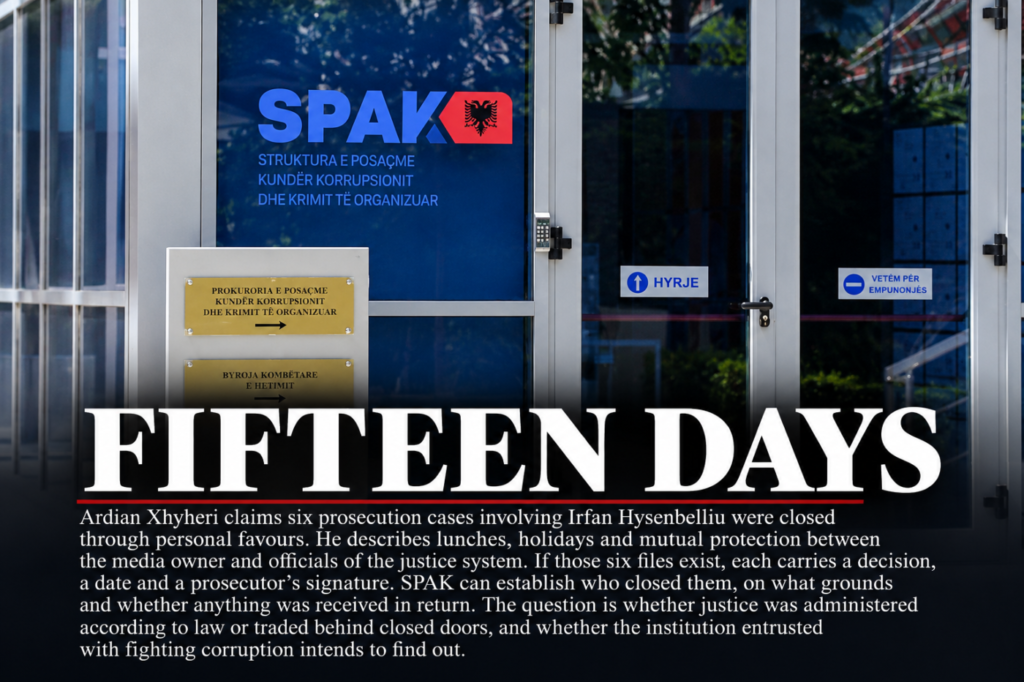
A published recording in which a media owner’s adviser describes prosecution files closed as a favour is, in law, notice of a crime. The Criminal Procedure Code says what the Special Prosecution must do with notice, and how long it has.
By Renada Bici, Legal Desk
On 30 October CNA.al published a video in which Ardian Xhyheri, adviser to Irfan Hysenbelliu, is heard, by CNA’s transcript, saying that Hysenbelliu “had six files” and that “those cases were closed at the prosecution” because of “the goodwill of that gentleman there” (“Ai kishte 6 dosje. Ato raste janë mbyllur në prokurori. Sepse ishte dëshira e mirë nga ai zotëria atje”). Asked whether he meant the prosecutor, he says yes. He describes the relationship with the chief prosecutor of Tirana as one of lunches, summer holidays and mutual protection (“ata hanë dreka, ata bëjnë pushime verore. Ata mbrojnë njëri-tjetrin”). Elsewhere on the tape he describes an arbitrator secured in advance for a claim against the Albanian state, guaranteed by the lawyer “a thousand per cent” and kept from the clients so that it would not become public.
What the recording proves is a matter for an investigation. What it is, in procedural terms, is settled by the Code before any investigation begins.
Article 280 of the Criminal Procedure Code provides that the prosecutor takes notice of a criminal offence on his own initiative as well as through reports. Nothing in the Code requires a complaint before a prosecutor may act on what is already public, and the Special Prosecution has used the provision when it chose to. It registered proceeding no. 138 of 2024, on the killing of Aleks Nika on 21 January 2011, on 15 July 2024 on the strength of a court decision’s findings, thirteen years after the fact and with no complainant. Its chairman told the parliamentary commission on electoral reform this year that of the 46 proceedings SPAK opened on the 2025 elections, a quarter were opened on its own initiative. In June 2025 it registered a proceeding concerning a judge of the Special Court on a lawyer’s report built on a document a party leader had made public two months earlier. A recording in which a named man describes the corruption of a named office is notice of the kind Article 280 contemplates, whatever weight it finally carries.
The recording is also usable. On 19 February 2026 the Criminal College of the High Court, in decision no. 00-2026-208 (38), held that private audio recordings made by a victim may be used as material evidence in a criminal trial provided they are administered and authenticated according to law and assessed against the other evidence; it is a third party’s interception that requires a court’s authorisation. If the people across the table from Xhyheri recorded their own meeting, the tape can sit in a file. Whether it should carry a conviction is a different question and a later one. The defence will say the questions led and Xhyheri only agreed; CNA’s transcript shows the sharpest formulations put by the interlocutor and answered with “absolutely”. That goes to the weight of the evidence, which is judged after a file is opened. The full audio in its original language is the first thing a prosecutor would ask for. And if the tape was staged, the Code has an answer for that too: in February the Constitutional Court let stand the convictions of four men who had fabricated an audio recording of a staged conversation in order to set a prosecution in motion.
The offences described fall within SPAK’s competence and nowhere else. Article 75/a of the Code assigns to the Special Court, and through Article 25 to the Special Prosecution, the crimes of Articles 319, 319/a, 319/b, 319/c, 319/ç, 319/d, 319/dh and 319/e of the Criminal Code. Those include passive corruption of a prosecutor (319/ç) and active corruption of a domestic or foreign arbitrator (319/b), the latter added to the Code in 2012 to meet Albania’s obligations under the Council of Europe’s Additional Protocol on corruption, and rarely charged since, because such arrangements are rarely described aloud. SPAK reads these articles as live law: on 7 May 2026 it sent a former judicial police officer to trial under Article 319/ç, with Article 333/a alongside. The Tirana Prosecution Office, which would ordinarily handle Hysenbelliu’s tax matters, is the office the recording accuses, and the offence it is accused of is one the Code has taken out of its hands: under Article 28(3) a prosecutor who sees that a fact falls within the Special Prosecution’s competence passes the acts to its head. The Tirana office could not investigate the corruption of its own prosecutor even if it wished to.
Article 291 provides that when a report of an offence is registered with the prosecutor, he has fifteen days to issue a reasoned decision not to open a proceeding. Before the 2017 amendments the Code set no deadline at all; a prosecutor could sit on a report indefinitely. Law 35/2017 gave him fifteen days to say no with reasons, and the High Court has said what the fifteen days mean: in decision no. 948 (104) of 30 March 2023 its Criminal College held that a refusal issued beyond the fifteen-day period is a deviation in the exercise of the prosecutor’s function. The grounds for a refusal are not at the prosecutor’s discretion either. Article 290 lists them: the fact is not an offence under the law, the offence is extinguished, an amnesty applies, and the like. The thinness of the evidence is not among them. Evidence is tested by an investigation and, if it fails, the case ends in a dismissal under Article 328, which is itself appealable.
The deadline runs from a report, and so far the recording is public but unreported. Any citizen may change that under Article 283. CNA, which addressed its publication to SPAK by name, may do so. So may the Tax Directorate, which referred Birra Tirana to the Tirana prosecution in August 2022 and is entitled, as the reporting body, to know what became of its referral; Article 281 obliges public officials who learn of an offence in the course of their duties to report it, whether or not the offender has been identified, and an official who reads that his referral was among six files closed as a favour has learned of one. From the day a report is lodged, the Special Prosecution has fifteen days in which refusing is still lawful, and refusing means writing reasons a judge can read.
The reasons, if SPAK chose that route, would have to explain which Article 290 ground covers a recording of a party’s adviser describing the corruption of a prosecutor. They would have to do so against a register that can be checked in an afternoon. The Tirana Prosecution Office’s own records show which proceedings against Hysenbelliu’s companies were dismissed, by which prosecutor, on what dates. Either six such dismissals exist or they do not. Either one name recurs or it does not. A refusal that did not say which goes, within ten days of notification, to the judge for preliminary investigations, who decides on the file; and under paragraph 4 of Article 291 a court that upholds the appeal does not merely quash the refusal. It orders the prosecutor to register the proceeding and to investigate, and it sets the direction the investigation takes.
The re-evaluation of every judge and prosecutor in the country closed this year. The Special Appeal Chamber issued its last decision in March and held its closing ceremony on 17 June; the final count, after appeals, is 348 confirmed in office, 283 dismissed and 173 whose proceedings were terminated, most of them by resignation. The vetting was the state’s answer to the proposition that Albanian prosecutors could be kept by lunch and favours. Xhyheri’s words, if they are his, are a claim that the proposition still holds in Tirana after the vetting. The institution built to test that claim is the one Article 75/a names, and the test is a register.
Three questions put SPAK’s position beyond rhetoric. Has it obtained the recording from CNA, in the original language and unedited? Has it identified the proceedings against Hysenbelliu’s companies that the Tirana Prosecution Office closed, and the prosecutors who signed the dismissals? Has it read those decisions against what Xhyheri says on the tape? Every document those questions concern is held by the Albanian state, and every answer belongs to the public that pays for it. This publication asks them here, and will record what the Special Prosecution says, and when, and whether it says anything at all.
SPAK does not need a complaint to know what CNA published; Article 280 says so. If a complaint is registered, Article 291 gives it fifteen days in which a refusal is still lawful, and the High Court has said what happens to the sixteenth. The six files, if they exist, are already in the state’s possession. Fifteen days is the time the law allows for saying no. It begins the day someone asks, and nothing in the Code obliges SPAK to wait to be asked.
Renada Bici is a Tirana-based lawyer practicing in civil, criminal, and administrative law. She holds a law degree from the University of Tirana and has experience in both private legal practice and public administration. She writes for the Tirana Examiner Legal Desk.