The head of the OSCE Presence in Albania went to Elbasan to tell the young their voice was not heard, in the week their prime minister’s invitations were refused and the only door the state closed was the one the law closes. In July he said the protesters’ demands were not his mandate. In October, with his mandate ten weeks from renewal, they were.
By Ardit Rada (Tirana)
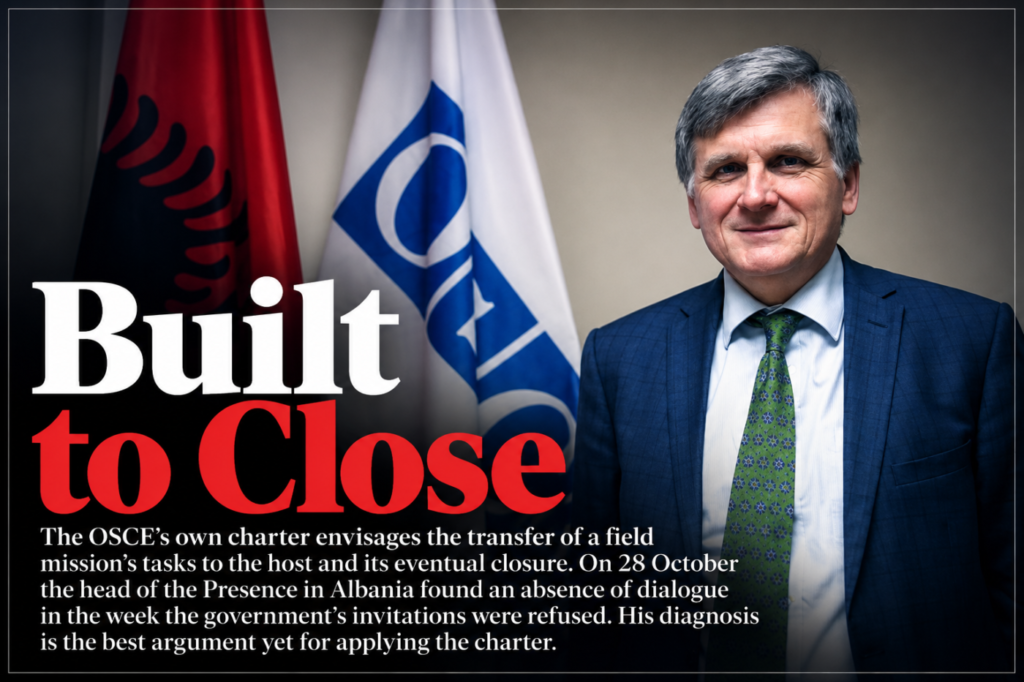
On 28 October Ambassador Michel Tarran, Head of the OSCE Presence in Albania, told reporters in Elbasan that his mission is there “to create channels of dialogue”, that what he has seen in recent months is “an absence of dialogue, in which people’s voice and opinion have not been taken into account”, and that he had come “so that citizens and especially the young understand” that democracy is not exercised once every four years.
He was speaking at an event on local democracy, in a provincial town, to an audience that did not include the Government of Albania, the Assembly, the President, or anyone who had asked him for a channel.
Nobody had. On 15 October his own Presence had welcomed President Begaj’s message, in which the President declared his office open to every young person and every citizen who wished to express their views, and had said it would “stand ready to assist in the facilitation of any such dialogue, if so requested”. Neither the government, nor the President, nor the Assembly requested it, and the students were refusing dialogue with the Prime Minister himself on the day Tarran spoke, as the bulletin carrying his remarks reported. Thirteen days later Tarran dropped the condition and announced the service, to “the people”, over the heads of the institutions whose consent he exists on.
The document that tells him how he is to work is Permanent Council Decision No. 588 of 18 December 2003. It says the Presence provides assistance and expertise “in close consultation and co-operation with the Government of Albania and other State institutions”, and it lists what the assistance is for: legislative and judicial reform, electoral reform, parliamentary capacity, anti-corruption, media law, civil society projects, and police assistance. It does not list diagnosing the country’s political health from a stage. On the one item in that list that was actually in the news, police assistance, Tarran was asked a direct question about rubber bullets and tear gas and answered that violence cannot be part of democratic life, that there had been many violent incidents in Tirana, and nothing more. He did not say who committed them. On the item not in the list, who is to blame for a political impasse, he gave a verdict.
He knew the difference in July. On 10 July, in Korça, 41 days into the summer protests, he said he was glad Albania had become a country where such protests could be held, that political dialogue in Albania was unfortunately not at the right level, and, on what the protesters were demanding, that “it is not my mandate to enter this debate”. That was the correct answer. It lasted until the mandate came up for renewal.
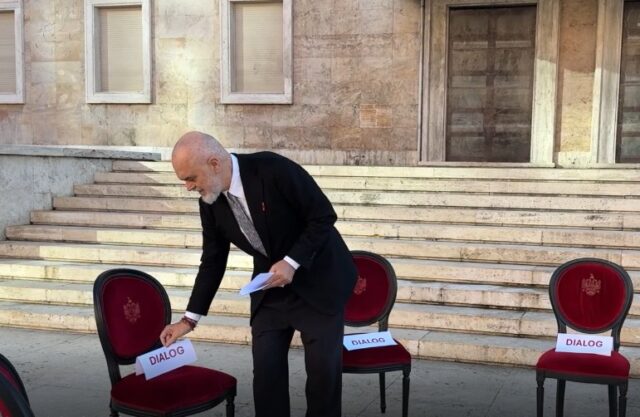
What he found absent in October was in front of him every morning. For a week the Prime Minister set a table on the steps of his own office. It was overturned, burned and written on, and set again the next day. The invitations outlasted the refusals. The one line the state drew was between those who argue and those who throw: with the people who hurled stones, flew explosive drones at the Prime Minister’s office and set fires, the government does not negotiate, because the prosecutor does. The Tirana Prosecution opened a file on the rubber-bullet injury to a 28-year-old within days. A diplomat who had followed the week would have known which side of the table was refusing.
Applied to that week, his two sentences cancel each other. If violence has no place in democratic life, the violent are not a party to dialogue, and the only dialogue the government withheld was with them. If the absence of dialogue is the government’s fault, he is asking it to sit with the people his own principle excludes. He stated the principle and the complaint in one breath and let the complaint point at Tirana.
The country he described is the one his mission was built for. Permanent Council Decision No. 160 of 27 March 1997 created a presence “in co-operation with the Albanian authorities”, at the Albanian government’s request, for democratisation, press and human rights, and the preparation and monitoring of elections, and said the time frame of the presence “will be reviewed by the Permanent Council after the elections”. The memorandum of understanding that gave the mission its immunities, vehicles and radio frequencies was signed in Tirana on 29 May 1997 by Secretary of State Pavli Zeri, for a state that could not then guarantee its own airport. Its Article 18 made it valid for the whole duration of the Presence. Its Article 3 bound OSCE personnel not to carry out activities outside their mandate and duties. The Council did review after the June 1997 elections, and renewed; in December 1997 it widened the mandate and ordered reviews every six months; in 2003 it recorded “the increased central position that the country’s institutions have taken” and made the mandate annual, every prolongation “subject to a new decision”. The exit was written into the design at every stage. At every stage the Council chose to stay.
Twenty-nine years and twenty-three annual decisions later, the host is a NATO ally, a candidate with 33 negotiating chapters open, a state with a working prosecution and a government that would not stop setting the table. None of that was in Elbasan. The only Albanians in Tarran’s account were young and unheard, because a mission whose reason to exist is that Albanians cannot talk to each other needs Albanians who cannot talk to each other, and its head went looking for them ten weeks before the vote on his own mandate.
He found them in a country that does not exist. The Permanent Council has reviewed this mission after every election since 1997 and renewed it every time. Before December, the Government of Albania should tell it that this review is the host’s.