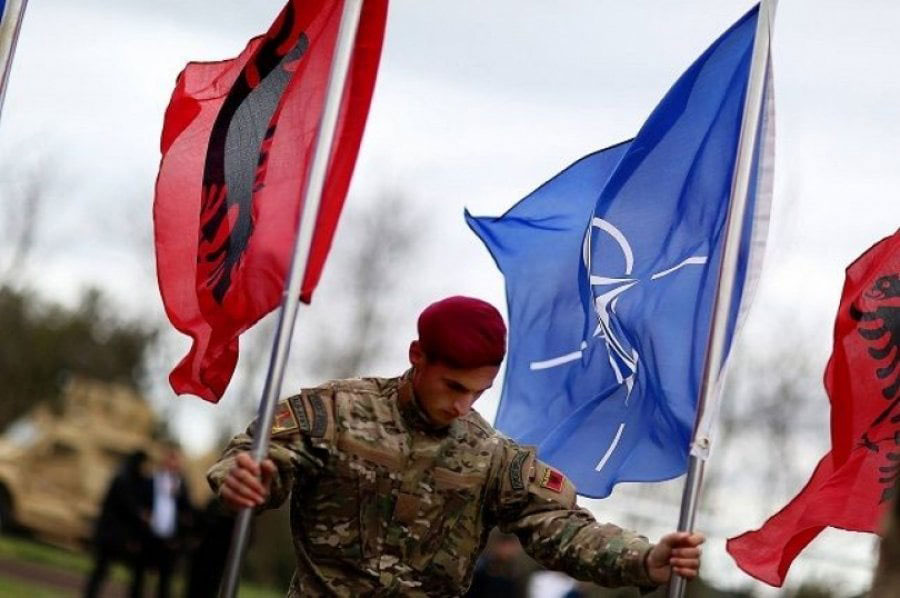
What began as a defense spending increase has evolved into a broader strategic transformation repositioning Albania from a peripheral NATO contributor into a southern-flank operational and production hub linked to Kosovo’s defense integration, the Adriatic-Ionian security corridor, and the alliance’s emerging post-Ukraine Mediterranean architecture.
Drizan Shala
The Republic of Albania has acquired, within 28 months, a position inside the NATO architecture that exceeds what its population, gross domestic product, or military size would predict. The transformation runs from January 2024 to May 2026. The cumulative evidence now supports a structural reading rather than a tactical one, though the trajectory remains conditional on execution variables that will become visible only in 2027 and 2028. The destination, if the trajectory holds, is no longer a small NATO member contributing platoon-sized rotations to coalition deployments. It is a defense industrial state under construction, an operational anchor for southern-flank alliance infrastructure, a cyber integration node within the NATO institutional architecture, and a regional integrator that channels alliance capability into Kosovo’s defense development. None of these positions existed in 2020. The structural foundations for all of them are now in place.
The transformation began as a budget curve. Albanian defense spending stood at 270 million euros in 2021. By 2025 it had reached 526 million, representing 2 percent of gross domestic product for the second consecutive year. The 2026 draft budget raises the figure to 589 million, approximately 2.1 percent of GDP. The Long-Term Plan for the Development of the Armed Forces 2023-2033 sets a 2.8 percent target by 2033. The cumulative five-year procurement projection through 2029 reaches 2.2 billion dollars, nearly doubling the 1.4 billion spent across the previous five-year cycle. These figures are ratified, appropriated, and contractually committed.
The analytically significant question is what the spending has purchased. The answer is that Albania has assembled the four operational pillars of a defense industrial base within a single fiscal year.
The first pillar is naval construction. The Italy-Albania intergovernmental summit chaired in Rome on November 13, 2025 by Giorgia Meloni and Edi Rama produced a memorandum of understanding between Fincantieri and KAYO, the Albanian state-owned defense company controlled by the Ministry of Defense. The full Joint Venture Agreement was signed in Tirana in April 2026. The venture is 51 percent Fincantieri, 49 percent KAYO. It acts as prime contractor for shipbuilding and maintenance in the Albanian market, with Fincantieri retaining prime-contractor status for export work involving vessels under 80 meters and 800 tons displacement. The Pashaliman shipyard near Vlora, where three of the Albanian Navy’s four Damen Stan 4207 patrol vessels were built under license between 2007 and 2014, is being modernized as the main production site. The industrial plan targets approximately ten Offshore Patrol Vessels across 2026-2030. The execution risk is Albanian shipyard workforce capacity, which has not built vessels above 50 meters since the 1980s, and which Fincantieri will need to either rebuild through training programs or supplement through expatriate technical staff.
The geopolitical inversion bears noting. Pashaliman, where Moscow once based its only Mediterranean submarine flotilla until the 1961 Albanian-Soviet break, is being reconstituted as a Fincantieri-led NATO-interoperable construction yard.
The second pillar is armored vehicle production. The Shota mine-resistant ambush-protected vehicle, designed by the Tirana-based company Timak and first presented at Eurosatory in Paris in 2024, entered joint Albania-Kosovo-Croatia production in December 2025 within the framework of the trilateral defense cooperation declaration signed in March of the same year. The Shota is a 13-ton platform in 4×4 and 6×6 configurations, built to STANAG 4569 Level 3 armor standards. It carries ten personnel. The assembly site in Albania is the former Autotractor Plant in Shkoza, Tirana, converted under KAYO management with Timak as the private industrial partner. The platform serves the domestic armed forces of all three signatories and is positioned for export. This is the first time three Balkan states have assembled jointly for armored vehicle production. The execution risk is workshare distribution and certification harmonization across three jurisdictions with different defense procurement bureaucracies, which has historically been the failure mode of European joint defense programs at every scale.
The third pillar is drones, light weapons, and ammunition. The Rubik facility, a former copper processing plant operational from 1965 and dormant for two decades, has been taken over by KAYO and is being converted into the central industrial site of the Albanian defense revival. The Israeli company Elbit Systems is the principal foreign partner, with the strategic defense agreement between Albania and Israel approved in mid-2025. Rubik will produce drones, light weapons, and heavy artillery. It will also provide brass-72 ingots to feed the cartridge case production line at the Poliçan ammunition facility. The legacy facilities at Gramsh and Mjekës are being reactivated under the same coordinated industrial doctrine. The Defense Industry Agency, established under the May 2024 defense industry law, provides the licensing and oversight architecture. Twenty-five international consortia from the United States, Europe, Israel, and the Middle East have expressed interest in additional partnerships. Approximately half of the 2026 defense budget will be directed toward equipment acquisition, the majority of which will flow through domestic production lines. The execution risk is the production-line ramp from announced facility to delivered platforms, which Albanian industrial recovery cycles have historically extended by 24 to 36 months beyond initial schedules, and which the Elbit partnership remains exposed to through Israeli political volatility.
The fourth pillar is cyber capability. The Military Cyber Security Unit was established in January 2024 with an 8.4 million dollar U.S. investment within a broader 50 million dollar cybersecurity assistance package. The unit operates under the Cyber and Signal Command of the Albanian Armed Forces. The Combatting Cyber Attack Response Center, equipped with IBM QRadar Suite, runs 24/7 threat detection. The institutional architecture was layered onto this baseline through 2024 and 2025: the Cyber Defense Strategy 2024-2028, the Cybersecurity Law of May 2024, the National Cybersecurity Strategy 2025-2030 approved in October 2025 with alignment to EU NIS2, eIDAS2, and EUCC. The KAYO-Leonardo partnership signed at the Rome summit added Italian electronic warfare capabilities. External validation came in two consecutive engagements: the Albanian team’s top scores at the Cyber Yankee 2025 multinational exercise in New Hampshire, and Tirana’s hosting of the 3rd NATO Cyber Defence Conference in October 2025, where Secretary General Mark Rutte announced the establishment of NATO’s Integrated Cyber Center in Belgium.
The decisive institutional step came on May 14, 2026, when Albania formally acceded to the NATO Cooperative Cyber Defence Centre of Excellence at the flag-raising ceremony in Tallinn, alongside Finland and Sweden. Albanian cyber operators now train, exercise, and develop doctrine within the same forum as American Cyber Command, the UK National Cyber Force, the Italian and German military cyber services, the Korean and Japanese cyber commands, and the Ukrainian cyber defense services with four years of active operational experience against Russian state-sponsored threats. No regional non-aligned actor has access to a training environment of this depth. The execution risk is talent retention, because Albanian cyber operators trained to NATO standards become immediately employable in significantly higher-paid private-sector positions across Europe, and the Ministry of Defense has not yet articulated a retention strategy at the compensation levels the broader European cyber labor market sets.
The procurement record demonstrably executes. The Javelin anti-tank missile system, ordered through Foreign Military Sales channels years earlier, completed its first delivery to the Albanian Land Force in late December 2025, with the full handover ceremony conducted in Tirana in February 2026. A second tranche follows in 2026. The Albanian Ministry of Defense separately acquired Command Launch Units, additional launchers, and simulation and training systems through national funds, with the stated objective of certifying a full battalion group capability. Bayraktar TB2 systems from Turkey provide ISR with secondary strike capability. Black Hawk helicopters anchor the rotary-wing modernization. Thales Ground Master 400 Alpha radar systems for airspace monitoring are scheduled for 2026. Short Range Air Defense capabilities are programmed for the next phase. The U.S. bilateral cooperation framework covers Albania and Kosovo as a single programmatic envelope, with Foreign Military Sales functioning as the common procurement architecture for both states.
The personnel architecture is responding to the structural reforms. The Albanian Armed Forces field approximately 7,500 active personnel. The Military Reserve Force legislation adopted in late 2024 establishes a voluntary, trained, and equipped reserve with 15.5 million euros in dedicated funding for 2025. Conscription remains abolished. In the first two recruitment sessions of 2025, more than 470 young people joined the Armed Forces, a 70 percent increase compared to 2024, while the resignation rate dropped 64 percent year-on-year. A functional reserve of 5,000 to 8,000 trained personnel, executed at committed funding levels, would expand mobilizable Albanian strength by 70 to 100 percent within the planning horizon. The execution risk is institutional absorption capacity, given that the Defense Ministry contracting infrastructure was sized for a force of 7,500 active personnel and a 250 million euro budget, and is now being asked to manage a procurement and industrial pipeline several times larger without proportional administrative expansion.
The architectural picture is multidimensional. Albania has acquired five distinct structural positions within the NATO security architecture. The simultaneity is the analytical point. Small alliance members typically occupy one or two such positions. Albania is now layered into the alliance architecture across operational, industrial, geographic, doctrinal, and political vectors at the same time.
The first position is the southern Balkans operational anchor. The Kucova Air Base, opened in 2024 as the first dedicated NATO tactical airbase in the Western Balkans, locates the alliance’s regional air operations capability on Albanian territory, available for forward deployment, air policing rotations, and exercises across the southern Balkans and the central Mediterranean. The new naval base under construction at Porto Romano will provide operational fleet basing, available as a NATO naval facility according to Albanian government statements. The Pashaliman shipyard becomes the industrial naval node. The functional division between Pashaliman as the shipbuilding yard and Porto Romano as the operational fleet base is unusual for a country of Albania’s size and indicates a level of alliance investment in Albanian infrastructure that exceeds normal small-member basing arrangements. The execution risk is dual-site operational coordination, which Albanian naval command has not previously been required to perform at this scale.
The second position is the southern flank industrial node. Albania is being constructed as a defense production location within the post-Ukraine European rearmament cycle, financed by national defense spending, European Defence Fund and SAFE instrument access, U.S. Foreign Military Financing, Israeli industrial capital through Elbit Systems, and Italian industrial capital through Fincantieri and Leonardo. The financing structure is unusual for a country of Albania’s GDP scale and indicates that the build-out is being underwritten by external capital that has identified Albania as a strategic location for southern-flank defense production. The role Albania is constructing is structurally comparable to the role Czechia, Bulgaria, and Romania have built over three decades, attempted within a three-to-five-year horizon rather than a generational one. The execution risk is the compression itself: industrial absorption that took those countries thirty years cannot be guaranteed to mature within five, and the partnerships sustaining the build-out remain exposed to political volatility in Rome, Washington, and Tel Aviv.
The third position is the cyber integration anchor. The CCDCOE accession on May 14, 2026 completes the institutional anchoring of Albanian cyber capacity within the NATO architecture. The chronology from January 2024 to May 2026 demonstrates that the positioning has been constructed deliberately across multiple external partnerships and institutional layers within a 28-month window. The capstone is the accession. The foundation is the U.S.-funded operational unit. The Italian, EU regulatory, and NATO doctrinal integration is layered between. This pillar is the one least visible to conventional military analysis, because it produces no platforms and no troop deployments, and it is therefore the pillar most likely to be underweighted in regional threat assessments that focus on conventional capability. The execution risk is institutional sustainability beyond the current U.S. funding cycle, which has not yet been programmed past 2027.
The fourth position is the southern Balkans regional integrator. The Tirana-Pristina-Zagreb trilateral framework, operationalized through the Shota MRAP joint production, the joint Albanian-Kosovar military unit announced in September 2025, and the U.S. bilateral cooperation that explicitly covers Albania and Kosovo as a single programmatic envelope, positions Albania as the channel through which alliance-grade capability flows to Kosovo’s security force without requiring formal Kosovar accession to NATO. This is a structural workaround. It addresses a problem the alliance has been unable to resolve through conventional accession processes because of the Russian and Serbian veto positions within the OSCE and UN Security Council frameworks that govern Kosovo’s status. Albanian membership in NATO is being operationally extended to cover Kosovo’s defense development. The execution risk is the political durability of the trilateral framework across electoral cycles in three jurisdictions, and the Western Balkans regional cooperation record on this question is largely a record of unrealized declarations.
The fifth position is the Italian-led central Mediterranean security partnership. The November 2025 Rome summit produced sixteen agreements across multiple sectors, eight focused on defense, military industry, and civil protection. The Rome-Tirana relationship now exceeds standard bilateral defense cooperation and approaches the structural depth of the Italian-Greek defense relationship in selected dimensions. Italy has effectively underwritten the construction of Albanian defense industrial capacity in exchange for strategic positioning on the southern flank, access to Pashaliman as a NATO-available naval facility, and a privileged voice in southern Balkans security questions. The southern flank is acquiring an Italian-led sub-architecture that runs from Rome through Tirana into Pristina and Skopje. It complements rather than competes with the U.S.-led core architecture, occupying functional space Washington has chosen not to invest in directly. The sub-architecture also operates alongside the Greek and Turkish positions on the broader southern flank, adding a third Adriatic-Ionian dimension to the alliance’s Mediterranean posture rather than displacing the existing two. The execution risk is Italian fiscal capacity, given the budgetary pressures facing the Meloni government across the 2026-2028 horizon, and the durability of the Italian commitment to underwriting external industrial capacity at the levels the current architecture requires.
The consequences for security in the Western Balkans and the central Mediterranean are now legible.
The regional balance has shifted, though not as decisively as the trilateral envelope arithmetic alone would suggest. Serbia’s defense budget of 2.2 billion euros in 2025 remains the largest single defense expenditure in the former Yugoslav space, exceeding the combined budgets of Albania, Kosovo, Montenegro, North Macedonia, and Bosnia and Herzegovina. The arithmetic looks different when extended to the Tirana-Pristina-Zagreb trilateral envelope, which reached approximately 2.08 billion euros in 2025 between Albania at 526 million, Kosovo at 208 million, and Croatia at approximately 1.345 billion. If current trajectories hold, the trilateral envelope reaches 3.5 to 4 billion euros by 2027-2028, against a Serbian budget unlikely to grow at the same rate without imposing fiscal stress the Serbian economy is not structured to absorb.
The Serbian strategic response is constrained but not negligible. Yugoimport-SDPR retains genuine industrial depth across small arms, artillery, and armored vehicles. The Chinese drone partnership, the Russian procurement relationship, and Belgrade’s continued investment in domestic missile and air defense capability provide adaptive capacity that the trilateral envelope advantage does not automatically neutralize. The asymmetry Belgrade spent two decades constructing is being challenged, not dissolved.
The Adriatic and Ionian maritime domain is being reconstituted as a NATO operational space with embedded production capacity. Kucova provides the air component. Pashaliman and Porto Romano provide the maritime component. The Italian-Albanian industrial relationship provides production and sustainment depth. The central Mediterranean has been a NATO operational area since the alliance’s founding. The embedded production capacity is new. Until 2024, the alliance’s southern flank produced limited defense industrial output, with most platforms imported from northern European or U.S. suppliers. The Albanian build-out, combined with the broader Italian industrial expansion, creates a southern-flank production base capable of supplying the alliance with patrol vessels, MRAPs, drones, light weapons, ammunition, and cyber services.
Kosovo’s security position is materially strengthened through institutional integration rather than unilateral capability development. Kosovo’s defense budget of 208 million euros in 2025, even with the announced four-year billion-euro program, cannot match Serbia’s spending in absolute terms. What Kosovo has acquired through the trilateral framework, the Albanian alliance channel, and the U.S. joint envelope is access to capability and training that would be unavailable through unilateral procurement at any budget scale. The Javelin systems delivered to Albania in 2025-2026 cover Kosovo as part of the same programmatic envelope. The Shota MRAP joint production gives Kosovo an industrial role. The Albanian Armed Forces channel provides Kosovo with operational interoperability with NATO no other arrangement could produce within a comparable timeframe. The structural workaround Albania performs for Kosovo is the most significant security development affecting Kosovo’s defense position since 2008.
The Belgrade analytical response has lagged. The Russian-Serbian framework has historically read Western Balkans security through the lens of NATO expansion, Albanian-Kosovar irredentism, and great-power encroachment. The current build-out does not map cleanly onto any of these frames. It is not NATO expansion in the conventional accession sense. It is not Albanian-Kosovar irredentism in the territorial sense. It is the deep integration of a small NATO member into the alliance industrial, operational, institutional, and political architecture at a level normally reserved for larger states. Belgrade has the analytical vocabulary to describe encirclement and great-power instrumentalization. It has not yet developed the vocabulary to engage with the structural specificity of what is being constructed. The lag is conceptual rather than informational. It creates a window during which Albanian positioning can consolidate, though the window is narrowing as Serbian analytical institutions begin to engage with the industrial dimension of the transformation.
The European defense autonomy architecture is acquiring a southern flank that did not previously exist. The European Defence Fund, the SAFE instrument, and the post-Ukraine rearmament cycle have produced a substantial increase in European defense spending and industrial capacity, concentrated in Germany, France, Poland, and the Nordic states. The southern flank has been comparatively underdeveloped in the European defense industrial conversation. The Albanian build-out, anchored in Italian industrial capital and integrated into the broader trilateral framework, introduces a southern flank pillar into the European defense autonomy architecture. Whether this pillar matures depends on execution variables that will become visible in 2027-2028, when the simultaneous delivery and integration phases of the Pashaliman naval line, the Rubik production lines, the Shota MRAP joint manufacturing, and the Leonardo electronic systems integration reach operational maturity.
The risks to the trajectory are real and cumulative. Fiscal sustainability of the 2.8 percent of GDP target through 2033 requires sustained Albanian GDP growth above 4 percent annually, or politically difficult trade-offs against social spending, EU accession compliance costs, and infrastructure modernization. Procurement absorption capacity has been demonstrated through the Javelin sequence but has not been tested against simultaneous execution of four parallel industrial reconstitution programs reaching operational delivery in 2027-2028. The partnership frameworks across Tirana, Rome, Pristina, Zagreb, Tel Aviv, and Washington introduce dependencies no single capital controls. The Albanian state capacity to manage procurement, sustainment, and industrial partnership at this scale was not designed for the architecture it is being asked to administer. Corruption and rule-of-law concerns, which the European Commission tracks closely within the IBAR and chapter-cluster framework, intersect with defense procurement in ways that could expose the partnerships to political volatility in Brussels. The Western Balkans regional cooperation record is largely a record of unrealized declarations. Whether the current cycle is structurally different remains conditional on platforms delivering, production lines operating, and the trilateral framework producing integrated force structure rather than aspirational documents.
The direction of travel is now legible. The institutional foundations are in place. Albania has been positioned, in 28 months, into a structurally integrated southern-flank NATO partner whose national defense and alliance defense are operating as a single connected system across operational, industrial, institutional, and political dimensions. The position is comparable in functional logic, though not in scale, to the roles other small NATO members occupy at the alliance’s other flanks. The implications extend beyond Albania’s borders into the strengthening of Kosovo’s position through institutional integration, the reconstitution of the Adriatic and Ionian maritime domain as a NATO operational space with embedded production capacity, the challenge to the regional defense balance Belgrade spent two decades constructing, and the addition of a southern flank pillar to the European defense autonomy architecture.
The window for consolidation is open. It will not remain open indefinitely. The platforms have to deliver. The production lines have to operate. The trilateral framework has to convert from declaration to integrated force structure. The cyber and industrial partnerships have to survive political volatility in multiple capitals. The institutional capacity to absorb the architecture has to mature on the same timeline as the architecture itself.
The Albanian Armed Forces of 2030 will not be the Albanian Armed Forces of 2020. That much is determined. Whether they become the institution the current trajectory points toward depends on execution variables that no analytical framework can fully anticipate, and on political continuity across six jurisdictions that have not previously been required to sustain a coordinated defense industrial architecture across multiple electoral cycles.
The architecture is being constructed in real time. The capacity is being built alongside it. The trajectory points toward a structural transformation. The destination remains conditional on whether the institutional capacity Tirana is building matches the architecture Tirana is now being asked to occupy.
Drizan Shala writes on security, institutions, and political violence for Kosovo Dispatch and Tirana Examiner.