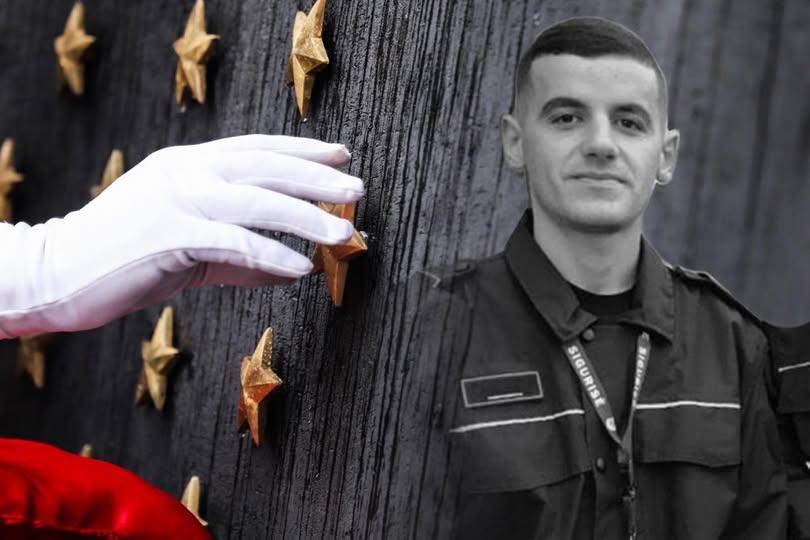
A 28-year-old officer of the Eagles unit was killed for asking a driver to slow down. On Saturday he was reinterred at the National Martyrs’ Cemetery, six weeks after the Court of Appeals cut his killer’s life sentence to thirty-five years.
Drizan Shala
A twenty-eight-year-old police officer in uniform stops his car on a village road in Fier. He asks the driver of an Audi A3, who has just entered the curve at speed, not to drive that way. The driver gets out of his vehicle, walks back with a bag containing a pistol, loads the weapon in front of four witnesses including his own mother, presses the barrel against the officer’s left eye, and fires once. The officer dies on the road. The shooter, twenty-three years old, had been enrolled three years earlier in a civilian armed structure organized by a parliamentary party for the protection of votes in the 2021 election.
Albanian state institutions have been processing this case, in different registers, for two years. On Saturday it acquired its institutional closing chapter. Novruz Cenalia was declared Martyr of the Fatherland by presidential decree and reinterred at the National Martyrs’ Cemetery in Tirana, in the presence of Interior Minister Besfort Lamallari and the Director General of the State Police, Skënder Hita.
The Court of Appeals had already spoken. Six weeks earlier.
What Article 79/b is for
The killing of a uniformed officer is not a private crime against a private individual. Article 79/b of the Albanian Criminal Code, under which Azgan Mërnica was charged and convicted, rests on a principle older than any modern penal code: the use of organized force belongs to the state, and an attack on the man wearing the uniform is an attack on the state itself.
Lamallari, at the cemetery on Saturday, said it directly. “Those who think they can frighten the state by striking a police officer are gravely mistaken. The loss of Novruz Cenalia is a great pain, but it does not weaken our mission; on the contrary, it strengthens our resolve to fight crime and to protect order and public safety.” The killing, the minister continued, was “a blow not only against an officer of public order, but against the authority of the state itself and against trust in the law.”
He had said the same thing six weeks earlier, in a register that was less ceremonial and more pointed.
On 10 April 2026, the day after the Court of Appeals reduced Mërnica’s life sentence to thirty-five years, Lamallari published a statement on his official Facebook page. “The decision to reduce the sentence against the perpetrator of the murder of a State Police officer is deeply troubling. Even though we have not yet been acquainted with the full reasoning, the killing of the Shqiponja officer Novruz Cenalia was an open attack on the state itself and on the legal order. Such an act not only wounds the family of the deceased and discourages colleagues in uniform, but risks sending the wrong message to anyone who dares to oppose the law and the rule of law. We respect the independence of the judiciary, but we expect justice to be strong and at the height of the responsibility it has toward citizens and toward those who protect public order every day.”
The two statements are doctrinally identical. The cemetery is where the second one acquired institutional form.
The road in Baltëz
The facts of 13 May 2024 are settled in the judicial record. Cenalia, an officer of the State Police’s Shqiponja Special Forces attached to the Local Police Directorate of Fier, was off-duty but in uniform, driving toward the start of his shift. At a turn in the village of Baltëz, in the Dërmenas administrative unit, an Audi A3 driven by Azgan Mërnica entered the curve at speed. Cenalia stopped. He asked Mërnica not to drive that way.
Four people were present at the scene, including the perpetrator’s mother Ajete Mërnica, and their statements are consistent. Mërnica stopped his car. He retrieved a bag containing a pistol. He walked back toward Cenalia’s vehicle. He drew the weapon and loaded it. His mother called out, “Don’t do it, Azgan, let’s go.” A bystander, Cen Qelia, told him to put the weapon away because it was not a toy. Cenalia stepped out of his car. The two men exchanged words. Cenalia, in the red and blue police uniform, attempted to lower Mërnica’s gun hand. Mërnica raised the pistol to the officer’s left eye and fired once.
Cenalia died instantly.
Mërnica fled with his mother in the Audi, abandoned the vehicle four kilometers away at an uncle’s apartment, and went into hiding in canals near the river Seman. He surrendered after forty-eight hours, mediated by family members. At the moment of his handover to RENEA, in the presence of his lawyer, he stated that he was not remorseful for what he had done.
The shooter, and the man he killed
Mërnica’s older brother, Kiri Mërnica, is serving nineteen years for the 2019 murder of a young man named Florian Selimi, whose body was recovered from a canal in Fier. Azgan Mërnica’s own enrollment in the Democratic Party’s Armed Structure for Vote Protection in 2021 is documented through a photograph published at the time by then-DP MP Luan Baçi and surfaced in subsequent reporting on the case.
A civilian armed structure attached to a parliamentary party is a primary marker, in any functioning democratic order, of the erosion of the state’s monopoly on legitimate force. Albania’s post-1990 record, with the exception of the institutional collapse of 1997, has held that line. The Democratic Party’s 2021 vote-protection structure was a departure from it, organized within the same electoral cycle in which the party produced budgets and votes in the Kuvend.
The man who executed a uniformed officer for asking him not to speed had been recruited into one of the parliamentary expressions of that grammar three years before he pulled the trigger.
Cenalia’s father, Asllan Cenalia, was a long-serving officer of the State Police who worked in the operational hall. Novruz had three years in the Eagles unit. He had been married one month before his death. The Cenalia family had relocated from Has to the Fier region years earlier to leave behind a blood feud, a movement intended to remove the next generation from the risk of violent death.
The relocation succeeded against the threat the family knew. It did not anticipate the one waiting on a village road.
The trial, and the appeal
On 30 July 2025, the First Instance Court of Fier, sitting as a three-judge panel under presiding judge Elira Hroni, with prosecutor Denis Hyka, found Mërnica guilty under three articles of the Criminal Code: Article 79/b (murder of a police officer), Article 278 (unauthorized possession and manufacture of weapons), and Article 291 (irregular operation of a motor vehicle). The court accepted the prosecution’s request and sentenced him to life imprisonment.
The judgment was, on the facts established at trial, the legally available maximum and the doctrinally proportionate response. Article 79/b removes a defined category of crimes from the ordinary calculus of mitigating factors, on the principle that the killing of a state officer is qualitatively different from the killing of a private citizen. The premise is standard across continental criminal traditions and is the legal embodiment of the rule that the uniform represents the state, not the man.
On 9 April 2026, the Court of Appeals with general jurisdiction reduced the sentence from life imprisonment to thirty-five years. The reasoning has not been disclosed in adequate detail in the public record. Whether the reduction rests on mitigating circumstances, on procedural review of the trial record, or on a reclassification of intent is, at the moment of writing, unanswered.
The victim’s father, who spent his career in the operational hall of the same institution that buried his son on Saturday, called the reduction “a second murder.” The family will pursue the case at the High Court.
The appeals decision is the structural fact around which everything else in the Cenalia file now arranges itself.
Why the category exists
The status of Martyr of the Fatherland is codified in Law No. 8607 of 27 April 2000, which deliberately extended the category beyond the partisans of the National Liberation War to include those who fall in service to the state across all historical periods, including the post-1990 republic. The precedent for police officers is established. Kristaq Begu, killed in 1997 by the Katesh gang while on duty, was declared Martyr of the Fatherland in 2011, thirteen years after his death. The category exists for the kind of death Cenalia died.
There is, in the modern repertoire of police sacrifice, more cinematic ground. Officers fall in shootouts with organized crime, in undercover operations against trafficking networks, in hostage situations. Cenalia’s death was none of these. He was killed performing the most elementary function of a uniformed officer of the state: telling a citizen, on a public road, not to endanger the lives of other citizens by driving recklessly. There was no operation in progress. There was no investigation. There was no organized criminal target. There was a man in uniform doing what the uniform exists for, and a young man whose answer to the lawful word of the state was a pistol pressed to the eye.
Lamallari, at the cemetery: “The State Police carries in its history and memory one more martyr. The name of Novruz Cenalia will remain forever among those men and women who saw the uniform not as a privilege but as a mission in service to citizens and to the homeland.”
If the category is to mean anything other than a ceremonial title attached to deaths the state finds politically convenient, it must mean this. It exists to honor sacrifice that is unspectacular in its setting and absolute in its content.
Two organs, two answers
The Albanian state has spoken twice about the killing of Novruz Cenalia, and it has not said the same thing.
The Court of Appeals reduced a life sentence for the execution of a uniformed officer to thirty-five years. The published reasoning does not resolve the question of why an attack on the State Police, premeditated to the extent of a witness sequence in which the shooter retrieves a weapon from a bag, loads it in front of his own mother, and walks back to fire, fell outside the category of crimes the Albanian state classifies as warranting permanent removal from society.
The presidency, the executive, and the Ministry of the Interior, through the decree of martyr status and the reburial at the National Martyrs’ Cemetery, declared the killing an attack on the state itself.
In the doctrinal grammar of separation of powers, these are complementary registers, not competing ones. The judicial branch works inside the constraints of procedural review of the trial record. The executive branch works through symbolic affirmation: decrees, ceremonies, designations. When the two diverge on the same act, the executive’s symbolic instruments function as institutional counterspeech, the assertion that the state, as a constitutional whole, has not accepted the judicial conclusion as its final answer.
That is what the cemetery was on Saturday. The executive branch, having stated its objection in real time on 10 April, embedded the same objection in the most durable symbolic form available to it.
“Criminal justice for Novruz is not only a legal obligation,” Lamallari said. “It is a moral obligation to his sacrifice and to every police officer who faces danger every day to protect citizens. A state that honors its martyrs must guarantee that crime will never triumph over law.”
The address was directed forward, at the High Court proceedings still ahead. The cemetery was the message.
The hill
A state buries its martyrs in the place it reserves for those it cannot afford to forget. The decision to extend that place to Novruz Cenalia is correct, not because the ceremony repairs what cannot be repaired, but because the category exists for exactly this kind of death and exactly this kind of moment. He was killed in uniform. He was killed in the act of asking a citizen to obey the law. He was killed by a man whose enrollment in a parliamentary party’s armed civilian structure preceded the killing by three years. He was killed at the elementary point of contact between the State Police and a public road.
Lamallari’s closing words at the cemetery: “In this sacred place, beside the martyrs of the nation, rests today another worthy son of Albania. A man who did not seek glory, but did his duty to his final breath.”
The reburial does not close the case. It marks the boundary the state has chosen to defend.
The High Court will decide whether the criminal justice system intends to defend it in the same terms.
Until then, the cemetery is the more truthful answer.
Drizan Shala writes on security, institutions, and political violence for Kosovo Dispatch and Tirana Examiner.