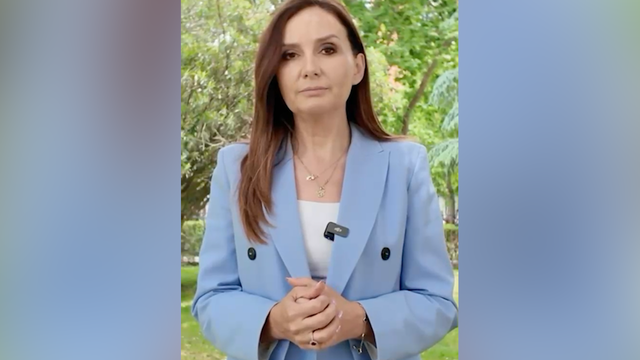
On May 15, 2026, Democratic Party MP Jorida Tabaku made five statistical claims about procurement and concessions. Three are false. One is misleading. One is incoherent. None of them holds.
Bekim Besimi and Renada Bici
On May 15, 2026, Democratic Party MP Jorida Tabaku went before the public with a statement on public procurement and concessions in Albania. The statement contained five distinct statistical assertions. Within 72 hours, each of them could be checked against official data from the Public Procurement Agency, SIGMA/OECD reports, World Bank assessments, and statistics published by OpenTender.EU and the United Nations Development Programme.
We did the check. The result is plain. Of five claims, three are factually false, one is misleading in the way it is constructed, and one is incoherent to the point that it cannot be verified at all.
None of them holds as stated.
This piece takes them one by one. The claim as made. The data that contradicts it. The verdict. No flourish, no defence of anyone, no political framing. Only the figures, and the question of where they came from.
Claim one. “Roughly 2.2 billion euros have been tendered in concessions.”
Tabaku does not say where this figure comes from. The available public data gives entirely different numbers depending on the period and the methodology used.
BIRN Albania has documented 220 concession and public-private partnership contracts with a total value of 4.27 billion euros for the period 2004 to 2020. Monitor magazine calculates the budget commitments for PPP contracts at roughly 2 billion euros for the period 2019 to 2032, but these are scheduled budget payments, not total contractual value, which are two different things. The 2025 draft budget projects annual concession payments at approximately 14.2 billion lek, or roughly 130 million euros, for a single year.
None of these indicators is 2.2 billion euros. As a bare figure, with no context attached, it corresponds to no verifiable indicator, no specified period, and no declared methodology.
Perhaps it is a calculation that Tabaku or her staff produced by combining different categories. Perhaps. But that is an assumption we have to make on her behalf. The statement itself offers no explanation.
Verdict: a figure with no source, no methodology, no period. Unverifiable as presented.
Claim two. “Roughly 1 billion euros of these are under formal investigation for corruption.”
This is the most complicated of the five claims, and why it is complicated will become clear in what follows.
As a statement about the volume of contracts currently in SPAK files, the figure can be defended. The four healthcare concessions alone — sterilization, basic medical check-up, dialysis, and laboratories — have a combined value of roughly 420 million euros, and all four are under investigation. Add the Tirana, Fier, and Elbasan incinerators, plus several road infrastructure concessions, and the figure could plausibly reach the “roughly 1 billion” range. As a statement about contractual volume under scrutiny, it stands.
But the figure is not there to stand as a statement about contractual volume. It is there to let the reader reach a different conclusion. And that is the problem.
When an Albanian reader hears “1 billion euros under formal investigation for corruption,” they do not process the phrase as a procedural category. They process it as damage. They read it as “1 billion stolen.” Tabaku does not pronounce this translation, but the construction of the sentence makes it unavoidable.
A distinction worth attention enters the picture here, because without it nothing else makes sense.
Under the Albanian Criminal Procedure Code, a corruption investigation into a concession contract moves through four distinct phases, and each produces a different figure.
The first phase is the opening of the criminal proceeding. The object of scrutiny in this phase is the total contractual value suspected of constituting the alleged offense. This is the largest figure that can legitimately be presented under the formula “under investigation,” but it is also the least useful, because it says nothing about real damage.
The second phase is the indictment. When the prosecution decides to send the case to trial, it isolates the alleged damage and separates it from the total contract value, because criminal liability rests on what can be proven, not on the total under suspicion.
The third phase is the court judgment, which narrows the figure once again, this time with the weight of what can be proven in court.
The fourth phase is the civil recovery procedure, which produces the figure of practical relevance: what is actually returned to the state budget.
These four figures differ from one another by an order of magnitude. In the sterilization case, the contractual value was in the range of tens of millions of euros. The specific damage alleged in the indictment against former Minister Beqaj is a fraction of that, limited to the documented price inflations and the alleged bribery transactions. The amount recovered to date is practically zero. The same proportion applies to the Tirana incinerator, to the laboratory contracts, to dialysis. The historical level of proven damage in Albanian procurement cases has consistently stood at a double-digit percentage of contractual value, never approaching the total.
So when Tabaku says “1 billion under investigation,” she is referring to the first procedural phase. She is saying it in a technically accurate way. But she is saying it in a context where no one hears it as a procedural phase. They hear it as damage.
Tabaku is a lawyer by training. She has served for years in parliamentary committees where this distinction is daily routine. She cannot fail to know it. So the choice to present “1 billion” as a single figure, without clarifying that this is contractual volume and not proven damage, is a choice, not an error.
Verdict: defensible as a technical statement about contractual volume. Misleading as a statement about proven corruption. A rhetorical construction, not information.
Claim three. “One in two tenders is awarded without competition.”
This is the central claim of the entire statement. And it is factually false in a way that can be verified within ten minutes, by anyone with an internet connection.
The official 2025 indicators report of the Public Procurement Agency, published openly and accessible online, states it plainly.
Negotiated procedures without prior publication of a contract notice, the technical-legal category corresponding to “tender without competition” in the formal sense, account for 2.4 per cent of the total procedures with a winner in 2025. Forty-five times less than “one in two.” This is not opinion. It is an official figure produced by the institution that manages the system itself. And it is not a single-year anomaly. This category has fallen year on year from 30 per cent in 2010 to 2.4 per cent in 2025. Fifteen years of procedural reform, recorded year by year in official data.
The average number of bids per procedure in 2025 is 3.7. For public works, the category with the largest weight in the limit fund (44.3 per cent of the total), the average rises to 5.9 bidders per procedure. For a typical public works tender in Albania in 2025, on average six companies compete against one another. This is not “without competition” in any sense the phrase can carry.
Distinct economic operators awarded contracts in 2025 numbered 2,537. The annual average of distinct winning operators for the period 2014 to 2025 is 2,351, compared with 1,378 for the period 2009 to 2013. Small and medium-sized enterprises won 95.4 per cent of procedures in 2025.
Three independent international frameworks have converged on these data. SIGMA/OECD, a framework of the most established international organization for economic governance, placed Albania first in the Western Balkans in 2025, with 81 points out of 100, above Serbia, North Macedonia, Montenegro, Kosovo, and Bosnia. The World Bank, through the PEFA assessment, raised Albania’s grade from B+ to A, with maximum A ratings across all four dimensions, including the specific dimension of “Procurement Methods.” OpenTender.EU, an independent transparency instrument managed by the Government Transparency Institute in Budapest, gave Albania 71.41 points in Integrity, above 16 European Union member states, including Austria, Italy, France, Spain, Portugal, Poland, Hungary, Romania, and Ireland.
No reading of these figures produces “one in two tenders without competition.” The figure “50 per cent” does not appear in any published official Albanian procurement statistic. There is no reasonable methodology that produces it.
Tabaku does not cite the source because no source exists.
Verdict: false. False against figures that are three clicks away.
Claim four. “Sixty per cent of funds end up with only 20 companies.”
This figure on concentration has no declared source either. There is no public Albanian study that documents this percentage with this methodology.
Worse for Tabaku: her figure is questionable on simple arithmetic alone. If 60 per cent of funds were indeed going to only 20 companies, then the remaining 40 per cent would have to be distributed among the other 2,517 operators that won contracts in 2025. This would produce a distribution so extreme that it would long ago have drawn the attention of the European Union, of SIGMA/OECD, and of every international body monitoring the system. None of them has reported it.
A formal calculation could be done, similar to the Herfindahl-Hirschman Index, which would give a standardized measure of concentration in the public procurement market. No such calculation has been made public, and Tabaku does not offer one.
Concentration does exist — that is true — but it exists in a specific sub-category: large public works infrastructure. Highways, national roads, corridors. The usual names are Gjoka Konstruksion, Salillari, Kastrati, Gener 2. This is part of the public record, and no one contests it. As a sectoral statement with specified boundaries, it can be defended. But it requires the specification that Tabaku does not provide. As a statement about the total volume of Albanian public procurement, it is unsupported and mathematically dubious.
Verdict: a figure with no source, no methodology, no sectoral specification. A rhetorical device.
Claim five. “Serbia has 97 per cent of tenders with competition.”
This is the statement that exposes Tabaku most directly. Because unlike the earlier ones, this is not incoherent, not exaggerated, not unsupported. This is simply false.
The data of the United Nations Development Programme for Serbia is clear: 55 per cent of Serbian tenders have only a single bidder, against a European Union average of 23.9 per cent. So Serbia is not among the best in Europe in real procurement competition. It is among the worst. The UNDP has explicitly described this as a “lost opportunity” for the Serbian state and as a central indicator of weaknesses in the Serbian procurement system.
Albania, according to the OpenTender.EU framework, stands above Serbia in the Integrity indicator, with 71.41 points against approximately 64 points for Serbia. According to SIGMA/OECD, Albania ranks first in the Balkans; Serbia, last or second-to-last in several key dimensions.
The figure “97” does not appear in any published Serbian statistic. It is not in the reports of the Serbian Public Procurement Office. It is not in SIGMA/OECD assessments of Serbia. It is not in OpenTender.EU databases. It is not in European Commission documents on Serbia. It is not in any annual report of the Directorate-General for Neighbourhood and Enlargement Negotiations. Nowhere.
A simple question remains: where did Tabaku get it?
The only possible answer is: from nowhere. The figure was invented to fill a space in a paragraph that required a positive regional comparison for Serbia, a comparison that makes Albania look worse. Either Tabaku or her staff fabricated it, or borrowed it from a source that fabricated it, and neither party bothered to verify it before presenting it to the Albanian public as fact.
This is not interpretation. It is a simple finding: if a figure is presented as fact and cannot be found in any public source that could support it, and if its author does not cite a source, then the figure was either invented or borrowed from a source that had not been subject to verification. Both are errors an MP with parliamentary responsibilities has no right to commit.
There is also another dimension that Albanian readers will recognize immediately. Serbia is the country which, according to the sustained documentation of the Tirana Examiner and the Kosovo Dispatch, runs the most developed apparatus of information operations against Albanian interests in the region and in Brussels. Belgrade is the address from which fabrications damaging to Tirana and Pristina arrive in European media. The choice of Belgrade as a positive point of comparison in a public Albanian statement, where Belgrade is presented as a standard Albania fails to meet, is a gesture that reveals either a lack of strategic attention or a lack of awareness of the diplomatic context in which Tabaku herself operates as a member of parliamentary delegations to Brussels and Strasbourg. Neither possibility excuses her.
Verdict: false. And revealing, because it lets you see how the statement itself was produced.
Why this matters
Jorida Tabaku is not an ordinary politician making ordinary statements at a regional press conference. She is Chair of the Parliamentary Committee on Media and Human Rights. She is a member of Democratic Party parliamentary delegations that appear before the Bundestag, the Council of Europe, the Parliamentary Assembly of the Council of Europe, the European Commission, the European People’s Party. She is the most frequent opposition voice in foreign audiences, a role she has cultivated with devotion over four years.
When she makes statistical assertions about the Albanian economy, those assertions carry the institutional credibility of the opposition. They enter briefing notes prepared for meetings in Brussels. They are cited in foreign press communications. They pass into the briefing notes of European deputies’ offices. They become part of the picture that forms around Albania in the capitals where decisions on integration are made. Once they are in circulation, refuting them requires institutional work that Albania does not have the apparatus to perform routinely in every EU capital.
This is not theory. This is how the architecture of European opposition communication functions. And that is precisely why the responsibility for accuracy is greater here, not lesser. Greater than the responsibility of a journalist or an independent researcher.
When the Chair of a parliamentary committee fabricates a number about Serbia in order to damage Albania in regional comparison, this is not opposition. It is damage to the country’s own informational capacity before its partners. When the same MP presents “1 billion under investigation,” knowing the public will read it as “1 billion stolen,” she is not making institutional criticism. She is producing disinformation. When she claims “one in two tenders without competition” while the official figure is 2.4 per cent, she is not simplifying for the public. She is fabricating.
These are not errors. They are choices.
The pattern
This is not the first instance in the past year when Tabaku’s public statements have failed elementary verification.
On May 14, the day before the statement on procurement, she published four paragraphs in Albanian on her X account that reframe SPAK as “a closed system, far from accountability and democratic control.” This positioning contradicts four years of her own declarations, in Albanian and in English, in the halls of the Bundestag, in meetings with the European Commission, in A2 CNN television interviews where she had described any government criticism of SPAK as “a coup,” and in public appearances where she identified SPAK as the Democratic Party’s institutional partner. The Tirana Examiner documented that record in full on May 14.
Five figures in a statement of May 15. Four paragraphs in an X post of May 14. The pattern is there, and it is readable.
Statements constructed for effect, not for accuracy. Statements that do not survive elementary scrutiny. Statements that, when challenged, are not withdrawn, not corrected, and not accompanied by clarification. Positions that change to their opposite within a few months without any public explanation.
When the same speaker produces unsustainable claims repeatedly, in different fields, and without public correction, we are no longer talking about error. We are talking about practice.
And a practice of this kind, when maintained by a figure with parliamentary responsibilities and access to international audiences, has a cost. Not for Tabaku. For the country whose partner she presents herself to be.
The record
Jorida Tabaku will continue to present herself before European partners as the competent and credible voice of the Albanian opposition. She will continue to produce statements like the one of May 15. The Albanian media cycle will continue to amplify her headlines without checking her figures. The English translation will appear tomorrow, or the day after, or in a briefing note ahead of a Brussels visit next week.
The public record, constructed from her own statements, shows a different figure. A figure who produces numbers that do not hold. Who rewrites her own positions without explanation. Who has learned, and rightly so, that the Albanian media cycle never holds her to account.
The only thing that changes is that the record is now being written.
On May 15, 2026, MP Tabaku made five statistical claims about the Albanian procurement and concessions system. Three of them are factually false. One is misleading. One is incoherent. None of them holds as stated.
The verification took six hours, using public sources, freely available online to any Albanian citizen and any European official with an internet connection. That this verification was not done before the statement, and that it was not performed by any other Albanian newsroom in the 72 hours that followed, is part of the record we are now closing.
The rest is for Tabaku to explain. If she chooses to.
Bekim Besimi writes from Venice, where he contributes to the Tirana Examiner with a focus on economic governance, public finance, and fiscal transparency in the Western Balkans.
Renada Bici leads the Legal Desk of the Tirana Examiner, with a focus on the procedural architecture of Albanian justice, criminal corruption investigations, and the link between legislation and enforcement in matters of governance.