Spajić named no states. His sources named two. What Podgorica reveals by letting the second name stand.
By Albatros Rexhaj (Tirana)
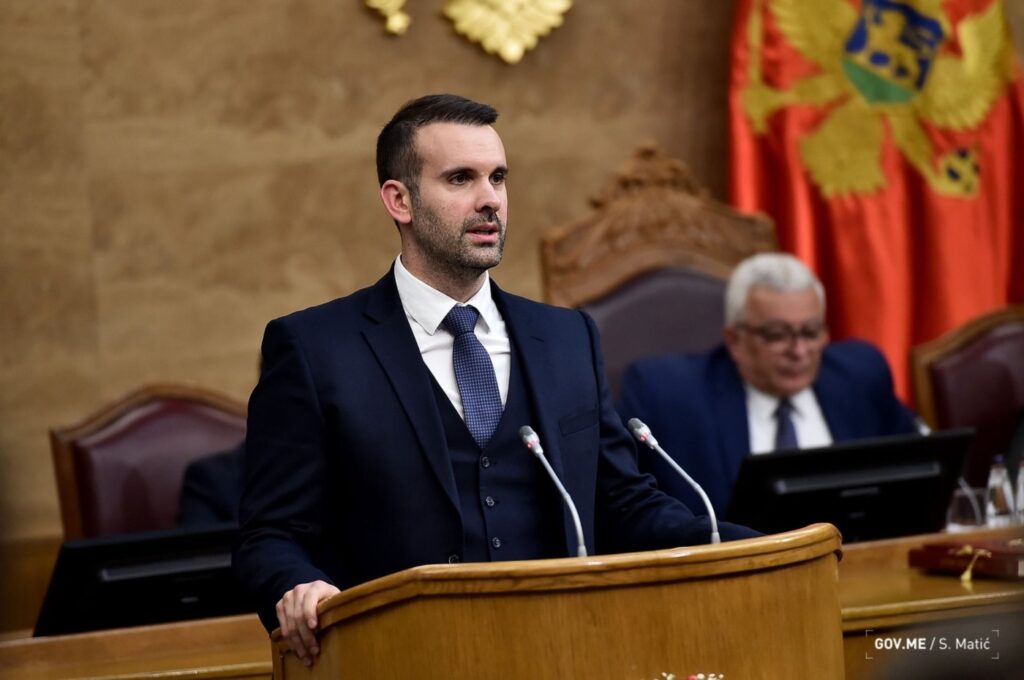
On Thursday afternoon, the Prime Minister of Montenegro announced on X that his government holds “serious operational security information” that the coming closure of negotiating chapters with Brussels will be accompanied by coordinated hybrid action involving “officials of at least two states from the region.” He named no states and no officials. He described no operation. Within hours, Vijesti reported that the two states Milojko Spajić had in mind were Serbia and Albania, attributing the identification to “multiple sources” it did not name.
Note the division of labor. The Prime Minister’s post carries the authority of office and the protection of vagueness. The newspaper carries the names and the deniability. And consider what the paper’s unnamed sources claim to know: not a fact about the region, but the content of the Prime Minister’s intention, which states he meant. Knowledge of that kind lives in exactly one place, inside and around the government that produced the sentence. The identification therefore faces a dilemma with no exit. Either the sources are governmental, and this is an authorized leak wearing plausible deniability, or they are not, and the Montenegrin public has been handed guesswork dressed in the credibility of sourcing. If the identification proves inconvenient, no Montenegrin official ever made it; if it proves useful, it is already in every headline in the region. What was assembled on Thursday is an accusation-shaped object, built so that no one has to own it.
None of this is a reproach to Vijesti, which did what newspapers do with senior sources: publish what they say. The paper’s independence was paid for over decades, in ways no one in this region has forgotten, and that independence is precisely the asset the leak borrows. An identification placed in a government bulletin would persuade no one. Placed in Montenegro’s most credible independent masthead, it arrives pre-believed. The byline tells its own story, since the identification ran under the name of Mihailo Jovović, the paper’s longtime editor-in-chief, and sources who can speak to a Prime Minister’s meaning do not call the newsroom switchboard. They call the top of the paper, and the top takes the byline. That is how information of state weight travels, and everyone in this trade knows it. It is worth recalling, though, that this government and this newsroom currently stand in the same trench of the media war with Belgrade. When Serbia banned TV Vijesti’s Petar Komnenić from entering the country in July, its answer to Podgorica declaring Informer’s editor unwelcome, the Prime Minister reacted within hours, personally and publicly, to reject any equivalence between the two journalists. The channel between his office and this newsroom is cordial, and it is fast. Whether something traveled down it on Thursday evening is a question only two parties can answer, and one of them has already declined to sign its name.
To understand why the object was assembled this week, one need only read the parliamentary record. On Monday, the Skupština adopted constitutional amendments on the judiciary and the central bank exactly as the government submitted them, brushing aside the public consultation entirely. During that same sitting, a deputy of the Prime Minister’s own governing majority, Milan Knežević of the pro-Belgrade DNP, called the package “Sattler’s amendments,” a foreign imposition on “the most anti-Serbian document” in Montenegro’s legal order, and challenged Spajić on the floor to prove he was never a reservist of the Serbian army, pledging to leave politics if he could. Opposition heckling sounds different. This was a coalition eating itself in open session.
Spajić governs at the sufferance of an improbable arithmetic: pro-Belgrade parties on one side, and on the other the Albanian, Bosniak and Croat minority parties without which, as Montenegrin analysts have noted all year, his majority would have neither the numbers nor the optics of inclusiveness. When that arithmetic strains, and this week it strained in public, a government has choices. It can negotiate with its partners, or it can relocate them. “Officials of at least two states from the region” performs the relocation in a single phrase. The pressure Spajić faces from deputies inside his own parliament is reissued as a threat from across two borders, and domestic coalition management becomes counter-hybrid defense. The Prime Minister stops being a politician struggling with his partners and becomes a statesman besieged by jealous neighbors on the eve of his European triumph.
As domestic theater, this is unremarkable. Governments in this region have played the victim of neighborly envy since before some of these neighbors existed, and the Montenegrin public, which has heard the register before, will price it accordingly. The inclusion of Albania has an obvious dramaturgical function. An accusation aimed only at Serbia would read as one more round in Spajić’s running feud with Belgrade, and would further inflame the pro-Belgrade half of his own coalition. Adding Albania balances the composition. It converts a partisan grievance into an impartial-looking security posture, threats on every side and the Prime Minister above them all. So long as no Montenegrin official repeats the names on the record, the whole construction remains what it is, a public relations exercise for domestic consumption. And that, frankly, would be fine. Every government in Europe has done cruder things on a bad Thursday.
But there is one problem with it, and it is not a small one. Montenegro and Albania are NATO allies.
Run the motive ledger honestly. Serbia, a state that functions in this region as Moscow’s proxy and arms itself outside every European framework, watches Montenegro’s accession the way a man watches his neighbor’s harvest fail to fail. It has every conceivable motive to destabilize Montenegro’s path and a documented record of trying. Now name the Albanian motive. I have tried to construct one in good faith and there is none to construct. Albania is running its own accession at pace, has opened every chapter, and aims to close them on a timeline that lives or dies by a single condition, that enlargement remains real. A Montenegrin accession completed is the best news Tirana could receive, proof of concept for Tirana’s own file. An Albanian official who set out to sabotage Montenegro’s chapter closures would be sabotaging Albania’s. The accusation lacks more than evidence. It lacks a reason to exist.
Which is precisely why its existence is instructive. You do not leak this insinuation against a fellow member of the Alliance unless something in your political system finds it natural. Even Athens and Ankara, with their airspace incidents and their genuinely open disputes, observe more discipline toward each other than this. And what finds it natural in Podgorica is the thing the stunt was designed to conceal. The problem is inside Montenegro, not outside it. Belgrade’s influence sits in the parliament and in the coalition, and it presides over the chamber from the Speaker’s chair. It is close to an on/off switch, and this week the parliament showed how little it takes to move it. A Prime Minister who cannot say this, who must instead let an Albanian threat be invented to avoid naming a Serbian presence, has told us more about his state’s condition than any hybrid operation could.
This is the uncomfortable conclusion Thursday’s stunt forces, and I will state it plainly. NATO membership did not solve this problem for Montenegro; it imported it into the Alliance. EU membership will not solve it either; it will import it into the Union. A member state in which Belgrade holds this much coalition leverage is no success of enlargement but a Trojan horse that enlargement wheeled in itself. Albania voted, as every ally did, to ratify Montenegro’s accession in 2017, in good faith and in the genuine belief that membership anchors states. On the evidence of a Prime Minister who lets an insinuation against Tirana circulate in his name and declines to disown it, I will say what no Albanian official can. That vote was a mistake, and every day the disavowal does not come it becomes harder to argue otherwise.
What should happen now is simple, and Podgorica should not be allowed to avoid it. Either the Government of Montenegro owns the accusation, names the Albanian officials and presents the operational information to Tirana through the channels that exist precisely for this, in Brussels, through allied intelligence services, or government to government. Or it publicly disowns the identification published in its name and leaves Vijesti to defend its sourcing alone. Allies with security concerns about allies raise them in closed session, with evidence. They do not float them through anonymous sources at half past six in the evening to cover a bad week in parliament. Tirana should ask the question once, in writing, and then treat the silence that follows as the answer it will almost certainly be.
Spajić wanted a story about Montenegro’s jealous neighbors. He has instead written one about Montenegro. It deserves to be read carefully in Tirana, and especially in Brussels, where the file on Montenegro’s readiness is still open, and where someone should note that the candidate closing chapters fastest is also the one whose Prime Minister cannot tell his own parliament from a foreign operation.
Albatros Rexhaj is an author, playwright, and analyst with a background in national security studies and nearly three decades of experience in political and security affairs. You can write to the author at albatrosrexhaj@gmail.com.