By Drizan Shala, Security Desk
Violence inside a protest movement is never a single data point. It is a signal that must be read against the movement’s trajectory, and on Day 33 of the Tirana protests the trajectory tells a specific story. The turn to street violence reveals two things at once, and neither of them is what the movement’s organizers would want an observer to conclude.
First element: the anarchy phase is attempting to take form
There is a pattern familiar to anyone who has studied engineered protest cycles in this region and its neighborhood. A movement that cannot grow begins to burn. Skopje lived it in April 2017, when the storming of the Macedonian parliament came after the political battle had already been lost at the ballot box and in the coalition arithmetic. Tbilisi followed the same arc in June 2019; the attempt to breach the Georgian parliament arrived just as the street phase peaked without producing rupture. And Belgrade, July 2020: the storming of the National Assembly, thick with provocateurs whose affiliations were never resolved, was the night a genuine protest wave lost its coherence and, within days, its crowds. The three contexts differed in almost everything, coalition politics in Skopje, geopolitics in Tbilisi, a pandemic curfew in Belgrade, and that is precisely what makes the shared progression significant. Mass mobilization has a ceiling. When the ceiling is reached without the promised political rupture, the repertoire shifts, numbers get replaced by intensity, and the crowd stops being the argument and becomes the cover.
These are the markings of the anarchy phase, and their logic is not spontaneous. Violence at this stage is not the overflow of popular anger. It is a substitution for popular anger that failed to materialize at the required scale. The blockade announcements, the incendiary device instructions circulating in protest channels, the professionally produced materials appearing in the crowds: these are not the improvisations of a movement gaining strength. They are the instruments of a movement compensating for weakness. A protest that believed it was winning through numbers would protect its legitimacy jealously. A protest reaching for fire has already concluded that legitimacy alone will not deliver the objective.
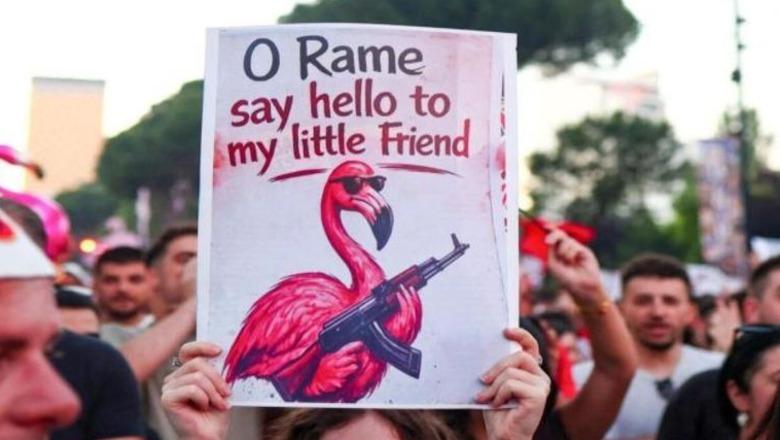
The movement’s own iconography confirms the shift, and one poster from this week’s crowds condenses it into a single frame. The flamingo, the mascot that once signaled carnival and generational irony, now appears in sunglasses cradling a Kalashnikov above the words “O Rame say hello to my little Friend.” The reference is Tony Montana’s line as he opens fire, addressed by name to the head of government. Defenders will call it a joke, and at the level of the young woman holding it, surrounded by a relaxed evening crowd, it almost certainly is. That is not the point. The point is what the movement’s visual language now tolerates. A symbol chosen to advertise harmlessness has been redrawn in the grammar of armed threat, and the crowd’s laughter is doing the work of normalization. When a movement’s emblem picks up a rifle, the emblem is telling you which way the script is drifting, whatever the person holding it believes she is holding.
There is a second detail in that poster worth a security analyst’s attention. It is professionally printed, not hand drawn. Someone designed it, printed it at scale, and put it into circulation. Weaponized iconography appearing at scale is a production question before it is a speech question, and in a protest cycle whose information operations this publication has documented, the provenance of printed materials is not trivial. Who is manufacturing the movement’s turn toward martial imagery is a question the poster asks on its own.
Try, thirty three days in, to state the protest’s objective as a policy demand. It cannot be done. The demands have dissolved into a general insistence on rupture, and that formlessness is itself diagnostic. As a rule, movements with genuine constituencies negotiate. Movements built as pressure instruments escalate, because escalation is the only product they were designed to deliver.
Second element: the neutralization is already visible
The second signal is the more important one, and it is counterintuitive. The violence proves that the protest’s political effect has been neutralized, not that it is peaking.
The reason is the Albanian public itself. Citizens in Tirana have watched this script before, and they have learned to read it. The awareness that foreign services have an operational interest in Albanian instability is no longer a specialist’s assessment. It has entered public common sense, and that shift is fatal to a hybrid operation, because such operations depend on the crowd not knowing what it is standing inside.
The record that produced this awareness is documented, not speculative. Iranian state cyber operations against Albanian government infrastructure led Tirana to sever diplomatic relations with Tehran, a first among NATO states, and Iranian interest in Albanian street instability has been traced through the amplification architecture around this very protest cycle. Russian aligned information networks, and the Serbian portal ecosystem that services them, have treated Albanian unrest as content and opportunity in equal measure. The assessment that other services watch the same space and feed the same channels is reasonable, and should be stated as assessment.
What is observation rather than assessment is this: on certain portals and media platforms, Albanian speaking voices now argue against the Albanian state itself, openly, recklessly, in language that no domestic political grievance requires. That speech does not prove foreign direction, and honesty demands saying so. Radicals and nihilists need no handler to talk this way. But it is consistent with a serviced narrative, it matches the amplification patterns this publication has already traced, and it earns the attribution question without yet answering it.
The public is not waiting for a verdict. It hears that register, draws its own conclusions, and for the operation the conclusion is what matters, not the proof. That is the neutralization. Look again at the photograph: a festive crowd carrying martial messaging it did not write. The wider public has learned to see that same gap, and citizens who begin to suspect the crowd around them is partly a stage set go home. Numbers plateau. The median participant ages toward the professional fringe. What remains for the organizers is the choice that produces the anarchy phase, dissolve or escalate, and Tirana is watching the second choice being made.
The necessary discipline
Two cautions belong in any honest version of this analysis. First, the existence of instrumentalization does not erase the existence of grievance. Albanians have real complaints, and the government’s obligation to answer them on the merits is not suspended because hostile services are farming the discontent. A state that treats every protester as an agent completes the adversary’s work for him. The same warning runs in the other direction on the street: heavy handed policing at this stage is precisely the escalation the anarchy phase is designed to provoke, and a government that supplies the movement with a martyr will have written the next act of the script itself. Second, attribution must stay tied to evidence. The Iranian record is documented, so is the Russian aligned and Serbian information architecture, and beyond that the honest formulation is capability and interest, not proven direction.
But the two elements stand. The violence marks the attempt to force an anarchy phase into being, and the attempt itself is the confession. It tells us the protest as a mass political instrument has already failed, that its audience has decoded it, and that what remains on the streets after Day 33 is not a movement but a mechanism running past the point of its own exposure.
From here the test is simple. If the crowds shrink while the violence grows, the diagnosis is confirmed, because that divergence, numbers falling as intensity rises, is the signature of the anarchy phase in every theater where it has been run. The early readings from Tirana point that way. Two weeks will confirm the curve or refute it, and this desk will report the answer either way.
Drizan Shala writes on security, institutions, and political violence for Kosovo Dispatch and Tirana Examiner. He is a doctoral candidate at the University of Sarajevo.